


GLOBAL VIEW
LONDONEnvisioning A Different Direction For Britain
Priti Patel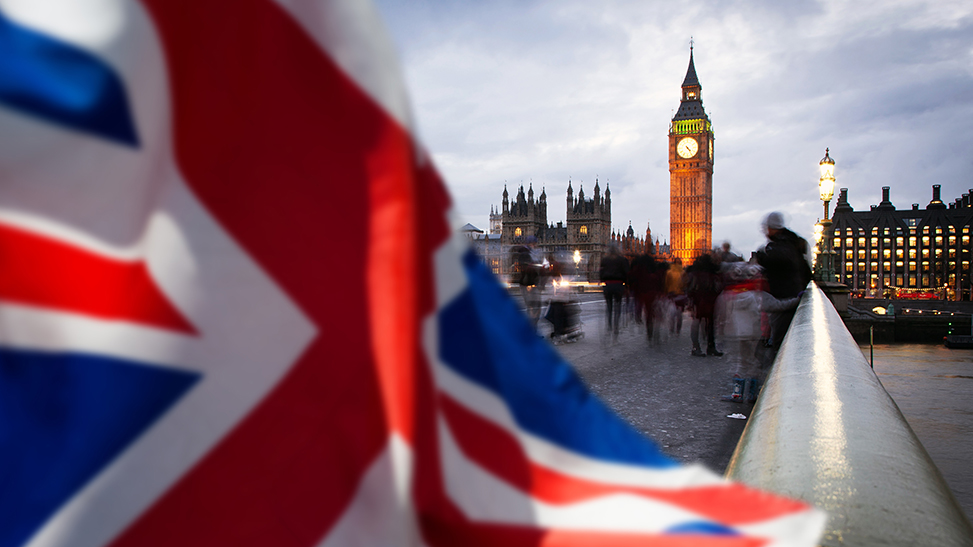

The Union Jack frames the illuminated Elizabeth Tower and Houses of Parliament.
The world as we have known it for most of our lives is over. The post-Cold War Era is well and truly dead. We are once again confronted by an axis of authoritarian states on an aggressive quest for global governance. This time, they are trying to tear down the international order on which the British and American economies, as well as their security, have rested for decades.
This contest has left today’s world more volatile, more insecure and more threatening than at any time in recent memory. But it is also an opportunity. Many times before in Britain’s history, it has fallen to Conservative governments to face off world-changing threats, and this one may turn out to be no different. So we are using our time in the political opposition to develop a hard-headed and serious plan to advance Britain’s interests against an ever more challenging backdrop; to seize new opportunities that make our country stronger, and to make the British people more prosperous and secure.
The threats are clear. Here in our European neighborhood, Russia’s invasion of Ukraine and its persistent hybrid activity have demonstrated clearly that the Kremlin is committed to dividing and destabilizing the West. The Middle East is rife with instability and conflict. Wars are raging across Africa, while an aggressive China is seeking to rewrite the Indo-Pacific order.
In a much tougher world, we have no choice but to be tougher too. Yet Britain’s current Labour government appears not to grasp the change that is happening all around us. It simply cannot break out of its comfort zone of vacuous internationalism, lecturing about international law and preaching to other countries.
That simply won’t do. Today, Britain needs a serious foreign policy—one that is unashamedly based on advancing our national interest.
A future Conservative government will have a harder edge. With our allies, our decision-making will be grounded in how to out-compete, out-cooperate and out-innovate our adversaries. Conservatives firmly believe in Britain’s place in the world. We must build more strategic alliances wherever there is a need as well as reinvigorate old ones that have served us well in preceding decades. And we need to ensure that Britain is a far more ambitious foreign policy power. Because if recent years have shown us anything, it is that unless you try to shape the world around you, it will shape you.
Our politics has an unfortunate tendency to overlook Britain’s agency in the world. All too often, it fails to notice the costs of inaction, with deeply unfavorable consequences. This is a grave error. We need the courage to defend the international order in ways that sustain our economy and security.
A serious British foreign policy – a conservative foreign policy – certainly doesn’t mean isolationism, and most definitely doesn’t justify exploiting others. It means working with other countries as much as we can, while always standing up for our national interest and being honest about doing so, both with our international partners and with the British people.
Indeed, we have already been making the case at home that Britain must spend significantly more on defense. The last Conservative government set us on a path to higher defense spending. We are now calling for defense spending of three percent by the end of the current Parliament. This should be funded not by borrowing more or raising taxes, but through judicious reforms of things like our aid budget, welfare, and the civil service headcount.
In this vein, we have also pledged to create a Sovereign Defense Fund to help leverage private investment. This is partly because we need to be ready for continuous tension with Russia, with the ability to effectively deter threats like hybrid warfare, the sabotage of infrastructure and the manipulation of information. Simply put, if we don’t put up these boundaries, Russia will come closer.
Britain also needs to be more far more assertive in response to the real and growing threats to our security posed by China. Rather than Labour’s naïve and failing bid for greater economic integration and dependence in the vain hope that it will make China play by the rules, we need to find solutions that allow Britain to reduce its strategic dependency on the PRC.
Our alliances in the Indo-Pacific must go far deeper, too. This is not just about arrangements such as AUKUS or CPTPP, but about our whole network of bilateral security and defense, technology and economic partnerships. Post-Brexit, Britain has been much more active in the region. We need to take it to the next level.
As for the Middle East, Britain does have influence – not on a par with the United States, but still considerable for a power outside the region. A Conservative government would put its shoulder to the wheel to support a constructive direction for the region, including an expansion of the Abraham Accords and a more active role in securing the disarmament of Hamas and the rebuilding of Gaza.
We also need to develop strategic patience to see through long-term plans in other parts of the world, like Central Asia, Latin America and Africa. In those places, we must work to make our offer of partnership much more compelling than it is currently. We want countries there to see Britain and the West as natural partners for mutual benefit, and to steer clear of partnerships with authoritarian powers that only want one way extraction, closed trade and debt traps.
Britain already has all the capabilities it needs to be a significant global player. The question is whether we have the political will and the diplomatic firepower to deliver. Conservatives are unequivocal: we do, and we must.