

GLOBAL VIEW
TEL AVIVMaking The (Moral) Case For Israel
Eran Ortal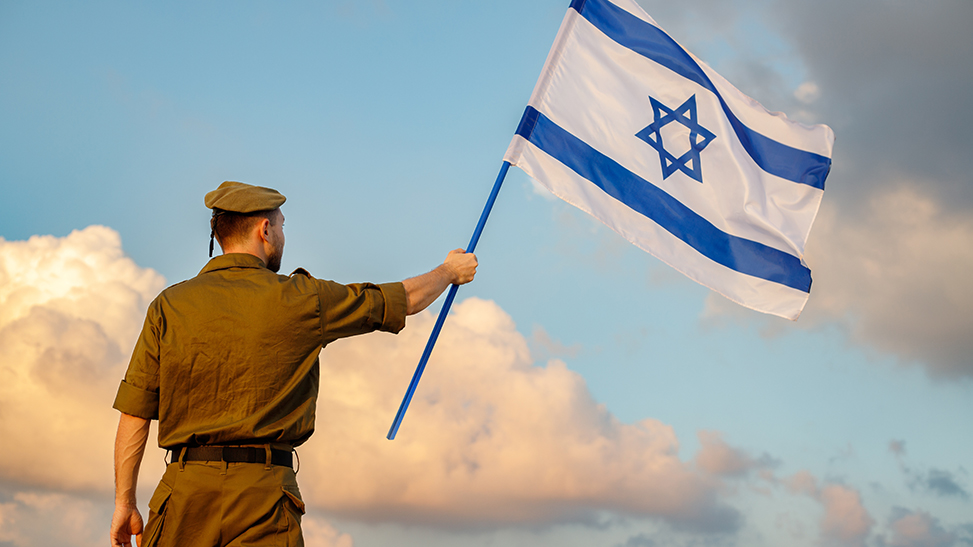

An Israeli soldier stands against an open sky, holding the national flag.
As the blood-soaked year of 2025 gave way to 2026, neither the regional nor the global picture can be said to appear especially promising, as seen from Israel.
In the Middle East, the war that erupted following Hamas’s murderous rampage of October 7, 2023 may ultimately prove not to have ended at all, but merely to have entered a tactical pause. All the fronts of that war – Gaza, Lebanon, Iran, and Yemen – remain open as of this writing, and their re-activation seems not a matter of “if” but of “when.” As if that were not enough, the dynamics of confrontation continue to intensify as Turkey – previously a distant rival – now seeks to capitalize on new regional realities and establish a presence in both Syria and Gaza, thereby positioning itself as a leader of a hostile Islamist-Sunni axis opposed to Israel.
Moreover, Israel has come to realize that the war it waged for its survival for two years not only failed to generate waves of sympathy and solidarity in the West, but has in fact produced the opposite. Even before the last Israeli communities near the Gaza border were cleared of terrorists on October 8, 2023, demonstrations had erupted in Western capitals in which the victims were condemned as perpetrators of an imaginary genocide against their Palestinian murderers. Chants of “From the river to the sea” made clear that it was not Israeli government policy that was under attack, but rather the very right of the Jewish state to exist.
More than two years on, Israel continues to hold on to hope that all this has merely been a bad dream. But it is increasingly being forced to confront a bitter reality. Decades of quiet groundwork and mountains of Qatari money have transformed bastions of Western academia, as well as swathes of the media, into centers of anti-Western propaganda – undermining not only Israel’s existence but the legitimacy of Western civilization itself.
Decades of intensive immigration to Europe, meanwhile, have enabled anti-Western ideology to become a political force in its own right, shaping the policies of left-leaning governments across the continent. Those governments did not hesitate, at the height of the war, to join in the vicious anti-Israel propaganda and effectively deny the only Jewish state the right to defend itself.
As if all this were not enough, it is now becoming clear that antisemitism in the 21st century is no longer the exclusive domain of the pro-Islamist radical left. For those in Israel who took comfort in the support of right-wing movements, that complacency has been shattered by the recent, virulent spread of antisemitism on the American political right as well.
These trends, which are likely to intensify in the months ahead, are not merely alarming in terms of the age-old Jewish anxiety about recurring waves of antisemitism, or due to justified fears of collapsing global sympathy for Israel. They constitute a genuine cause for concern at the level of Israel’s national security.
National security practitioners understand well that different types of states employ different types of security strategies. Great powers compete over spheres of influence, the setting of global norms, and the shaping of economic and international rules that best serve their interests. Small states, by contrast, compete not for influence but for survival. Faced with potential threats far larger and stronger than themselves, they have several possible strategies.
Collective security is one, and the growing interest in NATO exhibited in recent years by potential targets of Russian aggression is a prominent example. Neutrality is another, but it needs to be backed by a credible military deterrent and some form of incentive. This is how Switzerland and Sweden survived World War II – thanks to defensible topography, a reasonable military capability, and incentives in the form of Swiss banking and Swedish iron ore, both of which were vital to Nazi Germany.
Another strategy is exceptionally flexible political maneuvering. The Hashemite Kingdom of Jordan, for instance, knew how to rely on Britain on the one hand while joining Nasser’s Egyptian camp in 1967 on the other; how to receive Israeli support against a Syrian threat in 1970 and join the Yom-Kippur war against it three years later, in 1973; and how to back Saddam Hussein in 1991 and yet still remain in the pro-Western camp immediately after the Gulf war.
Israel, despite its military prowess, is ultimately a small state both geographically and demographically – as well as one surrounded by numerous hostile forces. From the outset, it has known that its survival depends on the combination of two basic principles. The first is its ability to defend itself, by itself. The second is clear, consistent, and practical support from a global great-power patron. Israel’s situation simply does not permit a strategy of neutrality. And despite the impressive regional coordination against ballistic missiles, drones and cruise missiles during the June 2025 war against Iran, Israel also lacks access to a meaningful collective-security framework. Nor does Israel have any great-power camp supporting it other than the West, led by the United States. It simply has no place in a pro-Chinese or pro-Russian bloc. Even its potential role in regional defense, particularly oriented around missile defense, stems first and foremost from the perceived closeness between Israel and the United States.
The rapid and profound erosion of Israel’s standing in the West is therefore a matter of genuine existential concern. Israel is not a financial powerhouse like Qatar. The Jewish diaspora in the West has become numerically insignificant relative to the tens of millions of Muslims flooding Western capitals and campuses, and its ability to combat propaganda in international institutions – where an automatic political majority is aligned against it – is extremely limited. For this reason, Israel has always been preoccupied not only with being liked, but with being a tangible asset to its supporters. Even today, there is lively debate in Israel over the question of whether it is an asset to the United States in particular, and to the Western world more broadly.
For decades, Israel was commonly described as the West’s aircraft carrier in a critical region – a forward operating base and a laboratory for testing weapons and tactics. In more recent years, Israel has also distinguished itself as a hi-tech powerhouse, one that not only exports technology and innovation but shares critical and unique military technologies with its allies. Western publics are less aware of a fact that is obvious to their leaders: Israel is also a critical asset in the intelligence domain, particularly in the context of counterterrorism.
This utility has always been a component of Israeli policy, in various ways. In the 1960s, Israel was active in providing agricultural assistance to many African nations. Today, even Israel’s natural gas reserves have become a valuable policy tool, helping the United States stabilize the Eastern Mediterranean and improve its relations with Egypt.
Israel’s true value runs deeper, however. Because Israel has always been a moral asset. At its founding, Israel symbolized the ability of a people to rise from the ashes of the Holocaust and create a new, optimistic, and thriving nation. It is no coincidence that tens of thousands of young Europeans from the post-war continent flocked to Israel to volunteer on kibbutzim and be part of something greater than themselves.
This was made clear to me years ago, during a late-night conversation in a small Athenian taverna with a wise Greek professor. Despite a long tradition of pro-Palestinian sentiment, he explained to me, Greece has in recent years become a close friend of Israel. This was not just because of shared geopolitical interests in the Mediterranean, however. Nor was it solely because of Turkish aggression threatening both countries.
Look around you, he said. It is rare to see parents and children on the streets of Athens. Greece, like much of Europe, is a fading nation. In that context, Israel is not merely a regional ally. It is an example – a model – of a nation that manages to be Western, open, and liberal, while also being patriotic, growing, optimistic, and life-affirming. Hardened by war, yet life-loving. Secular and liberal, yet a young nation full of families, children, and demographic growth. A traditional society that respects religion, alongside vibrant technological innovation and rich social and cultural life. A state whose governance and social services are under strain, yet whose civil society has revealed immense strength.
All these features were apparent during Israel’s most recent war. And they matter a great deal for the future.
Western civilization is currently experiencing a murky and dangerous wave, saturated with self-hatred masquerading as post-colonial critical discourse. Its toxic, polarizing politics erode social cohesion and undermine the foundations of collective existence. This phenomenon, in turn, is being fueled by external forces seeking to destroy Western civilization and undermine the values of freedom, democracy, and humanism that it embodies.
To be sure, Israel is far from perfect in this regard. It, too, is suffering from malaise born of an extreme ruling political coalition and social polarization on an epic scale. Nevertheless, it has a key role to play in the West’s current identity crisis. For all its troubles and challenges, this is a nation to which its sons and daughters flock, rather than flee from, when battles break out. As intellectuals, social activists, military leaders and eventually even politicians awaken and seek a model through which the West can rediscover itself, Israel’s true value will once again become apparent.