

GLOBAL VIEW
TAIPEITaiwan’s Version Of Peace Through Strength
Fei-Fan Lin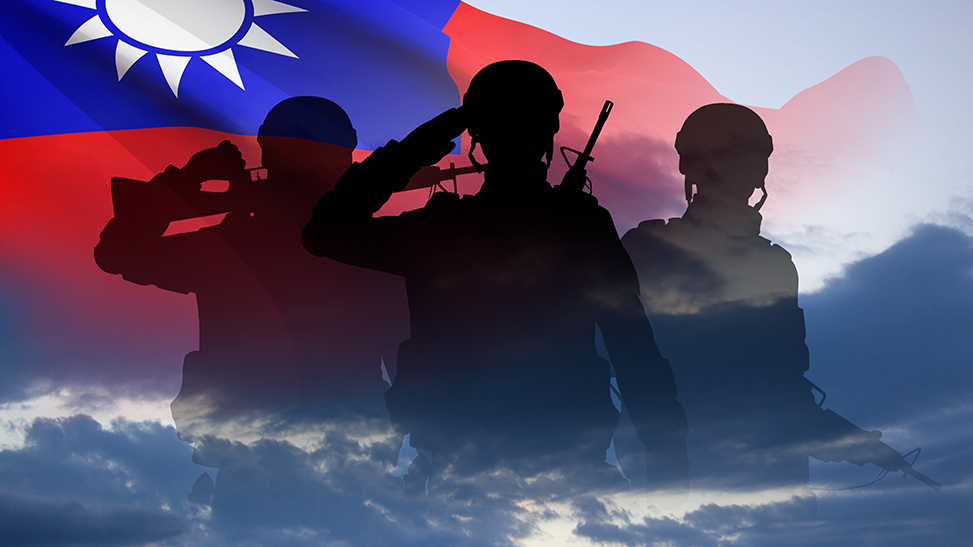

Silhouetted soldiers before Taiwan’s flag symbolize deterrence against China.
Peace in the Taiwan Strait is not preserved by slogans. Nor is it kept by weapons alone. Rather, what is essential is to eliminate any expectation in Beijing that military coercion can achieve its goal at an acceptable cost. This is the logic of peace through strength for Taiwan: sustaining military denial, government continuity, and societal resilience so that China’s coercion becomes too costly for it to endure.
Deterrence therefore extends beyond the military power. It rests on whether Taiwan can remain functioning under sustained pressure over time. Accordingly, Taiwan is integrating whole-of-society resilience into its overall defense concept as a core element of deterrence, enabling the nation to endure and adapt under coercion. In practice, this framework has two mutually reinforcing pillars.
Military Denial
Taiwan remains steadfast in its commitment to self-defense, fast-tracking the development of an asymmetric military posture to counter China’s rapid expansion of its kinetic assault capabilities. This strategy is engineered to deny a “quick seizure” of Taiwan, and prioritizes surviving initial strikes, disrupting landing operations, and sustaining combat power well beyond the opening phase of any potential conflict.
President Lai Ching-te has translated this strategic vision into decisive action with a record-breaking 2026 defense budget of $31.1 billion. This fiscal expansion is further anchored by a landmark $40 billion special budget dedicated to the development of the “T-Dome” – a multi-layered, AI-integrated air defense shield – and other asymmetric capabilities over the next couple of years. By pledging to increase defense spending to 5% of GDP by 2030, the Lai administration is signaling generational resolve to safeguard sovereignty through credible deterrence and resilient command-and-control.
Ultimately, Taiwan’s defense concept prioritizes dispersion and mobility in order to minimize early losses. By deploying small, mobile, and widely distributed assets that are difficult for an attacker to target, Taiwan aims to amplify its defensive capabilities with the resources it has at hand. This approach, backed by a strengthened fuel, munitions, and repair capacity, ensures that Taiwan will be able to maintain operations even under the most intense pressure.
Societal Resilience
But coercion rarely begins with amphibious landings. It begins with pressure designed to fracture society, disrupt governance, and erode the will to resist. Modern conflict focuses on society as much as on conventional battlefields. Energy, communications, logistics, healthcare, and public trust are all targets an adversary will seek to disrupt. As a result, Taiwan has been strengthening societal resilience so that schools, hospitals, transportation, and basic governance remain functional enough to prevent panic and paralysis.
This effort starts with continuity planning for critical infrastructure. Taiwan has been hardening and adding redundancy across essential systems, from the power sector to telecom to transportation. Taiwan has also treated medical and emergency services as stabilizers of daily life by improving surgery capacity, essential stockpiles, triage procedures, and coordination among hospitals and local authorities so disruption does not cascade into a broader public health breakdown.
Resilience likewise depends on whether supply chains can keep daily life steady by keeping materials supplied. Taiwan has been strengthening distribution through clear access points for essentials, reserve stocks, and coordination between central and local governments so execution remains coherent under pressure. Just as importantly, Taiwan has been expanding civic preparedness – including basic first aid and emergency response skills, community communication networks, and realistic exercises that make procedures familiar before a crisis.
This year, Taiwan is placing particular emphasis on civil-military integration to turn these separate efforts into a more integrated system. It is working on aligning national agencies, local governments, and critical infrastructure operators on shared procedures and clear responsibilities, so the country can absorb shocks, restore services, and sustain defense tasks. When coordination is rehearsed in advance, responses become faster and more synchronized even in the most emergent situation.
Collective Deterrence Needed
But external responses are also critical. For Beijing, a successful invasion will look plausible only if it expects the international reaction to be slow and disjointed. That is why Taiwan and its partners need to make a quick grab implausible.
This, in turn, means routine coordination that builds shared assumptions, regular cooperation, and practical interoperability so that decisions can translate into action quickly. Taiwan and its international partners can also prepare clearly defined, trigger-based economic and political measures that can be activated rapidly, rather than negotiating them from scratch in the middle of a crisis. Finally, partners should maintain crisis communication channels to coordinate in real time during fast-moving situations, when information is incomplete and misjudgments are most likely.
At the end of the day, partnership is a critical pillar of deterrence, and Taiwan has repeatedly demonstrated that it is a responsible, capable partner rather than a passive beneficiary of protection. Taiwan can contribute to the shared security of the global community, and it is ready to shoulder responsibilities alongside other democracies in defending the peaceful status quo against autocratic forces.
It brings frontline experience in countering cyber intrusions and information operations. It has deep competence in disaster response and civil coordination, along with hard-earned institutional knowledge of maintaining governance and social cohesion under persistent coercion. In addition, Taiwan helps sustain trusted technology ecosystems through world class engineering and reliable production. Recognizing these features strengthens the case for deeper coordination built in advance, rather than improvised in a crisis.
A New National Operating Model
Peace through strength reduces the risk of miscalculation by removing Beijing’s expectation that military coercion can deliver quick political results. For Taiwan, this is now a national model, the objective of which is a military is designed to deny aggression asymmetrically, a society able to sustain daily life under disruption, and a well-coordinated group of international partners willing and able to react quickly.
When these elements are credibly demonstrated through training, readiness, and visible execution, military operations to alter the status quo in Taiwan Strait becomes impractical. That, in turn, remains one of the most practical ways to preserve peace in the Taiwan Strait.