

GLOBAL VIEW
KYIVTrump’s War, and What Putin Really Wants
Oleksandra Matviichuk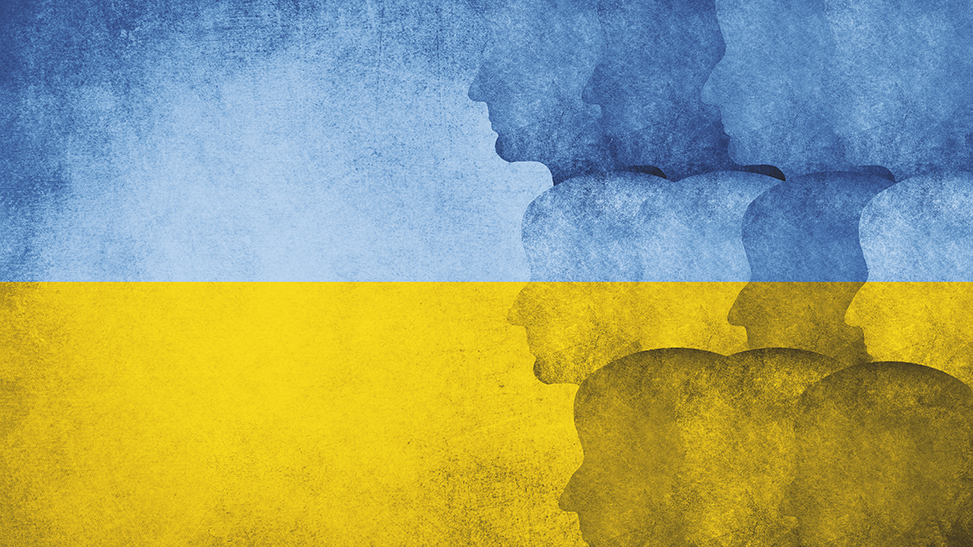

Silhouettes over the Ukrainian flag symbolize the human toll of Russia’s war in Ukraine.
President Trump has frequently argued that Russia’s ongoing aggression against Ukraine is not his war. He has claimed that, had he been in the Oval Office in February of 2022 instead of President Biden, the war would never have started. But after a full year of futile American peace overtures toward Russia, the reality is undeniable: this is now well and truly Trump’s war.
It is Trump’s war not simply because he had promised to end it in twenty-four hours. It is so because Russian President Vladimir Putin has responded to every one of the White House’s peacemaking efforts with intensified attacks on and the systematic destruction of Ukraine. If Trump fails in this peacemaking mission – or if he facilitates a “peace agreement” that paves the way for further Russian aggression – he will be etched into history as a weak President. Worse, he will be seen as a weaker leader than Putin, a dictator presiding over a country that has long fallen out of the rankings of successful economies. President Trump certainly cannot allow that to happen.
Over the past year, two irreconcilable realities have taken shape. In Washington, Geneva, Istanbul, and Miami, a series of international meetings has created the appearance of progress on the path to peace. But the reality on the ground tells another story. According to UN estimates, Trump’s year of negotiations has become the deadliest period for civilians in Ukraine since 2022.[1] The number of those killed and wounded has surged 31 percent higher than in 2024 and 70 percent higher than in 2023. Russia has increased the number of its attacks, launching drones and missiles at peaceful cities far from the front lines. During Trump’s year of negotiations, missiles and drones constantly terrorized the civilian population and deliberately destroyed civilian infrastructure across the country.
In January, temperatures in Ukraine plunge to minus 20 degrees Celsius (-4 Fahrenheit). Ukrainian cities are literally freezing, and Ukrainians are struggling to survive without heat, water, electricity, and connection. UN experts have classified Russia’s actions as crimes against humanity.[2]
Why have America’s overtures not worked? The answer lies in Putin’s goals. Putin did not launch a full-scale invasion simply to occupy more Ukrainian territory. It would be naive to think that hundreds of thousands of Russian soldiers died so that the Kremlin could capture Avdiivka or Bakhmut – cities that most Russians cannot even find on a map. No, Putin launched a full-scale invasion in order to capture all of Ukraine, and then to move further still. To him, Ukraine is a bridge to Europe.
The logic is clear. War is beneficial to Moscow because it provides a simple answer to all of the country’s current problems and cements Putin’s personal power. Putin dreams about his legacy and seeks to restore the Russian empire.[3]Europe’s population is relatively safe only because the Ukrainian army is holding back the Russian advance. Like any dictator, Putin only understands the language of force. He is pretending to engage in peace talks in order to reduce international support for Ukraine, thus making it easier for him to achieve his goals.
When Putin occupied Crimea and part of eastern Ukraine in 2014, Ukraine had no way of reclaiming those territories. Consequently, Ukraine grudgingly signed two peace agreements with Russia (known as the Minsk Accords). Over the following eight years, Russia transformed Crimea into a powerful military base, girded its economy for sanctions, produced artillery shells, increased the size of its army and reached a range of military agreements with China.
In January 2022, senior Russian officials dismissed talk of a full-scale invasion as nonsense. Yet the following month, that is precisely what their government launched. Consequently, one of the key issues in peace negotiations is the provision of security guarantees. Ukrainians have learned from history; they gave up the world’s third-largest nuclear arsenal in exchange for security guarantees in the early 1990s, only to find themselves facing renewed aggression from Moscow without adequate support from the West. Ukrainians do not need a third Minsk Agreement, or a second Budapest Memorandum. The words “Vladimir, stop!” alone will not protect them.
Rather, to truly halt Russian aggression, the cost of the war for Putin must exceed the cost of peace. There is no magic button: coordinated action by the U.S. and the EU is needed to reduce the ability of the Russian economy to finance this war. Officially, some 40 percent of the Russian budget now goes to military spending.[4] But it’s not just about curtailing the Russian government’s ability to produce and purchase missiles and drones. It’s also about changing the minds of ordinary Russians.
Here, an example from history is useful. After Soviet troops entered Afghanistan, families in the USSR began to receive coffins, which led to growing public discontent and, ultimately, to Moscow’s withdrawal from the country. Now, Russian families are again receiving coffins, but they are also receiving money – even as many of their countrymen live in extreme poverty. As long as that money continues to flow, Putin will continue to have willing conscripts for his war of aggression. But if coffins are sent back to Russia without money, the population’s attitude towards the war will change immediately. And that would make the price of continuing the war prohibitive for Putin’s imperial ambitions.
Putin is trying to portray Ukrainian resistance to Russian occupation as actions that undermine peace. Consequently, we must constantly reiterate the obvious: the Ukrainian people want peace more than anyone else. This war is being waged on their territory and has knocked on almost every door. But occupation is not peace. Occupation is war in a different form. It’s not just a change from one national flag to another. It means disappearances, rape, torture, the forced adoption of your children, the denial of your identity, filtration camps, and mass graves.
I should explain why a Russian victory would not be in the national interest of the United States. But I won’t. We have become too preoccupied with a transactional approach. Over the past year, we have witnessed a return to a past in which the world is defined not by international law, but by the exercise of the will of the strongest. Let’s be brutally honest: that past was not a great one. In such a world, even the strongest are not safe. A world with nothing to rely on is fragile. It is always a world of wars and mass violence. We should aspire to better.
-
[1] United Nations, Office of the High Commissioner for Human Rights, “2025 Deadliest Year for Civilians Since 2022, UN Human Rights Monitors Find,” January 12, 2026, https://ukraine.ohchr.org/en/2025-deadliest-year-for-civilians-in-Ukraine-since-2022-UN-human-rights-monitors-find.
[2] United Nations Ukraine, “Russian authorities committed crimes against humanity targeting civilian populations through drone attacks, as well as war crimes of forcible transfer and deportation of civilians,” October 27, 2025, https://ukraine.un.org/en/304119-russian-authorities-committed-crimes-against-humanity-targeting-civilian-population-through.
[3] This is made clear in Putin’s various pronouncements, such as his 2021 essay “On the Historical Unity of Russians and Ukrainians.” Scholars like Timothy Snyder have argued that Putin’s ideology is explicitly imperial. See Timothy Snyder, The Road to Unfreedom: Russia, Europe, America (Crown, 2018).
[4] See, for instance, “Путин подписал закон о трехлетнем бюджете РФ. В 2025 году в нем заложены рекордные расходы навойну [Putin has signed a law on Russia’s three year budget. In 2025, it provides for record levels of spending on the war],” Meduza, December 1, 2024, https://meduza.io/news/2024/12/01/putin-podpisal-zakon-o-trehletnem-byudzhete-rf-v-2025-godu-v-nem-zalozheny-rekordnye-rashody-na-voynu.