

THE HOT SEAT
Crisis and Opportunity
Newt Gingrich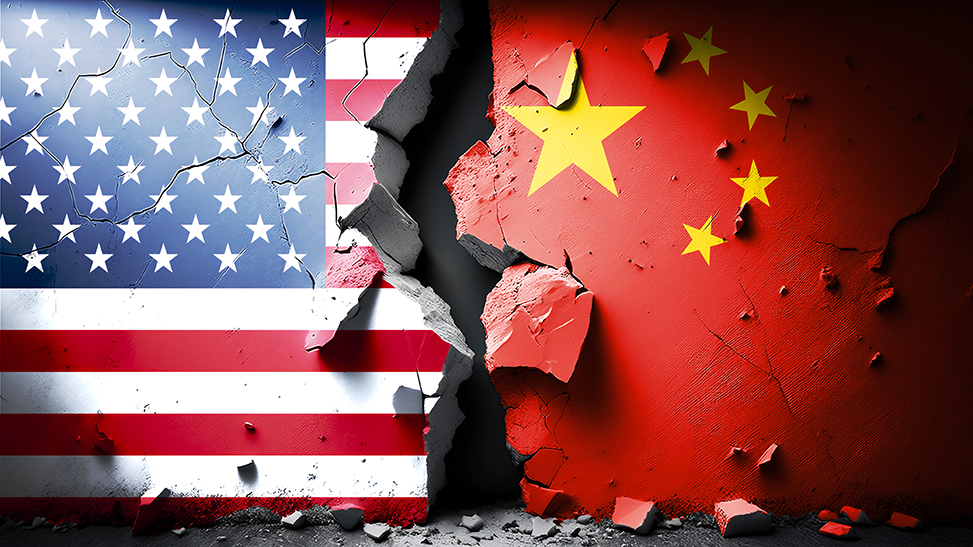

Strained political relations between United States of America and China.
Interview with The Honorable Newt Gingrich
The Honorable Newt Gingrich is the former Speaker of the U.S. House of Representatives and one of America’s most prominent public intellectuals. First elected to Congress from Georgia in 1978, Gingrich served for two decades in the House, rising to national prominence as the chief architect of the 1994 “Contract with America,” which led Republicans to their first House majority in forty years. He was elected the 50th House Speaker in 1995. Both during his tenure in Congress and in the years since, Gingrich has been a leading voice in shaping conservative thinking on national security, foreign policy, and global competition.
In January, he sat down with Statecraft & Strategy Editor-in-Chief Ilan Berman to talk about the Trump administration’s foreign policy priorities, America’s unfolding great power competition with China, the course of the Ukraine war, and political turmoil in the Middle East.
Q: In recent years, the need for serious strategic competition with China has become increasingly well understood in Washington, to the point that it now ranks as one of the very few issues where Republicans and Democrats see eye to eye. You have been an advocate of such an approach for years. So far, though, we have not seen a transformation of industries or a national mobilization of the sort that would enable us to truly compete with the PRC. What, in your opinion, needs to be done in this regard?
The issue is less settled than it appears. There is currently a split in our approach to Communist China between three camps: the national security-focused (of which I’m one), the economically-focused (who seek benefits on the scale of Apple’s investment in China, for instance), and what might be termed the “reality avoidance” wing, which is ignoring mounting evidence that China is a true long-term competitor. But Xi Jinping’s aggressiveness, such as China’s current military exercises around Taiwan) are gradually strengthening the national security wing and undermining the other two.
To truly compete, the United States has to develop an all of nation strategic approach to countering China. We have to mobilize on the entire range of functions which could break down or be threatened by the PRC, including defense industry. We may need to spend as much on an all of society defense industrialization base as we currently spend on military threats to field the proper capabilities for true competition.
Q: In your 2019 book Trump Versus China, you laid out how, during President Trump’s first term in office, the White House fundamentally shifted its view of the PRC toward one of competition. President Trump’s second term foreign policy toward Beijing, however, appears to be very different. How do you explain this change, and what does it signify?
The biggest change in Trump’s thinking seems to be – and here I emphasize “seems,” because I do not have unique information – that it has sunk in how truly devastating and potentially civilization-ending a nuclear war would be. This has affected the President’s approach to both Russia and China, and it is making him much more tentative and cautious than he was in his first term. In addition, Trump is wrestling with how best to influence Xi Jinping without getting headlong into a war with China. At the same time, however, the Administration is rebuilding American military power and strengthening both Taiwan and Japan so as to make any foreign policy adventurism by Communist China more expensive to undertake and less likely to succeed.
Q: China’s leaders are now making serious strategic investments in everything from artificial intelligence to supply chains to space development. What domains do you believe are most consequential, and which should the United States prioritize?
Quantum computing, artificial intelligence, cyber capabilities, and space development are all so vital that none can be neglected. But simply investing in those areas is not sufficient. The United States also needs to go back and reread the dictums of Sun Tzu and realize just how many vulnerabilities there are in America’s open culture and society. These represent critical vulnerabilities that could be exploited in the event of a conflict with China, with devastating effects. Imagine, for instance, a cyber-induced collapse of ATMs or electronic banking, and the societal chaos that this would create.
Q: Moving on to Russia, Vladimir Putin’s war on Ukraine is now four years old, and the Kremlin shows no signs that it is prepared to make a meaningful compromise in order to end the conflict. In your estimation, what is driving Putin – and what is he seeking to achieve?
In his own mind, Putin is the personification of Russian destiny. He has clearly stated that he believes the collapse of the Soviet Union represented the greatest disaster of the 20th Century. He has been methodically expanding Russian influence in Central Asia, and has tried to expand it in the West as well.
We’re discovering in real time that economic sanctions have only a limited effect on a totalitarian state. Moreover, there is an assumption of pain and deprivation that is ingrained in Russian culture and Russian history, and it helps to inform why Putin is still so popular despite the country’s current hardships. What this means for the current war is that it will probably take a substantial increase in Ukraine’s military capabilities to finally force Putin to accept a truce on terms that the West can live with.
Q: You have been a vocal critic of arrangements that reward Russia for its aggression against Ukraine. As the Trump administration continues to attempt to negotiate some sort of settlement between the parties, what would be your advice to the White House for how best to do so?
My advice would be to dramatically increase the weapons available to Ukraine, and to support them with intelligence that would enable Kyiv to carry out a substantial logistics campaign inside Russia. Quite simply, every missile or drone attack on Ukraine should be met with a similar attack somewhere inside Russia as a way of raising the cost to the Kremlin for its war effort.
Q: Let’s shift to the Middle East. America’s participation in the “Twelve Day War” that targeted Iran’s nuclear program last June was arguably President Trump’s crowning achievement of 2025, because of the danger posed by Iran’s atomic effort to America and its allies. That threat, though, hasn’t gone away. The Islamic Republic is now making serious gains once again in terms of its ballistic missile capabilities and perhaps even its nuclear development. How serious is all this?
It’s clear that as long as the Islamic dictatorship in Tehran survives, it will seek to acquire both nuclear weapons and the missiles to deliver them. The Islamic Republic has made clear that it is committed to the destruction of both Israel and the United States. America’s goal, therefore, should be regime replacement, because anything short of a fundamental change in Tehran will eventually lead to a nuclear- and missile-armed Iran committed to destroying the U.S, and its allies.
Q: Does the White House share this perspective? President Trump’s November 2025 National Security Strategy laid out a rather triumphant view of the Middle East, framing the region more as a zone of economic opportunity than one of security challenges. What does this formulation get right? What does it get wrong?
The White House and the U.S. government as a whole consistently underestimate how deep the dangers are. Our enemies are serious adults who actually mean what they say. Hamas has the goal of eliminating Israel embedded in its constitution. When a Hamas leader proclaims that not a single Jew will remain in “Palestine,” it means precisely that – that the group is still committed to its eliminationist goals. That said, what Trump has achieved is a remarkable in terms of bringing together moderate states into a collaboration with Israel. He now may be in the process of liberating both Lebanon and Syria in partnership with the Saudis and others.
These are enormous achievements. They represent big steps toward a more stable, prosperous and peaceful region. But there is still a lot of work to be done with regard to deterring and marginalizing hardline elements in the region (such as Hamas, the Houthis, and the Islamic Republic of Iran). So I would give President Trump enormous praise for progress, but wouldn’t yet concede that peace is at hand.