

THE BIG QUESTION
CON: The Continent Is Still A Helpless Dependent
Doug Bandow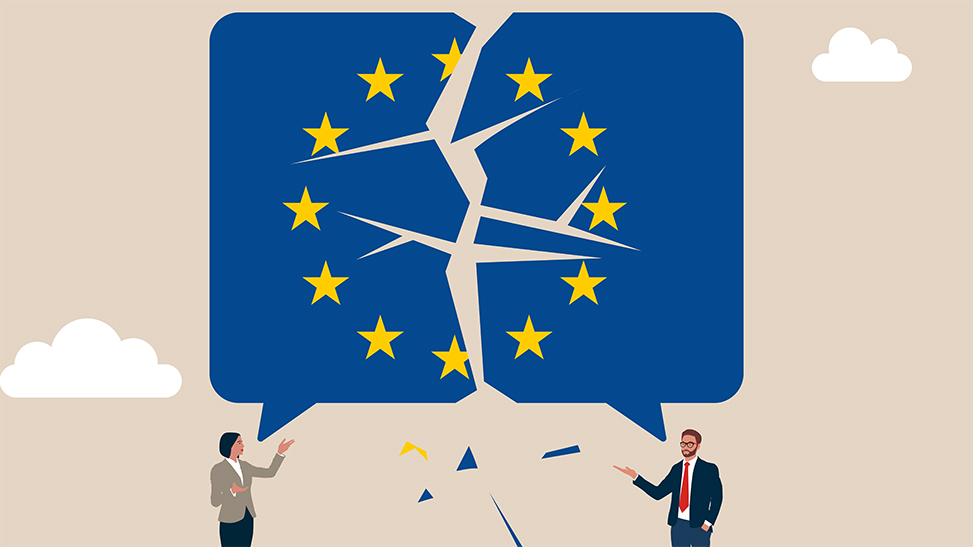

A fractured speech bubble of the EU flag, symbolizing deepening divisions.
A century ago, Europe was the focus of global events. Two decades later, the continent was in ruins after six years of self-immolation. Even then, the Soviet Union forced a continuing focus on European affairs. However, with the dissolution of the USSR in 1991, transformative international events quickly shifted the global focus elsewhere. Today, most Americans barely notice as Europe suffers through its worst war in eight decades. The continent no longer matters so much to the United States.
Europe’s dramatic fade is unfortunate, since it could be – indeed, should be – a serious, even essential, partner for Washington. The shared historical ties remain deep. The shared democratic ideals remain enduring. The shared geopolitical interests remain important. Nevertheless, the continent falls far short of its potential.
Serious European leaders recognize this unfortunate reality. Last year, Polish Prime Minister Donald Tusk highlighted “a paradox” involving Europe’s relationship with Washington. “500 million Europeans,” he argued, “[are asking] 300 million Americans to protect them from 140 million Russians.”[1] His numbers were slightly off, in terms of population (roughly 600 million Europeans are relying on 340 million Americans), but he was right to argue that Europe “must take greater responsibility for the continent’s security.” Until it does, it will not be a serious partner for America.
Learned Helplessness
Temporary European dependence on Washington was inevitable after the Soviet Union concluded World War II by occupying most of the eastern part of the continent. However, that did not necessitate enduring dependence. Indeed, U.S. officials insisted that the newly formed North Atlantic Treaty Organization was to be only temporary, a needed but limited shield behind which European nations could recover. Wartime commander Dwight D. Eisenhower, who served as NATO’s first Supreme Allied Commander Europe before being elected president, explained that, “If in ten years, all American troops stationed in Europe for national defense purposes have not been returned to the United States, then this whole project will have failed.”[2]
Fast forward eight decades. U.S. forces are still there, while European militaries remain notable for their lack of serious combat capabilities. America’s allies are even unable to adequately supply weapons to Kyiv, instead agreeing to purchase U.S. arms for transfer. European governments have traded the essentials of statehood, most importantly the ability to protect their people, for a mess of pottage, indirect foreign subsidies underwriting generous welfare states for appreciative populations.
In defending this perceived bargain, European governments have remained steadfast in the face of increasingly angry, even querulous, American administrations. In 2011, then-Defense Secretary Robert Gates delivered what amounted to his valedictory address, arguing: “The blunt reality is that there will be dwindling appetite and patience in the U.S. Congress—and in the American body politic writ large—to expend increasingly precious funds on behalf of nations that are apparently unwilling to devote the necessary resources or make the necessary changes to be serious and capable partners in their own defense. Nations apparently willing and eager for American taxpayers to assume the growing security burden left by reductions in European defense budgets.”[3]
However, European governments remained loath to erode Washington’s military domination, which allowed them “to spend a certain amount on butter that might otherwise have gone on guns,” as Financial Times columnist Janan Ganesh has explained.[4] The Europeans accurately judged their American guardians to be wanting, and did essentially nothing in response. For U.S. officials believed Washington’s military domination gave them disproportionate influence over other European policies. Thus, no matter how vociferously Americans complained about European behavior, they would not take the one step that could force a change in continental policy: end the U.S. defense dole.
Lesson Still Not Learned
Ironically, Vladimir Putin did what Gates and a succession of other American presidents, defense secretaries, and secretaries of state could not: stimulate growth in European military outlays. Yet even after Russia’s 2022 invasion of Ukraine, and with five years of Donald Trump as president, Europe remains a largely hapless and hopeless military laggard. Last year, leading European governments staged an emergency summit in Paris, at which they agreed, again, that they should spend more on their militaries. Yet when it came to Ukraine, the dependency was still there. As British Prime Minister Keir Starmer argued, tellingly: “Europe must play its role, and I’m prepared to consider committing British forces on the ground alongside others, if there is a lasting peace agreement, but there must be a U.S. backstop, because a U.S. security guarantee is the only way to effectively deter Russia from attacking Ukraine again.”[5]
Indeed, reported the International Institute for Strategic Studies, “The gaps in [the continent’s] military hardware and software are considerable, and the IISS estimates that replacing key elements of the U.S. conventional military capabilities assumed to be assigned to the Euro-Atlantic theatre could cost approximately USD1 trillion.” [6] No one in America – or especially in Europe – imagines that European governments will come up with such a sum. “European NATO members took just over ten years to increase spending from an average of 1.4% to 2.1% of GDP, so the new commitment will require even greater uplifts and difficult policy choices, raising doubts as to whether it is achievable for all allies,” the IISS study politely observed.[7]
Nor have the Europeans been willing to step up on Ukraine, the survival of which matters far more to them than it does to Washington. Of course, there is much rhetoric about the need to act. Yet who in Europe is willing to do what would be necessary to yield “a just peace,” as advocated by The Telegraph’s Hamish de Bretton-Gordon?[8] Greg Swenson, the chair of Republicans Overseas in the UK, was brutally honest when he noted that “it’s all talk. It all sounds great when you talk about democracy and defending Ukraine, but they’re just not willing to do it.”[9]
Alas, the issue is not simply feckless European leaders. Although there may be broad popular support for Ukraine versus Russia, there is little public willingness to sacrifice wealth and lives on Kyiv’s behalf. Indeed, one Pew Research Center survey found that most Europeans did not want even to fight for other NATO members, while assuming that Americans would rush to their defense.[10] Only 25 percent of Greeks and Italians would defend their neighbors, the survey found. Just 32 percent of Slovaks and Turks would do so. The percentages for Hungarians, Germans, and Czechs were 33, 34, and 36, respectively. For Poles, French, and Spanish the numbers were 40, 41, and 41. Of Europeans questioned, only a majority of Lithuanians (51 percent), British (55 percent), and Dutch (64 percent) favored acting. Nevertheless, in all cases at least a plurality, and usually a majority, believed Washington would.
Alas, with the populist right generally on the rise, Europe is not likely to adopt a more responsible approach. Czechia, Italy, and Slovakia have moved toward nationalism and away from continentalism. Traditional ruling parties are under severe pressure in Austria, Belgium, Netherlands, Norway, Romania, Spain, and Sweden. Even more worrisome are the politics in France, Germany, and Great Britain. Last August, NBC reported: “For the first time in modern history, far-right and populist parties are simultaneously topping the polls in Europe’s three main economies of Germany, France and Britain.”[11]
Although hardline nationalists could end up falling short in all three countries, ruling parties are more likely to accommodate than resist extremist demands in order to retain power. Worse, imagine a European Union with French President Marine Le Pen or Jordan Bardella, German Chancellor Tino Chrupalla or Alice Weidel, and British Prime Minister Nigel Farage, along with a gaggle of other European leaders twisting with the political winds.
Even if the establishment parties hang on in all three countries, their priority, along with that of the rest of Europe, is likely be retaining American support, not developing a serious continental military capability. European officials, across individual governments, the European Union, and NATO, have relentlessly played Trump. During the latter’s first term, observed Politico, NATO general secretary Mark Rutte leaned “heavily into public and private flattery.”[12] After Trump’s ostentatious state visit to Britain last year, Ganesh admitted the obvious: “the reason for courting Trump isn’t (just) to puff up Britain on the world stage or to secure AI investments. It is to keep him engaged in Ukrainian and European security. Just be glad that he does respond to flattery and obeisance. Imagine if he didn’t.”[13]
This perspective was obvious at last June’s NATO summit, when members approved the five percent of GDP to defense guideline. Sort of. Spain simply said no. Other governments emphasized that compliance would be difficult. Civilian projects will count as “military expenditures” up to 1.5 percent. Finally, the standard won’t take effect until 2035, long after Trump’s departure, leaving plenty of time to relax the requirement.
Indeed, Europe most clearly demonstrated its desperate desire to preserve American military domination of the continent when the European Union sacrificed its members’ economic strength to preserve Trump’s favor – or, at least, reduce his previously expressed hostility. Originally, European officials appeared to gird for economic battle. However, what followed was almost complete, abject surrender.[14]
Why? Admitted Ganesh, the continent had to “assume the position” and sacrifice the “ultimately not existential matter of trade.”[15] Similarly, explained Carnegie Europe’s Stefan Lehne: “Faced with the double threat of a trade war and of the United States abandoning Ukraine, European leaders decided to bow to the wishes of the Trump administration.”[16]European Trade Commissioner Maroš Šefčovič forthrightly conceded that the trade pact “is not only about… trade: It’s about security, it is about Ukraine, it is about current geopolitical volatility.”[17]
Locking In Dependence
The Trump administration, or at least Donald Trump himself, appears to believe this is a good bargain for America. Despite years of complaining about allied fecklessness, he turns out to be more interested in using U.S. military power to squeeze economic concessions out of other nations than to reduce the military risk to Americans. Unfortunately, his approach is a fool’s bargain. Trump’s deals turn ever more of the international economy over to the U.S. government and especially the U.S. president, for the benefit most obviously of him, along with his family and supporters. His strategy, meanwhile, weakens friendly states economically while locking in their military inferiority.
In Europe’s case, Washington is ensuring that the continent is not, and might never become, a serious and responsible partner for America. Thankfully, despite endless fearmongering among the U.S. foreign policy elite, the world is not particularly dangerous for America, which enjoys enormous military, geographic, economic, technological, political, and cultural advantages. Nevertheless, Americans would be better off if their most obvious and enduring allies were both willing and able to protect themselves and contribute proportionally to global security, as well as cooperate with the U.S. on a range of other shared interests.
Paradoxically, the best strategy for encouraging Europeans to become such partners would be to end U.S. domination of continental decision-making, especially the provision of security. No doubt, American policymakers would be frustrated at the inevitable willingness of Europe to disagree more with Washington and even oppose its policies. Nevertheless, serious allies warn each other when one or the other is wrong. The U.S. needs precisely such a friend in Europe.
-
[1] As cited in Mark Toth and Jonathan Sweet, “Europe’s thin red line in Ukraine,” The Hill, March 6, 2025, https://thehill.com/opinion/national-security/5178860-europes-thin-red-line-in-ukraine/.
[2] As cited in Farah Stockman, “NATO Has to Change. Here’s How,” New York Times, July 7, 2024, https://www.nytimes.com/2024/07/07/opinion/nato-europe-us-ukraine-defense.html.
[3] “Text of Speech by Robert Gates on the Future of NATO,” Atlantic Council NATOSource, June 10, 2011, https://www.atlanticcouncil.org/blogs/natosource/text-of-speech-by-robert-gates-on-the-future-of-nato/.
[4] Janan Ganesh, “Europe must trim its welfare state to build a warfare state,” Financial Times, March 5, 2025, https://www.ft.com/content/37053b2b-ccda-4ce3-a25d-f1d0f82e7989.
[5] Patrick Wintour, “US ‘backstop’ vital to deter future Russian attacks on Ukraine, says Starmer,” The Guardian, February 17, 2025, https://www.theguardian.com/world/2025/feb/17/starmer-urges-trump-to-provide-backstop-to-european-peacekeeping-force-in-ukraine.
[6] “Progress and Shortfalls in Europe’s Defence: An Assessment,” International Institute for Strategic Studies Strategic Dossier, 2025, https://www.iiss.org/globalassets/media-library—content–migration/files/publications—free-files/strategic-dossier/pds-2025/complete-file/iiss_strategic-dossier_progress-and-shortfalls-in-europes-defence-an-assessment_092025.pdf.
[7] Ibid.
[8] Hamish de Bretton-Gordon, “Trump has failed to understand Putin’s warped psychology,” The Telegraph, November 24, 2025, https://www.telegraph.co.uk/news/2025/11/24/trump-putin-ukraine-peace-deal-psychology/.
[9] Tim Ross, Clea Caulcutt, Bjarke Smith-Meyer and Nette Nostinger, “Zelenskyy’s grim choice: Take Trump’s peace deal or rely on flaky European friends,” Politico, November 25, 2025, https://www.politico.eu/article/donald-trump-ukraine-peace-vladimir-putin-troops-nato-ceasefire/.
[10] Moira Fagan and Jacob Poulshter, “NATO Seen Favorably Across Member States,” Pew Research Center, February 9, 2020, https://www.pewresearch.org/global/2020/02/09/nato-seen-favorably-across-member-states/.
[11] Alexander Smith, “Far-right populists top polls in Germany, France and Britain for the first time,” NBC News, August 13, 2025, https://www.nbcnews.com/world/europe/far-right-populists-top-polls-germany-france-britain-first-time-rcna224706.
[12] Sophia Cai and Eli Stokols, “NATO chief calls Trump ‘Daddy,’” Politico, June 25, 2025, https://www.politico.com/news/2025/06/25/nato-chief-calls-trump-daddy-00423485.
[13] Janan Ganesh, “Europe’s necessary appeasement of Donald Trump,” Financial Times, September 24, 2025, https://www.ft.com/content/7d4866b6-28a9-4e69-9288-4e970447ffe7.
[14] See, for instance, “EU defends Trump trade deal after backlash from capital and businesses,” Le Monde, July 28, 2025, https://www.lemonde.fr/en/european-union/article/2025/07/28/eu-defends-trump-trade-deal-after-backlash-from-capitals-and-businesses_6743824_156.html.
[15] Ganesh, “Europe’s necessary appeasement of Donald Trump.”
[16] Rym Momtaz, “Taking the Pulse: With Trump, Has Europe Capitulated?” Carnegie Endowment Strategic Europe, August 28, 2025, https://carnegieendowment.org/europe/strategic-europe/2025/08/taking-the-pulse-with-trump-has-europe-capitulated?lang=en.
[17] Antonia Zimmermann, “Europe’s ‘century of humiliation’ could be just beginning,” Politico, August 26, 2025, https://www.politico.eu/article/europes-century-of-humiliation-could-be-just-beginning/.