

THE NEW COUNTERTERRORISM TERRAIN
Blacklisting the Brotherhood
Jonathan Schanzer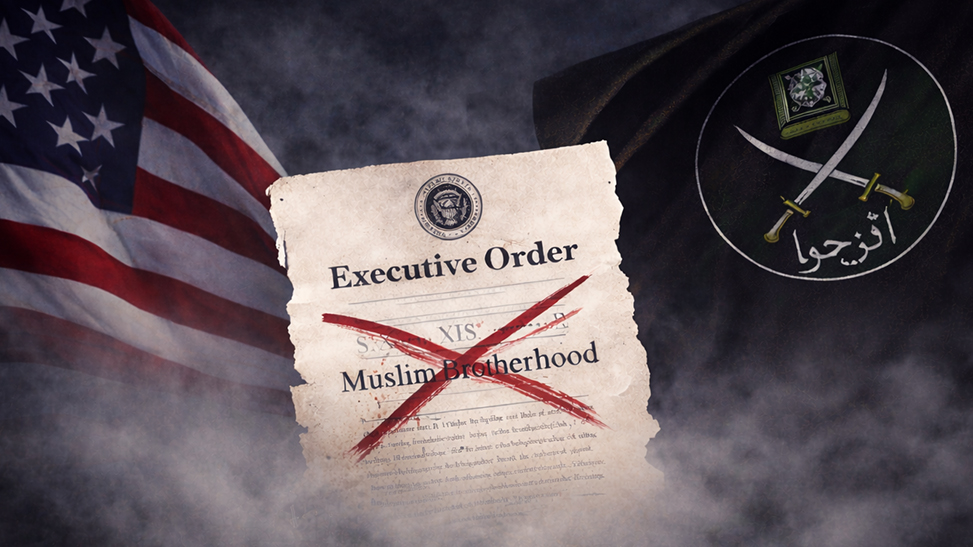

U.S. executive order marked for action sits between American and Muslim Brotherhood flags.
The Trump administration made history on November 24, 2025, when it issued an executive order calling for the U.S. government to designate “certain Muslim Brotherhood chapters as Foreign Terrorist Organizations and Specially Designated Global Terrorists.”[1] It made history again when it followed through and, in early 2026, formally designated three chapters of the global Islamist network.
Arriving at this moment was not easy. Previous attempts to place targeted financial sanctions on the world’s most influential Islamist organization had failed at the height of the “War on Terror.” Similar efforts, launched during the first Trump presidency, also sputtered. The problem was rooted in the Muslim Brotherhood’s lack of homogeneity. The modern Brotherhood is a sprawling network of national branches and affiliated groups that share a common lineage but not a unified chain of command. Some of its branches are violent. Others are patient, pragmatic, and inclined to accept the authority of their respective national governments. As a result, a “one size fits all” approach was rejected by the U.S. government’s scrupulous lawyers.
The new Trump administration effort is already more successful, because it is more modest in scope. Admittedly, questions remain as to how effective a step-by-step process can be over time. Much will depend on how the Administration follows up on its first tranche of designations – and how aggressive it will be as it widens the aperture.
Emergence In Egypt
The Muslim Brotherhood is the ideological progenitor of nearly every violent jihadist group in recent decades. And while Islamist groups operate the world over, few have the influence of this radical network.
Founded in Egypt in 1928 by schoolteacher Hassan al-Banna, the Brotherhood emerged in response to the collapse of the Ottoman Empire and the rapid spread of Western culture that resulted from successive Western interventions — France (1798-1801) and then Great Britain (1822-1936) — in its internal affairs. The Brotherhood sought to combat these unwelcome changes by stressing the need for the return of Islam as the dominant driver of Egyptian domestic culture, and for the defeat of the West.
Soon enough, the Brotherhood would spread its ideology beyond its own borders. But in the early years, the battle was largely domestic. In 1940, authorities arrested al-Banna in response to the activities of his organization’s “Secret Apparatus,” which carried out violence against the regime.[2] By 1948, the group had assassinated a judge and a police chief. That same year, a member of the Brotherhood succeeded in killing Prime Minister Mahmud Fahmi al-Naqrashi after he formally outlawed the group and ordered the seizure of its assets.[3] The regime responded with a nationwide crackdown, including the assassination of al-Banna himself.
Relations between the Brotherhood and the regime improved with the rise of the Free Officers group, which came to power by overthrowing the Egyptian monarchy in 1952. In fact, the MB was the only political group permitted to operate freely after the Free Officers’ rebellion. The movement was outlawed in 1954, however, following a failed attempt on the life of future president Gamal Abd al-Nasser, then the de facto leader of the Free Officers junta. In 1955, Nasser had six Brotherhood leaders executed, and he ordered the imprisonment of hundreds of others. Many Brotherhood operatives fled Egypt for other locales, where new chapters emerged.
During the 1950s and 1960s, the Brotherhood came under the sway of Islamist educator and political theorist Sayyid Qutb. Qutb argued that secular Arab rulers who claimed to be Muslims were apostates and that governments that failed to conform to the Brotherhood’s ideological standards were un-Islamic.[4] He suggested that jihad was the proper path for overthrowing what he deemed to be heretical regimes living in jahiliyya, or pre-Islamic ignorance. Today, this is a common theme among jihadists. However, at the time, Qutb was breaking new and dangerous ground. In 1966, he was tried and hanged for opposing the regime.
In 1967, after Egypt’s devastating loss to Israel in the Six-Day War, Nasser’s pan-Arabist ideology lost legitimacy, creating an opportunity for the Brotherhood to fill the void. In 1970, after Anwar Sadat came to power, he released many Brotherhood figures from prison. Sadat’s government allowed the movement greater freedoms and even encouraged Islamic groups to combat leftists and Nasserite organizations. The Brotherhood soon established its own financial institutions, social welfare organizations, publishing houses, and newspapers.
In the 1970s, the Brotherhood opposed Sadat’s liberal approach to women’s rights, the increase in nightclubs, prostitution, gambling, alcohol consumption, and other non-Islamic activities, as well as his outreach to Israel. In response, Sadat banned Brotherhood publications in September 1981 and ordered the arrest of approximately 1,000 of its members. The following month, Sadat fell to the bullets of an assassin from the Egyptian Islamic Jihad, whose extremism bore the direct imprint of Brotherhood ideology. The conspirators included Omar Abdel Rahman, the “blind sheikh” who later relocated to New Jersey and play a key role in the 1993 World Trade Center bombing, and Ayman al-Zawahiri, a physician and Brotherhood member who – alongside Osama bin Laden – later founded al-Qaeda.
The Brotherhood Goes Global
The Brotherhood was far from simply a local phenomenon, however. Following its entrenchment in Egypt, the movement’s influence spread throughout the region – and beyond.
In 1946, Mustafa al-Sibai, an associate of al-Banna’s, became the first leader of the Brotherhood in Syria. Like its Egyptian counterpart, the Syrian branch subsequently dispatched volunteers to fight in the first Arab-Israeli war in 1948.[5] For multiple reasons, the Brotherhood went on to oppose the rise of Syria’s Baathist regime in the 1960s. First, it resisted the regime’s inclination to westernize and secularize. Second, the Brotherhood was against the socialist nature of the regime. Third, it chafed at the minority rule of the Alawite sect. And lastly, it opposed the authoritarian rule of Hafez al-Assad.
What followed was a decades-long campaign of assassinations and bombings aimed at weakening the regime, culminating in the group’s attempted June 1980 assassination of Assad himself. The regime exacted immediate revenge by killing up to 1,000 Brotherhood prisoners, and conducting surprise searches and roundups in Hama, Aleppo, and other Sunni Arab strongholds. The Brotherhood responded on November 29, 1981, with a car bomb in Damascus, killing 64. The last straw came in early 1982, when a plot was uncovered within the Syrian air force to topple the regime. In response, Assad ordered his troops to enter the Brotherhood stronghold town of Hama. The battle lasted for 18 days, and the government leveled the city with no regard for civilians. Anywhere from 10,000 to 25,000 Syrians died. Even the survivors did not last long, as “virtually the entire Muslim religious leadership in Hama — from Sheiks to teachers to mosque caretakers — who survived the battle for the city were liquidated afterward in one fashion or another.”[6]
Five years after the devastation in Syria, the Brotherhood reemerged with new vigor in the Palestinian territories. The 1987 Palestinian intifada, or armed uprising, birthed a new violent faction of the movement. Of course, the Palestinian Muslim Brotherhood itself was not new. The first branch was formed in 1946 in Jerusalem, and the group was part of the patchwork of Palestinian groups struggling to establish a national identity in the early decades of the conflict.
In what would be later seen as a blunder of epic proportions, the Israeli military provided Ahmed Yassin, the eventual founder of Hamas, with a license to establish al-Mujamma’ al-Islami (the Islamic Center) in 1978. At the time, Yassin and his followers rejected the “external jihad” against Israel as impractical, choosing to focus on the “internal jihad” of building their influence within Palestinian society. This led Israel to view the group as an ally of convenience in a mutual struggle against Yasser Arafat’s secular Palestine Liberation Organization (PLO). Yassin’s movement boasted a network of health services, day cares, youth activities, and food services that won the support and loyalty of the destitute Palestinians in Gaza’s refugee camps.
In December 1987, the First Intifada erupted. Elements of the Muslim Brotherhood quickly embraced a more aggressive role in the “Palestinian resistance.”[7] In January 1988, weeks after the outbreak of the unrest, members of the Brotherhood splintered from the movement, creating the Islamic Resistance Movement, Harakat al-Muqawamma al-Islamiyya, whose acronym is Hamas. The group emerged as the military arm of the Palestinian Muslim Brotherhood and extended its influence from Gaza into the West Bank. By the end of 1988, Western and Israeli observers speculated that Hamas was on the verge of replacing Fatah and the PLO as the leading power in the territories.[8] Hamas went on to become the most violent and powerful of the Muslim Brotherhood’s various chapters and arms.
The rise to power of Omar al-Bashir in Sudan in 1989 marked another milestone in the history of the Muslim Brotherhood: the creation of the first government that embraced the Brotherhood’s ideology and strategy.
Admittedly, the Brotherhood was not a new phenomenon in Sudan either. The movement established one of its first chapters there in 1949, and it played an important role in Sudanese politics for decades – most notably after the rise of Islamist ideologue Hassan al-Turabi in the 1960s. Turabi created the Islamic Charter Front, a coalition of Muslims opposed to communism and seeking the adaptation of Shari’a as the basis for the country’s legal system.
In 1989, al-Bashir joined forces with Turabi, and the resulting government emerged as the world’s foremost state sponsor of terrorism, hosting groups like al-Qaeda and Hamas. In fact, in 1995, Bin Laden teamed up with his Sudanese hosts to launch a failed assassination attempt on then-Egyptian President Hosni Mubarak.[9] Subsequently, in 1998, the United States attacked Sudan in response to the twin embassy bombings in Kenya and Tanzania earlier that year, which were attributed to al-Qaeda.
The attacks of September 11, 2001 and the subsequent “war on terror” placed enormous pressure on the Bashir regime to cut its ties with terrorist groups. By then, Bin Laden had already relocated to Afghanistan, and Sudan mostly complied with subsequent American demands as a means to survive. Bashir’s regime was thus neutered ideologically but nevertheless held on for a time, eventually collapsing in 2019.
The Muslim Brotherhood experienced a resurgence during the “Arab Spring.” In the wake of the unrest that began in Tunisia in late 2010, Brotherhood factions enjoyed an increase in power and influence in Libya, Morocco, Egypt, Yemen, Jordan, and beyond. Egypt, for a brief period, was even led by an elected Muslim Brotherhood president, Mohammed Morsi, before a military coup d’etat toppled him. The Brotherhood-affiliated regimes of Turkey and Qatar were overt sponsors of these movements, and they remain pivotal supporters of the network today.[10]
The Arab Spring sputtered quickly, leaving behind mostly chaos and unrest. But the Brotherhood remains a powerful force. In fact, it maintains a presence in no fewer than 92 countries.[11] And while not all these chapters are violent, many are. In recent years, the Egyptian Muslim Brotherhood resurfaced and carried out terrorist attacks that caught the government off guard. Libya has experienced similar challenges since the fall of longtime dictator Muammar Gaddafi. In Jordan, the government disrupted a violent Muslim Brotherhood plot in April 2025, prompting an all-out ban on the group. Meanwhile, Hamas launched a brutal assault on Israel in 2023, sparking a wider regional war on seven fronts.
In 2025, when Donald Trump returned to the White House for a second term, it was clear that the threat of the Muslim Brotherhood had not abated. But with so many other conflicts around the world, the network seemed a relatively low priority. Nevertheless, within his first year, the president took unprecedented steps.
Two Trump Actions
The November 2025 executive order was bold in vision, yet modest in scope. Rather than attempting a blanket designation of the global Brotherhood network, the White House called upon the U.S. government to assess the viability of sanctions against individual foreign chapters of the Muslim Brotherhood. Specifically, it called on the State and Treasury Departments to examine the chapters in Egypt, Lebanon, and Jordan.
Egypt was a slam dunk. The United States had acted against the Brotherhood there in 2018 by imposing sanctions on two splinter groups: HASM and Liwa al-Thawra. Indeed, there was already a body of evidence against Muslim Brotherhood offshoots in Egypt, and the government in Cairo claimed to possess ample proof that the group was a threat in other ways. Indeed, the government of Abd al-Fattah al-Sisi had declared the Muslim Brotherhood to be an enemy of the state back in 2013.
Similarly, the case for designating the Muslim Brotherhood in Jordan was not a complicated one. The planned attack in April 2025 made clear the Brotherhood had abandoned its previous position of respecting the established order in the Hashemite Kingdom.[12] While the Brotherhood had been technically illegal in Jordan since 2020, this represented a ban in name only. For decades, the government in Amman had preferred to manage the threat rather than risk a confrontation. But that was before authorities thwarted the April 2025 plot.
Finally, there was the Muslim Brotherhood in Lebanon, where the local branch is known as the Islamic Group. The real threat there, of course, is Hezbollah. But the Islamic Group has an armed wing known as Quwwat al-Fajr that reportedly attacked Israel with rockets multiple times in 2023 and 2024.[13] Thanks to the peculiarities of Lebanon’s sectarian politics, the Islamic Group is fully legal and operates in the open – for now.
Not surprisingly, these branches met the criteria for designation, and on January 13, 2025, the Administration sanctioned all three. The U.S. government can now sanction the people, businesses, nonprofits, and networks that support these banned groups.
Widening The Lens
These moves are hopefully just the beginning. After a successful first tranche of sanctions, Washington can now widen the lens to target other branches of the Muslim Brotherhood.
Libya’s Hizb al-Watan is one possible target. Translated as either the Homeland Party or the National Party, Hizb al-Watan is led by Abdelhakim Belhaj and Salafi cleric Ali al-Sallabi. Prior to 2011, Sallabi had lived in Qatar and studied under the late Yusuf al-Qaradawi, who was regarded as a spiritual leader of the Muslim Brotherhood. Belhaj, also known as Abu Abdullah al-Sadiq, previously led the Libyan Islamic Fighting Group (LIFG), which the U.S. Treasury Department and UN Security Council both designated in 2001. During the 2011 uprising against Libyan dictator Muammar Gaddafi, Sallabi’s cadres reportedly received assault rifles, rocket-propelled grenade launchers, and military training from Qatar.[14]
After the toppling of Gaddafi, Sallabi formed the National Gathering for Freedom, Justice and Development party, which aimed to make Islamic law the basis of Libya’s constitution. In 2011, Belhaj announced the launch of Hizb al-Watan. The group subsequently joined other Islamist militias in the 2014 “Libya Dawn” movement which drove the elected and internationally recognized government from Tripoli.[15] Sallabi and Belhaj appear on a list of 59 people that Saudi Arabia, the United Arab Emirates, Egypt, and Bahrain accuse of having links to terrorism and enjoying Qatari support.[16]
Yemen’s al-Islah is another option. This is Yemen’s local Brotherhood affiliate, with its membership consisting of Brotherhood supporters, Salafists, and tribal figures (who have more reach and influence with the rural Yemeni population). Islah’s recent history is filled with ties to terrorism. One co-founder was the late Sheikh Abdul Majid al-Zindani, whom a federal lawsuit identifies as a coordinator of the 2000 attack on the USS Colethat killed 17 U.S. Navy sailors.[17] The United States designated Zindani in January 2004 as a Specially Designated Global Terrorist, describing him as a “spiritual leader” of Osama bin Laden and playing “a key role in the purchase of weapons on behalf of al-Qaeda and other terrorists.”[18] The United Nations followed suit a month later.
In 2013, the U.S. Treasury Department noted that Zindani, along with another designated terrorist, had “issued religious guidance in support of AQAP [al-Qaeda in the Arabian Peninsula] operations.”[19] In 2006 — two years after being designated — Zindani led a fundraising campaign for Hamas in Yemen, reportedly collecting over $279 million from 50,000 mosques for the terrorist group.[20] Zindani was likewise a board member of the Union of Good, an umbrella organization the U.S. designated for financing Hamas. Zindani also founded al-Iman University, which has served as a jihadist recruiting hub.[21] Senior Islah Party members reportedly harbored senior al-Qaeda leader Anwar al-Awlaki prior to his 2011 death in a U.S. drone strike.[22]
Today, Islah is part of the anti-Houthi coalition, with two of its members sitting on Yemen’s internationally-recognized Presidential Leadership Council. But this does not make Islah moderate. Critics charge that Islah quietly collaborates with the Houthis, and Islah leaders endorse Houthi attacks on Israel.[23]
The Malaysian Islamic Party (Parti Islam SeMalaysia) or PAS is yet another option. PAS is the country’s oldest and largest opposition political party, advocating the establishment of Malaysia as an Islamic state.[24] PAS has a history of strong ties to the broader Muslim Brotherhood movement, and today Malaysia plays host to some of the movement’s top figures.[25] PAS has troubling ties to terrorism. Specifically, the group may be providing in-country assistance to the Palestinian terrorist group Hamas, dating back to 2002.[26] In 2012, at least 10 Hamas members traveled to Malaysia for training to prepare for a cross-border attack against Israel. The group reportedly trained for kidnapping soldiers, anti-tank ambushes, and sniper attacks.[27] In 2014, Israel conducted a sweeping raid in the West Bank during which it captured one Majdi Mafarja, who admitted to training in message encryption and computer hacking for Hamas in Malaysia.[28]
In 2015, Israeli media reported that at least two senior Hamas officials – Ma’an Hatib and Radwan al-Atrash – were operating out of Malaysia.[29] Hamas has also operated a cultural organization in the country called Rabitat Bilad al-Sham (Greater Syria Association).[30] In 2013, a Hamas delegation led by then-politburo chief Khaled Meshaal visited Kuala Lumpur. Meshaal returned in 2015 and openly advocated for violence against Israel.[31] More recently, in 2018, the Israeli spy agency Mossad tracked and assassinated Fadi Mohammad al-Batsh, a Hamas member operating out of Kuala Lumpur. Al-Batsh was reportedly involved in developing drones, rockets, and other weapons for the group, and may also have been negotiating arms deals with North Korea.[32]
Assuming these branches of the Muslim Brotherhood meet the criteria, the U.S. government would be able to sanction the people, businesses, nonprofits, and networks that support them. The network of sanctioned Muslim Brotherhood entities would grow, thereby restricting the ability of the wider network to access the formal banking sector.
Assessing these and other branches of the Muslim Brotherhood will likely also highlight bridgeheads that the movement established in the West. Many Brotherhood figures who fled their home countries in the Middle East are now based in Europe, where the organization enjoys mostly free reign (the only European country that currently outlaws the Brotherhood is Austria).
One jurisdiction to watch in this regard is the UK. London is a notorious haven for Egyptian Islamists. Now that the United States has determined that the Egyptian Muslim Brotherhood is a terrorist organization, it may now generate intelligence on certain Brotherhood figures in the UK – something which could, in turn, further spur debate already taking place in the United Kingdom about proscription.
Battles Not Yet Joined
Absent in the Trump executive order was any mention of the Muslim Brotherhood in the United States, where it has had a presence since the 1960s. In the U.S., as in most of Europe, the Brotherhood rarely announces itself publicly but rather acts through a network of organizations it controls informally. These bodies range from student groups to businesses to advocacy organizations. Substantial information about this network became public through the 2008 Holy Land Foundation terror financing trial, in which prosecutors presented evidence that the foundation had funneled more than $12 million to Hamas before being shuttered in 2001.[33]
From a policy perspective, it is important to understand that the U.S. government is unable to impose sanctions on domestic persons or entities. Whereas the Treasury had the authority to do so in the early 2000s, that power has since been curtailed. The reason is simple: sanctions are a tool for imposing costs on those beyond the reach of U.S. law enforcement. If citizens of the United States, or resident non-citizens, are guilty of supporting terrorism, they should be arrested and tried. This approach has occasionally led to the arrest and conviction of major terror financiers, and should remain the U.S. government’s approach.
Moreover, the battle against domestic extremists may not be one that the White House wishes to fight – at least for now. After amassing more evidence on the wider network of Muslim Brotherhood chapters worldwide, there may be clearer indications of domestic actors’ support for terrorists abroad. In turn, this evidence could help build a case against American extremists. Such things take time, but should not be ruled out.
Another fight that the Trump administration has deferred, at least for the moment, surrounds state sponsors of the Muslim Brotherhood. The tiny Gulf emirate of Qatar possesses bottomless energy wealth and spends a great deal of it promoting the Brotherhood worldwide. This is done through soft power tools like the pro-Islamist Al Jazeera television network and the direct funding of various Muslim Brotherhood groups, including Hamas. The Republic of Turkey is another sponsor – one that, despite lacking the wealth of Qatar, engages in a wide range of outreach to empower Brotherhood chapters across the Middle East. Indeed, the Brotherhood is an important vehicle for advancing Ankara’s neo-Ottoman ambitions across the Middle East. Together, Qatar and Turkey represent a dangerous axis in the promotion of Muslim Brotherhood ideology worldwide.
Inexplicably, despite the Trump administration’s recognition of the Muslim Brotherhood threat, these two countries are still viewed by the White House as allies. In fact, the level of bilateral engagement with each is now at an all-time high. Trump’s personal relationships with Qatari Emir Tamim Al Thani and Turkish strongman Recep Tayyip Erdogan remain warm, and they have received zero admonition for their continued nurturing of the Brotherhood. This will need to change if there is to be a meaningful effort to curb the growth of the global Islamist movement.
The Road Ahead
Given the failure of past efforts to designate the Muslim Brotherhood as a terrorist organization, the step-by-step approach adopted by the Trump administration is likely a wise one. This approach, which will enable the Administration to defend the evidence it compiled on the clearest examples of Muslim Brotherhood violence, is likely to ensure lasting progress on this issue.
Moreover, if the Trump administration stays focused on addressing issues such as state sponsorship of the global network, as well as designating other Muslim Brotherhood branches and their enablers abroad, the process could lead inexorably to a blanket designation of the Brotherhood as a whole. That could include the domestic branches, as well. All of which would be a remarkable, and surprising, achievement, and a lasting counterterrorism legacy.
-
[1] The White House, “Designation of Certain Muslim Brotherhood Chapters as Foreign Terrorist Organizations and Specially Designated Global Terrorists,” November 24, 2025, https://www.whitehouse.gov/presidential-actions/2025/11/designation-of-certain-muslim-brotherhood-chapters-as-foreign-terrorist-organizations-and-specially-designated-global-terrorists.
[2] Abd al-Monein Said Aly and Manfred W. Wenner, “Modern Islamic Reform Movements: The Muslim Brotherhood in Contemporary Egypt,” Middle East Journal, Summer 1982, 341.
[3] Richard P. Mitchell, The Society of the Muslim Brothers (New York: Oxford University Press, 1969), 67.
[4] Qutb expounded upon these subjects in his book Milestones. Sayyid Qutb, Milestones [Ma’alim Fi’l-Tareeq] (Egypt: Kazi Publications, 1964), https://ia802803.us.archive.org/3/items/milestones-syedqutb/milestones-f1.pdf.
[5] Mitchell, The Society of the Muslim Brothers, 152-162.
[6] Thomas Friedman, From Beirut to Jerusalem (New York: Knopf Doubleday, 1989), 86.
[7] Glenn E. Robinson, Building A Palestinian State: The Incomplete Revolution (Bloomington and Indianapolis, IN: Indiana University Press, 1997), 148.
[8] Ibid., 169.
[9] John Lancaster, “Gunmen Try To Kill Mubarak,” Washington Post, June 27, 1995, https://www.washingtonpost.com/archive/politics/1995/06/27/gunmen-try-to-kill-mubarak/19f4d0db-a1ca-4011-95cc-1003951a929a.
[10] Natalie Ecanow and Mariam Wahba, “Qatar Tacitly Approves Muslim Scholars’ Call for ‘Armed Jihad’ Against Israel,” Foundation for Defense of Democracies, April 11, 2025. (https://www.fdd.org/analysis/policy_briefs/2025/04/11/qatar-tacitly-approves-muslim-scholars-call-for-armed-jihad-against-israel)
[11] Jane Arraf, “Muslim Brotherhood, Mainstream in Many Countries, May Be Listed as Terrorist Group,” NPR, February 22, 2017,https://www.npr.org/sections/parallels/2017/02/22/516437938/muslim-brotherhoodmainstream-in-many-countries-may-be-listed-as-terror-group.
[12] Suleiman al-Khalidi, “Jordan says it has foiled attacks by Muslim Brotherhood,” Reuters, April 15, 2025, (https://www.reuters.com/world/middle-east/jordan-foils-plot-involving-rockets-drones-source-says-suspects-linked-hamas-2025-04-15.
[13] David Adesnik, Mariam Wahba, Ahmad Sharawi, David Daoud, Natalie Ecanow, Hussain Abdul-Hussain, and Bridget Toomey, “Patient Extremism: The Many Faces of the Muslim Brotherhood,” Foundation for Defense of Democracies, October 27, 2025, https://www.fdd.org/analysis/2025/10/27/patient-extremism-the-many-faces-of-the-muslim-brotherhood.
[14] Sam Dagher, Charles Levinson, and Margaret Coker, “Tiny Kingdom’s Huge Role in Libya Draws Concern,” Wall Street Journal, October 17, 2011, https://www.wsj.com/articles/SB10001424052970204002304576627000922764650.
[15] Chris Stephen and Anne Penketh, “Libyan capital under Islamist control after Tripoli airport seized,” The Guardian, August 24, 2014, https://www.theguardian.com/world/2014/aug/24/libya-capital-under-islamist-control-tripoli-airport-seized-operation-dawn.
[16] “Qatar-linked people, groups on terror list,” Reuters, June 9, 2017, http://gulfnews.com/news/gulf/qatar/qatarlinked-people-groups-on-terror-list-1.2040686.
[17] Muslim Brotherhood Terrorist Designation Act of 2015, H.R. 389, 114th Congress (2015), https://www.congress.gov/114/bills/hr3892/BILLS-114hr3892ih.pdf.
[18] U.S. Department of the Treasury, “United States Designates bin Laden Loyalist,” February 24, 2004, https://home.treasury.gov/news/press-releases/js1190.
[19] U.S. Treasury Department, “Treasury Designates Al-Qa’ida Supporters in Qatar and Yemen,” December 18, 2013, https://home.treasury.gov/news/press-releases/jl2249.
[20] Amani al-Soufi, “اليمن تجمع التبرعات لحماس عبر حساب رسمي [Yemen collects donations for Hamas via official accounts],” Elaph, March 22, 2006, http://elaph.com/Web/Politics/2006/3/136831.htm?sectionarchive=Politics.
[21] Thomas Joscelyn, Testimony before Senate Foreign Relations Committee, March 9, 2017, http://www.defenddemocracy.org/content/uploads/documents/030917_TJ_Resolving_Conflict_Yemen.pdf.
[22] Bill Roggio, “Anwar al Awlaki sheltered in homes of senior Islah party members,” FDD’s Long War Journal, October 6, 2011,https://www.longwarjournal.org/archives/2011/10/anwar_al_awlaki_shelter_in_hom.php.
[23] Adesnik et al., “Patient Extremism: The Many Faces of the Muslim Brotherhood.”
[24] Amy Chew, “The rising force in Malaysia’s opposition,” Al Jazeera, February 10, 2013, https://www.aljazeera.com/indepth/features/2013/02/201321092433869462.html.
[25] “Expelled Muslim Brotherhood leaders may head to Malaysia, says report,” The Star, September 17, 2014, https://www.thestar.com.my/news/nation/2014/09/17/muslim-brotherhood-leaders-expelled-from-qatar-malaysia.
[26] “Hezbollah, Hamas Speakers Address Malaysian Opposition Conference,” Associated Press, May 30, 2002, https://www.haaretz.com/1.5179792.
[27] Adiv Sterman, “Malaysia Denies it Trained Hamas Operatives,” Times of Israel, July 31, 2014, https://www.timesofisrael.com/malaysia-denies-it-trained-hamas-operatives.
[28] Mitch Ginsburg, “Abbas Orders Probe into Hamas Coup Plot Revealed by Israel,” Times of Israel, August 19, 2014, https://www.timesofisrael.com/abbas-orders-investigation-into-hamas-coup-plot-revealed-by-israel.
[29] Amos Harel, “Shin Bet: Hamas training Palestinian Students in Malaysia,” Haaretz, April 28, 2015, https://www.haaretz.com/.premium-shin-bet-hamas-training-palestinian-students-in-malaysia-1.5355790.
[30] “Hamas Activity in Malaysia,” Meir Amit Intelligence and Terrorism Information Center, May 6, 2015, http://www.terrorism-info.org.il/en/20805/.
[31] Stuart Winer, “Hamas Political Leader: Stabber are the’ most exalted, noblest of people,’” Times of Israel, December 15, 2015, https://www.timesofisrael.com/hamas-political-leader-urges-more-stabbing-attacks.
[32] Jonathan Schanzer, “How Malaysia Became a Training Ground for Hamas,” Tablet, May 4, 2018, https://www.tabletmag.com/sections/news/articles/how-malaysia-became-a-training-ground-for-hamas.
[33] Lorenzo Vidino, The New Muslim Brotherhood in the West (New York: Columbia University Press, 2010), Chapter 7.