

THE NEW COUNTERTERRORISM TERRAIN
Europe’s Changing Counterterrorism Challenge
Hans Jakob Schindler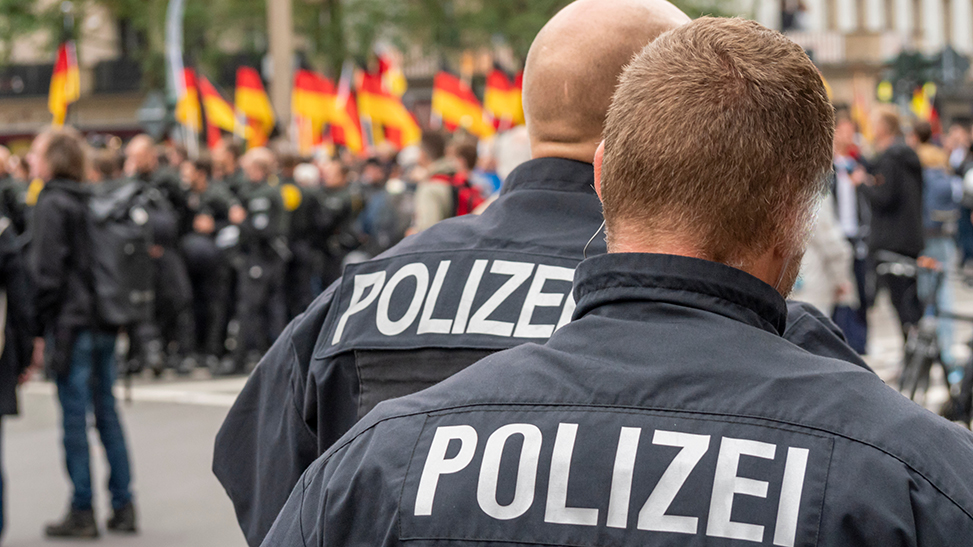

Panorama police operation in Germany during a demonstration.
Today, Europe is facing a resurgent and increasingly complex terrorism threat. Between 2022 and 2024, the European Union Agency for Law Enforcement Cooperation (EUROPOL) reports that 206 terror attacks—both foiled and successful—were recorded on the continent, and 1255 individuals were arrested on terrorist-related charges.[1] Put another way, Europe as a whole is experiencing more than one terror attack per week, on average; slightly less than six per month. Moreover, those statistics are assuredly incomplete, since EUROPOL only collates data that is forwarded by its member states.
The figures above reflect a structural challenge to Europe’s security environment. The continent now confronts the convergence of multiple external conflicts, accelerating radicalization dynamics, and institutional constraints that have hampered the ability of its governments to respond effectively.
Yet, although the current threat landscape is serious, it is not insurmountable. Addressing it, however, will require sustained reforms across the legal, financial and technical frameworks that the continent’s member states have marshalled in the fight against terrorism. And the continent’s current, heightened focus on defense and security provides a window of opportunity to do so.
External Shaping Forces
Europe’s internal security challenges cannot be understood in isolation. Rather, they are directly linked to instability on the continent’s periphery, where terrorist networks, proxy conflicts and state adversaries are now increasingly active.
One of the principal drivers of this disorder is the Islamic State. Since the 2021 withdrawal of international forces from Afghanistan and the return to power of the Taliban there, Islamic State Khorasan Province (ISKP), the Islamic State’s regional franchise, has flourished in the Southwest Asian state. While ISKP initially focused on destabilizing Taliban rule, it has increasingly turned its attention abroad – including toward Europe. The March 2024 attack on Moscow’s Crocus City Hall was only the most striking example of this activism and reach. ISKP has also been involved in guiding extremist actors in Europe; for instance, in September 2022, German authorities arrested an underaged ISIS sympathizer who had been instructed (via social media app Telegram) to establish a terror cell in the country and prepare a terror attack there.[2] Even when direct operational control is absent, ISKP propaganda has demonstrated the ability to inspire a range of hostile acts, from the successful knife attack in Solingen, Germany that took place in August 2024 to the foiled attack on a Taylor Swift concert in Vienna, Austria the same month.[3]
In the wider European neighborhood, other ISIS affiliates (and those of al-Qaeda) are growing as well. These include Jama’a Nusrat ul-Islam wa al-Muslimin (JNIM), the al-Qaeda affiliate in West Africa, and the Islamic State Sahel Province (ISSP), ISIS’ regional franchise, both of which control substantial territory in Burkina Faso and Mali and have extended operations into an increasing number of countries, including Niger, Chad and Cote D’Ivoire.[4] Islamic State West Africa Province (ISWAP), the IS affiliate in Nigeria, has likewise increased its operational capabilities, conducting terror attacks beyond its traditional area of operations in the northeast of the country. Islamic State Central Africa Province (ISCAP), for its part, continues to operate in Congo, Uganda and Mozambique, while the al-Qaeda affiliated al-Shabaab has gained ground in Somalia in recent years. Cumulatively, these groups now operate across a nearly continuous band of instability stretching from West Africa to the Indian Ocean.
Meanwhile, despite the destruction of its self-declared caliphate in 2019, ISIS in Syria has been able to rebuild increasingly capable clandestine networks, and to significantly increase the tempo of its attacks in the country.[5] It remains to be seen whether the new government of one-time jihadist Ahmed al-Sharaa can effectively contain this threat, now that it is in power in Damascus. But continued instability in the country—including sectarian violence as well as the presence of several thousand radicalized foreign terrorist fighters, among them individuals from Türkiye, the Caucasus and Europe[6]—does not bode well in this regard.
These extremist advances, in turn, have served to inspire sympathizers in Europe, and to at least partially reverse the ideological setback suffered by Islamist forces as a result of the destruction of ISIS’ physical caliphate nearly seven years ago.
A second challenge to the European order is the one posed by Russian hybrid warfare. Since its second invasion of Ukraine in February of 2022, Moscow has dramatically expanded its use of hybrid warfare against the countries of Europe. In addition to espionage and sabotage operations against military and critical infrastructure, the Kremlin’s asymmetric toolkit also includes assassination plots, including against leading members of the European armaments industry, which is now heavily involved in assisting Ukraine in countering Russia’s war of aggression.[7] Notable, too, is the larger Russian assault on Europe’s democratic system. Targeted disinformation campaigns have become a central part of the Russian hybrid warfare playbook, with the aim of undermining trust in governmental institutions and sowing discord in European societies. Collectively, this hybrid warfare campaign has imposed new and growing demands on Europe’s already strained internal security services.
Finally, Europe has been buffeted by the effects of the latest conflict in the Middle East. The terror campaign carried out by Hamas against Israel on October 7, 2023, and the ensuing war in Gaza as well as in Lebanon, with the Houthis and Iran, led to a significant radicalization of individuals across the Islamist spectrum. It also resulted in a strengthening of alliances between Islamist extremists and left-wing ones, based around a shared rejection of the State of Israel—with ominous results.
The conflict likewise exposed Hamas’s years-long attempts to establish a clandestine terror infrastructure on the continent, as subsequent arrests in Germany, the Netherlands and elsewhere uncovered networks tasked with procuring weapons and preparing for potential attacks.[8] These apprehensions highlighted that, in the years before Oct. 7, 2023, the Palestinian movement had succeeded in erecting a terror infrastructure that would have allowed it to carry out attacks on targets in Europe at will.
Other parts of Iran’s extensive proxy network also represent significant threats. For instance, Lebanon’s Hezbollah militia is known to have an extensive presence on the continent (and in Germany in particular), with its operatives continuing to use this beachhead to raise funds and prepare attacks, such as the 2012 assault on Israeli tourists in Burgas, Bulgaria.[9]
Meanwhile, Iran itself has become entrenched on the continent, with the Islamic Revolutionary Guard Corps (IRGC) developing connections to European organized crime groups that have enabled the regime to conduct attacks not only against Iranian dissidents abroad but also against Jewish and Israeli targets. Plots have been discovered primarily in Sweden, Germany and France, with a noticeable uptick between 2021 and 2024. [10]
Thus, while Europe has only limited ability to shape events in the Middle East, the continent is nevertheless forced to contend with the consequences of conflicts there.
A Grim Internal Picture
The external threats noted above intersect with internal vulnerabilities within Europe itself – vulnerabilities that have become increasingly pronounced in recent years.
Like the United States, Europe has experienced a significant uptick in antisemitic incidents in the wake of Oct. 7, 2023. Notably, these incidents have been driven not only by spontaneous radicalization, but by organized and increasingly effective antisemitic networks.[11] They have likewise been aided by newfound alliances between extremists of various ideological milieus – in particular, a growing interplay between Islamist extremists and left-wing radicals.
Such developments underscore a critical institutional failure. By and large, European governments have responded by punishing individual antisemitic incidents, without a focus on the underlying organizational networks enabling them. Moreover, European authorities have to date treated antisemitism as a derivative phenomenon, a unifying narrative that can bring together various extremist milieus, rather than recognizing it for what it is: a separate and distinct category of extremism.
At the same time, Europe faces extremist violence from across the ideological spectrum. Left-wing extremists have carried out a growing number of terrorist attacks; according to EUROPOL, since 2022 left wing violence has overshadowed that which has emanated from the European political right (71 terror attacks to 7).[12] Nevertheless, the latter cohort continues to be responsible for a significant amount of low-level violence that does not rise to the level of a terror attack.[13] During the same time period, EUROPOL registered 44 terror attacks by Islamist extremists in Europe.[14]
The heightened activism by all three ideological groups, meanwhile, has been augmented by new forms of extremist violence, with some primarily driven by a strong online component. One is conspiratorial or anti-government extremism, manifested in groups such as Germany’s Reichsbürger movement, which fundamentally reject the existing political order and have sought to subvert it.[15] Nihilistic extremist violence is an emerging issue as well, and the first court case against such a perpetrator is currently underway in Hamburg, Germany.[16] This loosely organized international network and focuses on promoting self-harm as well as inflicting serious harm on others, with a worldview that displays a deep rejection of the existing political and social order and promotes criminal acts.[17] And because this milieu is driven by individual connections online, without identifiable command and control structures, detection is challenging for security services. Perpetrators can consequently operate for prolonged periods of time before being detected.
Among the most troubling recent phenomena is the rise of individualized extremist violence. Increasingly, attackers combine various extremist narratives and personal grievances into an individualized worldview that lies outside known ideological strands. These actors often operate alone, requiring minimal logistical support, and can execute attacks with little warning. That was the case with the 2024 Christmas Market terror attack in Magdeburg, Germany, the perpetrator of which combined strong anti-Islamist views with a deep-seated hatred toward a range of German officials and institutions while not being connected to any wider ideological network or milieu.[18]
These extremist phenomena are both driven and accelerated by the existing social media landscape, which allows instantaneous, cost-free and international communication and thereby reduces operational costs for violent individuals, groups and networks. At the same time, the nature of social media platform algorithms, which are geared toward maximizing user engagement and therefore deepen personalized information bubbles, are accelerating radicalization.[19]
To date, this threat vector has received insufficient attention. Across Europe, security services are navigating the tension between operational efficiency and the protection of personal data and fundamental rights. Austria, for instance, is now debating the complicated issue of messenger monitoring capabilities, including the tracking of encrypted messages, with suggested upgrades hampered by political and legal challenges.[20] Similarly, Germany intends to expand the capabilities of its security and intelligence services, with an emphasis on bolstering their cyber capabilities.[21] But if the past is any guide, these planned upgrades will be met with fierce resistance. The latest legal reform of the German security and intelligence services even encountered challenges in Germany’s constitutional court which resulted in the introduction of new and restrictive data protection measures.[22] The list goes on. Given this pattern, it is unlikely that European security and intelligence services will be granted the technical capabilities to effectively monitor the current mass data environment—at least in the short to medium term. Nor would extensive monitoring necessarily be desirable, given the significant infringement on fundamental rights that it would entail. Rather, combining an upgrade of capabilities with an effective and legally mandated mechanism for cooperation with platform providers is far and away the more efficient way to proceed.
What Europe Must Do
The persistence and evolution of the terrorist threats confronting Europe represent a clear challenge to continental authorities. Addressing them requires European governments – both individually and collectively – to take a series of concrete steps.
First, Europe must strengthen its internal security capabilities. Resources for security and intelligence services should be increased to enable an expansion of both personnel and technical means. Hikes in European defense spending, now underway as part of Europe’s new, more fractious relationship with the United States, should include sustained investments in intelligence, law enforcement and counterterrorism infrastructure.
Second, European governments must modernize their analytical frameworks. The rise in antisemitic incidents in Europe, and the diversification of extremist ideologies, has presented a much more complex threat environment – one in which traditional models that categorize extremist threats along rigid ideological lines are increasingly inadequate. Administrative reforms are necessary to ensure more flexible and timely approaches that are better able to address new ideation, temporary ideological alliances, and nihilistic extremism in its various forms. Traditional approaches are clearly no longer adequate.
Third, European states need to deepen their intelligence cooperation. The area of the European Union and United Kingdom encompasses 28 separate governments and a multitude of different national security and intelligence authorities. Enormous financial, human and technical capabilities exist, but are fragmented across national systems. Terrorist and violent extremist threats, however, are inherently transnational in nature, and require closer collaboration between Europe’s constituent parts. Stepped-up information exchanges and cooperation is necessary, while burden sharing in areas like online monitoring and detection, as well as joint investigations, can enable authorities across the continent to more efficiently utilize the resources they have.
Finally, Europe must establish mandatory cooperation frameworks with technology platform providers. These entities are key; they are both the generators and managers of the current mass data environment. The online sphere has emerged as a key battleground for countering violent extremism and terrorism. Yet by and large, these commercial entities are not legally required to proactively cooperate with European security and intelligence services at present. Sadly, voluntary cooperation based on corporate social responsibility has proven not to be a reliable system. Legal mechanisms are required to compel platforms to identify and report credible threats and indicators of radicalization, much the same way such requirements currently inform the functioning of the financial sector with regard to suspicious transactions. Simply put, the custodians of data should be obligated to ensure that it does not create harm.
A Window Of Opportunity
The security challenges currently facing Europe are multifaceted, complex, and evolving. That, however, does not mean they cannot be addressed more effectively and efficiently. Doing so, however, will require an overhaul of existing legal, financial, administrative and technical systems.
Today’s continental debates about defense and security are driven by factors such as Russian aggression and an increasingly uncertain Transatlantic relationship. These are challenging dynamics, to be sure. But they also present a chance to revamp the way in which Europe responds to the persistent threat posed by violent extremism and disruptive ideologies. As German chancellor Friedrich Merz made clear during his opening speech at the recent Munich Security Conference, Europe must preserve its own values, protect its freedom and build on its strengths.[23] The continent should not squander the opportunity this moment presents.
-
[1] Europol, “TE-SAT. European Union Terrorism Situation and Trend Report 2025,” 2025, 15, https://www.europol.europa.eu/cms/sites/default/files/documents/EU_TE-SAT_2025.pdf
[2] Federal Attorney General, “ Anklage gegen ein mutmaßliches Mitglied sowie einen mutmaßlichen Unterstützer der ausländischen terroristischen Vereinigung „Islamischer Staat (IS) [Charges filed against an alleged member and a suspected supporter of the foreign terrorist organization “Islamic State (IS)],“ March 16, 2023, https://www.generalbundesanwalt.de/SharedDocs/Pressemitteilungen/DE/2023/Pressemitteilung-vom-16-03-2023.html
[3] Dino Krause, “The Islamic State’s Khorasan Province Terror plots in Europe,” Danish Institute for International Studies, September 2025, https://pure.diis.dk/ws/files/27802520/ISKP_terror_plots_in_Europe_DIIS_Report_2025_09.pdf
[4] For an overview, see Counter-Extremism Project, “CEP-KAS West Africa,” n.d., https://www.counterextremism.com/content/cep-kas-west-africa
[5] Adrian Shtuni, “The Islamic State in 2025: an Evolving Threat Facing a Waning Global Response,” International Center for Counter Terrorism, July 11, 2025, https://icct.nl/publication/islamic-state-2025-evolving-threat-facing-waning-global-response#:~:text=The%20number%20of%20attacks%20in%20Syria%20in,the%20number%20was%20almost%20three%20times%20smaller.
[6] Joseph Röhmel, “Gefährliches Erbe – Deutsche Dschihadisten in Syrien, Bayerischer Rundfunk [Dangerous heritage – German jihadists in Syria],“ May 30, 2025, https://www.br.de/nachrichten/deutschland-welt/deutsche-dschihadisten-in-syrien-hts,Um2UI11
[7] “Germany decries Russian plot to assassinate Rheinmetall boss,” Deutsche Welle, July 12, 2024, https://www.dw.com/en/germany-decries-russian-plot-to-assassinate-rheinmetall-boss/a-69641234
[8] Federal Public Prosecutor General, “Four Suspected Members of the Foreign Terrorist Organisation ‘HAMAS’ Arrested,” December 14, 2023, https://www.generalbundesanwalt.de/SharedDocs/Pressemitteilungen/EN/2023/Pressemitteilung-vom-14-12-2023-Nr-57-Englisch.html; “Fifth Terror Suspect Arrested in Germany in Connection With Wider Hamas Europe Plot,” Foundation for Defense of Democracies Flash Brief, November 13, 2025, https://www.fdd.org/analysis/2025/11/13/fifth-terror-suspect-arrested-in-germany-in-connection-with-wider-hamas-europe-plot/
[9] “2012 Bulgaria bus bomber buried at Hezbollah cemetery in Lebanon,” Times of Israel, April 12, 2025, https://www.timesofisrael.com/2012-bulgaria-bus-bomber-buried-at-hezbollah-cemetery-in-lebanon/.
[10] Swedish Security Service, “Iran is using criminal networks in Sweden,” May 30, 2024, https://sakerhetspolisen.se/ovriga-sidor/other-languages/english-engelska/press-room/news/news/2024-05-30-iran-is-using-criminal-networks-in-sweden.html; Matthew Levitt and Sarah Boches, “Iranian External Operations in Europe: The Criminal Connection,” International Center for Counter Terrorism, October 16, 2024, https://icct.nl/publication/iranian-external-operations-europe-criminal-connection#:~:text=In%20Germany%2C%20the%20IRGC%20hired,other%20in%20Essen%20in%202021.
[11] Alexander Ritzmann et al., “The Role of Antisemitism in the Mobilization to Violence by Extremist and Terrorist Actors,” Counter Extremism Project, February 2025, https://www.counterextremism.com/sites/default/files/2025-04/CEP%20Transnational%20Antisemitism%20Study%202025.pdf
[12] Europol, “TE-SAT. European Union Terrorism Situation and Trend Report 2025.”
[13] Bundesministerium des Innern, “Verfassungschutzbericht 2024,” June 2025, 27, https://www.verfassungsschutz.de/SharedDocs/publikationen/DE/verfassungsschutzberichte/2025-06-10-verfassungsschutzbericht-2024.pdf?__blob=publicationFile&v=9
[14] Europol, “TE-SAT. European Union Terrorism Situation and Trend Report 2025,“ 15.
[15] For example, a network of Reichsbürger and right-wing extremists attempted a coup d’etat in Germany in December 2022, including organizing armed groups across the country and a planned armed attack on the federal parliament of Germany, the Bundestag. Federal Attorney General, “Anklage gegen neun Personen u.a. wegen Mitgliedschaft in einer terroristischen Vereinigung, Vorbereitung eines hochverräterischen Unternehmens sowie versuchten Mordes vor dem Oberlandesgericht Stuttgart erhoben [Charges against nine people filed before the Stuttgart Higher Regional Court, including membership in a terrorist organization, preparation of a highly treacherous enterprise and attempted murder],“ December 12, 2023, https://www.generalbundesanwalt.de/SharedDocs/Pressemitteilungen/DE/2023/Pressemitteilung-vom-12-12-2023-Nr-54_.html
[16] “Anklage im Hamburger ‘White Tiger‘ Prozess zu Ende verlesen [Charge in Hamburg’s ‘White Tiger‘ trial to end],“ Die Zeit,January 13, 2026, https://www.zeit.de/news/2026-01/13/anklage-im-hamburger-white-tiger-prozess-zu-ende-verlesen
[17] Felix Neumann, „Terrorismus ohne Ziel? Die Entwicklung nihilistischer Gewalt,“ Konrad Adenauer Stiftung, January 2026, 10, https://www.kas.de/documents/252038/40211523/Terrorismus+ohne+Ziel+-+Die+Entwicklung+nihilistischer+Gewalt.pdf/38be0c07-90f4-5b36-b88b-800403f4ab16?version=1.1&t=1767863232346
[18] Marcel Fürstenau, “Weihnachtsmarkt-Prozess: ‘Dann habe ich einfach Gas gegeben‘ [Christmas market trial: ‘Then I just gave gas‘],“ Deutsche Welle, November 11, 2025, https://www.dw.com/de/magdeburg-weihnachtsmarkt-anschlag-prozess-anklage-amok-taleb-a/a-74663473
[19] Donghee Shin and Kulsawasd Jitkajornwanich, “How Algorithms Promote Self-Radicalization: Audit of TikTok’s Algorithm Using a Reverse Engineering Method,” Social Science Computer Review 42, iss 4, July 30, 2024, https://journals.sagepub.com/doi/10.1177/08944393231225547
[20] Parlament Österreich, “Nationalrat: Messenger-Überwachung sorgt weiter für Aufregung [National Council: Messenger surveillance continues to cause excitement],“ January 21, 2026, https://www.parlament.gv.at/aktuelles/news/in-einfacher-sprache/Nationalrat-Messenger-Ueberwachung-sorgt-weiter-fuer-Aufregung-00001
[21] “Aufrüstung des Bundes-Nachrichtendienstes: Kanzler Merz fordert Befugnisse für mehr Sabotage, Spionage und Cyberaktionen [Rearmament of the Federal Intelligence Service: Chancellor Merz demands powers for more sabotage, espionage and cyber actions],“ Die Weltwoche, February 18, 2026, https://weltwoche.ch/daily/aufruestung-des-bundesnachrichtendiensts-kanzler-merz-fordert-befugnisse-fuer-mehr-sabotage-spionage-und-cyberaktionen/
[22] Bundesverfassungsgericht, “Judgment of 19 May 2020, “ May 19, 2020, https://www.bundesverfassungsgericht.de/SharedDocs/Entscheidungen/EN/2020/05/rs20200519_1bvr283517en.html.
[23] Federal Government of Germany, “Speech by Federal Chancellor Merz at the Munich Security Conference,” February 13, 2026, https://www.bundesregierung.de/breg-en/federal-government/speech-chancellor-msc-2407256