

THE NEW COUNTERTERRORISM TERRAIN
Keeping Iran’s Proxies on their Back Feet
Matthew Levitt Michael Jacobson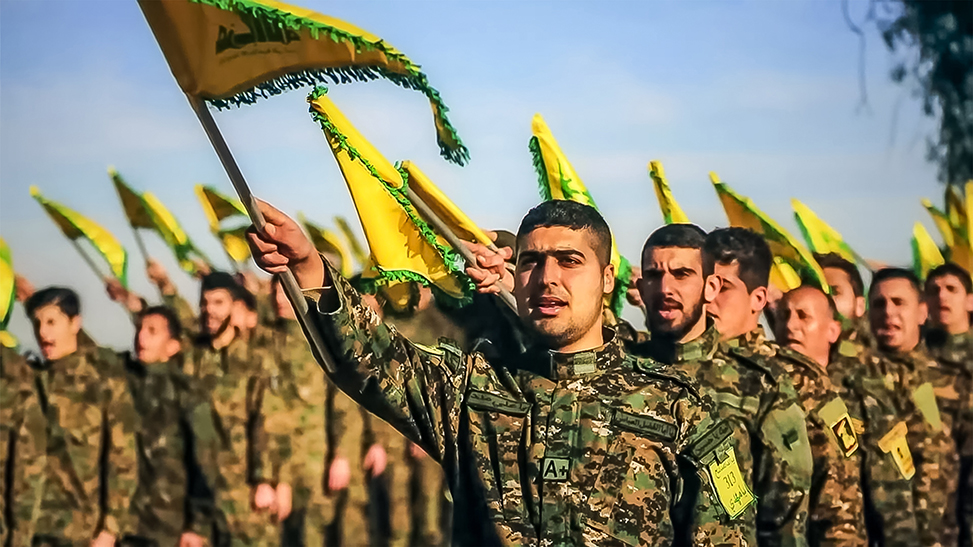

Hezbollah Members Standing During a Funeral of a Senior Official Member in South Lebanon.
The day after the Hamas-led campaign of terror on October 7, 2023, Hezbollah began launching near daily rocket attacks targeting Israel. A year later, Israeli forces finally took the fight to the Shi’ite militia in Lebanon, and on September 27, 2024, a targeted Israeli airstrike on an underground Hezbollah command center killed Hezbollah leader Hassan Nasrallah and senior Iranian IRGC commander Abbas Nilforoushan. Their bodies were recovered intact, embracing one another, underscoring the deep, longstanding ties between the Islamic Republic of Iran and its proxies.
Just two months earlier, Hamas leader Ismail Haniyeh had been killed by an explosive device planted in the IRGC guesthouse where he was staying in Tehran to attend the inauguration of Iranian president Masoud Pezeshkian, highlighting Hamas’ intimate ties to Iran even after the October 7th massacre. Yemen’s Houthis also made their allegiance to Iran clear following the U.S. attack on Iranian nuclear facilities in June 2025, warning of their “full solidarity with Iran and its right to respond and deter the arrogance of the American-Zionist aggression.”[1]
Then came the latest Israeli and U.S. strikes targeting Iran in March, which killed Supreme Leader Ali Khamenei and many other senior Iranian leaders and commanders and extensively targeted the infrastructure of Iran’s security establishment. Hezbollah decided to enter the fray, targeting Israel with rockets and drones once more, leading to a new wave of Israeli strikes against Hezbollah targets in Lebanon and, for the first time, a Lebanese government decision outlawing all Hezbollah military and terrorist activity in the country.
To be sure, Israel has inflicted major blows against Iran’s assorted proxies over the past several years, with Hamas and Hezbollah suffering particularly serious setbacks. Iran, for its part, has made clear that rearming and rebuilding its so-called “Resistance Front” remains a high priority for the regime.
But accomplishing this feat is far more difficult for Tehran than it was in the past. The regime of Bashar al-Assad, a key pillar of Iran’s proxy network, has been removed from power in Syria. A new government in Lebanon has begun clearing Hezbollah infrastructure and weapons from that country’s south. Israel, meanwhile, has demonstrated increased determination to target Hezbollah violations of the ceasefire. On top of this, Iran is facing a litany of challenges at home, including economic and environmental crises that contributed to massive protests across the country against the regime in January 2026.
And yet, Iran is finding ways to circumvent these potential roadblocks. U.S. officials report that Iran provided Hezbollah some $1 billion over the first ten months of 2025, and continues to provide significant funding to Hamas as well. Iran is also still finding ways to send weapons to Hezbollah and the Houthis, some of which (though certainly not all) have been seized or interdicted. Moreover, Hezbollah, Hamas and the Houthis all have their own independent fundraising, procurement and logistical networks around the world which can fill some of the gaps.
Iran’s proxy network, in other words, may be down, but it isn’t out. While the outcome of the U.S. and Israeli war against Iran and the separate Israeli assault on Hezbollah is far from clear, we should not assume that these threats will be behind us when the conflict concludes. Identifying how both the Islamic Republic and its radical partners might adapt to whatever new circumstances they are facing is therefore of the utmost importance.
Enduring Iranian Support…
From the outset of the Israeli retaliation, Iran has made clear that rebuilding the capabilities of its terrorist partners is a top regime priority. In May 2024, the heads of Iran’s Revolutionary Guard Corps (IRGC) and its paramilitary arm, the Quds Force, met with Hamas and Hezbollah leaders in Iran, with the Iranian generals underlining the importance of a “continued struggle to be jointly fought from across the region by all resistance groups.”[2]
In September 2024, Iranian Foreign Minister Abbas Araghchi reiterated this message on state television, underscoring that Tehran would provide “unlimited support” to its “Resistance Front.”[3] More recently, in November 2025, Aragchi told the country’s parliament, the majles, that one of the Iranian Foreign Ministry’s highest priorities is to support the “axis of resistance” and that his agency was “effectively functioning as the foreign ministry of the axis.”[4]
Iran has been attempting to follow through on these public pledges of support, undaunted by its deepening economic crisis at home. In November 2025, the U.S. Treasury Department publicly reported that Iran had provided Hezbollah with approximately a billion dollars in the first ten months of the year.[5] And while Hamas has always received far less than Hezbollah, Iran is still providing it with sizeable levels of funding. The U.S. government estimates that, since 2018, Iran has provided Hamas around $100 million per year, with that figure increasing to closer to $120 million annually in the lead up to the October 7th attacks.[6]
Many of these Iranian funds – for Hezbollah, the Houthis, and sometimes for Hamas – have come from the sale of illicit oil. In round after round of designations, the U.S. Treasury Department has exposed and targeted Iranian and other elements of this international oil smuggling network, which facilitates oil trades and generates funds for both the IRGC Qods Force and Hezbollah.[7]
Not surprisingly, given President Recep Tayyip Erdogan’s ideological alignment with Hamas, Turkiye has emerged as a major hub for Hamas financial activity as well, both for Iranian funding and for money coming from other sources.[8] In December 2025, the Israeli government revealed a network of money exchange houses operating in Türkiye staffed by Hamas members from Gaza and designed to facilitate the transfer of Iranian funding to the terrorist group. The Israelis alleged that this large-scale funding enterprise was in the “hundreds of millions of dollars.” Perhaps more unexpected have been the reports that Hezbollah was also using Turkiye as a transit hub for its financial activity.[9]
Iran remains equally committed to rebuilding the military capacity of its proxies and partners. The Islamic Republic is known to still be sending weapons to Hezbollah to help it reconstitute its badly damaged military capabilities.[10] Iran also continues to arm the Houthis, regularly sending a broad range of drones, missiles, among other sophisticated weapons systems, to the Yemeni group.
…But New Challenges
Yet, while bolstering its proxies and partners may be a priority for the Iranian regime, doing so is a far more challenging proposition than in the past. Historically, Iran provided weapons and funding to Hezbollah either via direct flights to Beirut or overland through Syria. There are now significant obstacles to utilizing either of these routes.
For instance, the Lebanese government has taken previously inconceivable steps, including preventing Iranian aircraft from landing in Beirut, searching Iranian couriers on arrival, and banning Lebanese banks and brokerages from working with several financial institutions tied to Hezbollah.
These difficulties are exacerbated by the fact that Hezbollah’s financial and military needs are also far more significant than in the past. On the military front, the Israeli Defense Forces estimates that it has destroyed some 80 percent of Hezbollah’s arsenal of short-range rockets.[11]
Civilian rebuilding costs are also estimated to be in the billions, and Hezbollah’s constituency in Lebanon’s Shi’a south is looking to the group for continued support for reconstruction and social services. Hezbollah has struggled to meet these increased financial needs, failing to cover promised reconstruction grants, salaries, and stipends for the families of killed and wounded fighters.
With regard to Hamas, while Iran remains able to provide funding to the terrorist group outside of Gaza without great difficulty, the movement itself has struggled at times to bring these resources into the Strip—particularly since financial institutions in the territories are now “non-functional.”[12] Iran-Hamas ties were also set back by Israel’s June 2025 killing of Muhammad Saeed Izadi, the commander of the Palestine branch of the Islamic Revolutionary Guard Corps-Qods Force (IRGC-QF). Izadi had served as the senior liaison between Iran and Hamas and was responsible for Iranian financial and military support for the group.
Meanwhile, the U.S. and international community have stepped up their interdiction efforts against vessels supplying arms to the Houthis. Thus, in late 2024, U.S. Central Command announced that forces loyal to the Yemeni government had seized a ship in the Red Sea with 750 tons of Iranian military equipment being shipped to the Houthis.[13] According to the U.S. military, this ranked as the largest weapons seizure in the history of the Yemeni National Resistance Forces. Additionally, many of the Yemeni banks that once operated in North Yemen have moved their headquarters to the government-controlled capital in the south, making it more difficult for the Houthis to transfer funding from outside the country.
There are also looming domestic challenges to Iran’s continued funding of its proxies. One of the notable grievances of protestors during the recent unrest in Iran was the Islamic Republic’s continued funding of Hamas and Hezbollah. The decision to prioritize funding foreign militant groups rather than addressing basic domestic economic problems led protestors to chant “Neither Gaza nor Lebanon, I sacrifice my life for Iran.”[14] As Iran grapples with ongoing domestic discontent, it may face internal challenges to funding its proxies to the extent it had in the past.
Despite these obstacles, however, Iran is aggressively and creatively seeking solutions. For example, instead of sending the majority of its weapons and funding resupply for Hezbollah overland through Syria, it is now increasingly relying on maritime routes for such shipments.[15] Additionally, as the Lebanese government cracked down on financial transactions and activity with an obvious Iranian link, Iran began instead leveraging money exchange houses and other businesses in Dubai to send hundreds of millions of dollars to Hezbollah.[16]
And although the new Syrian government is certainly attempting to intercept Iranian weapons transiting the country, its capabilities are still limited – something the Iranians are aiming to exploit. Iranian weapons smuggling has always thrived in places where state control has been weak, as it is in Syria today. With the Houthis, meanwhile, Iran has employed a range of techniques to avoid detection, including disguising the provenance of vessels carrying arms and skirting mandatory inspections. As for Hamas, while getting it weapons is certainly more difficult in the current environment, history suggests that Iran could do so again if the group remains in control of even just part of Gaza.
Independent Sources And Methods
What’s more, Hezbollah, Hamas and the Houthis all have their own extensive global procurement and financial networks – capabilities that allow them to address gaps in Iranian sponsorship on their own. As such, cracking down on Iranian support ranks as a critical step to mitigate these threats, but by itself it is not a sufficient one.
When it was short on funds in the past, Hezbollah relied on its own global networks in Asia, Africa, Europe, and the Americas to supplement Iranian funding. The trend began in earnest after Hezbollah’s 2006 war with Israel, when the group faced similar rebuilding and reconstruction challenges. These networks expanded further when Iran itself faced financial difficulties in 2009 from the combined impact of the “Green Revolution,” new Western sanctions, and a drop in global oil prices. Thereafter, Hezbollah again tapped its global networks when its entry into the Syrian civil war further strained its budget.
This time around, Hezbollah seems to have already turned to Africa and South America – both places where it has long had a significant presence – in order to raise funds. Thus, an October 2024 alert by the U.S. Treasury Department’s Financial Crimes Enforcement Network warned financial institutions that Hezbollah was active in West Africa, where it had a “network of financiers” raising and laundering money on the organization’s behalf.[17] More recently, in May 2025, the U.S. State Department issued a Rewards for Justice notice seeking information on Hezbollah’s financial mechanisms in the tri-border area where Argentina, Brazil, and Paraguay meet.[18] The notice laid out that Hezbollah financiers and facilitators operate there (and in other parts of South America) generating revenue from narcotics trafficking, money laundering, counterfeiting, and smuggling.
Hezbollah is also seeking to use its procurement networks and front companies around the world to acquire military and dual-use technologies. In 2024, for example, Britain, Germany, and Spain disrupted a major Hezbollah operation to obtain components for suicide drones that could carry explosives.[19] According to the U.S. Justice Department, Hezbollah has also procured precursor chemicals suitable for making bombs from a medical device company in Guangzhou, China, as part of its attack planning in Cyprus, Thailand, and elsewhere.[20]
Then there is Hamas. While the Palestinian movement has raised funds around the world for decades, its overseas financial solicitations increased after its October 7th assault on Israel. Just three days after the terrible 2023 attack, Hamas leader Khaled Mishal called on supporters to give “aid, money, and all that you have” in what he called an act of “financial jihad.”[21] Hamas fundraisers responded in force; within days, the group had launched several new fundraising campaigns, primarily under the guise of alleviating the genuine humanitarian suffering in Gaza. Europe has been a particularly active hotbed of Hamas’s post-October 7th fundraising—hardly a surprise given the group’s long-standing ties and networks there.[22]
The Houthis also have their own extensive international connections and reach. The group, for instance, has developed particularly strong ties in China, where it has obtained a broad range of cutting edge and dual use technology. As the Treasury Department has noted, the Houthis “leverage a global network of shipping and logistics companies to transport military-grade components from commercial suppliers to their terrorist forces in Yemen.”[23] This materiel has been essential to their efforts to target commercial and military ships in the Red Sea and disrupt the freedom of navigation in the region.
Adapt To Survive
There are several ways in which Tehran may seek to preserve some level of operational capability among its proxies. Such efforts could also help account for Iran’s own domestic financial and political instability, and the likelihood that international actors will increase efforts to disrupt large-scale Iranian efforts to fund and arm its proxies.
One is the increased efforts to develop proxy capabilities in drones and other unmanned systems. The use of surveillance and attack drones by Iran and its proxies has already become ubiquitous. In an era of scarcity, previous successful deployments may portend a growing interest in drone warfare. Additionally, drone components are more easily procured and smuggled than large, big-ticket weapons systems like precision guided missiles – and the technology lends itself to domestic production, creating a level of autonomy that is highly desirable among threat actors. As such, Hamas, Hezbollah and the Houthis are all likely to invest heavily in smuggling drones and drone components and building out their domestic drone production capabilities to field assets for conflicts and operations to come.
A second potential trend is a propensity for joint operations. At a time when Iranian proxies find their military capabilities significantly degraded, they may decide that, by acting together, they are stronger than the sum of their parts – especially if they carry out reasonably deniable attacks abroad. In the near to medium term, Iran’s proxies will likely prefer not to carry out attacks from Gaza, Lebanon or Yemen, for fear of inviting still fiercer Israeli responses. But they nonetheless all have significant interest in continuing to carry out foreign operations. One way they might be able to continue to do so is through activities carried out under the umbrella of the Qods Force’s unit 3900, a joint unit under the Qods Forces through which Hezbollah and Hamas operatives work with their Iranian counterparts.
A third potential trend is an emphasis on small arms. As its traditional proxy and partner groups work to resuscitate themselves, Iran is likely to double down on a tactic it initiated in the years leading up to October 7th: to try to flood the West Bank (and today also Jordan, Lebanon, and Syria) with small arms in an effort to promote instability and create opportunities for its proxies to operate more freely within a wider, lawless environment. As one former Israeli official has put it, “Iran is really, really focused on trying to create another front… because they’re having less success in Lebanon and Gaza.”[24] Indeed, an ongoing study by the Foundation for Defense of Democracies has found that a growing number of Palestinian rejectionist groups have become recipients of Iranian small arms as part of this emphasis.[25]
More Action Needed
The U.S. and allied governments have already taken a number of steps to prevent Iran from continuing to arm and fund its terrorist proxies and partners. However, much more still needs to be done to address the global terrorist, procurement and fundraising networks of Hezbollah, Hamas, and the Houthis.
As a first step, if they haven’t already, all countries should designate or ban all three, and then use the enforcement tools that flow from those designations to crack down on any associated activity on their soil. Such a step matters, because when terrorists plot and execute attacks, countries don’t need an official designation to apply relevant criminal charges. However, that is not the case when it comes to illicit fundraising, money transfers, procurement schemes, or other logistical support activities. Indeed, studies have found a direct correlation between such designation and a decline in a given group’s activities.[26] And while many countries, particularly in Europe, the Middle East, and South and Central America, have already designated Hamas and Hezbollah as terrorist organizations, far fewer have attached this label to the Houthis.
Other measures should be taken as well. Efforts like increased intelligence sharing among partner nations, heightened examination of alternative financial flows (like cryptocurrency) and stepped-up American assistance to allied governments can all help to better disrupt the activities of Iran’s proxy network.
The stakes are enormous. The Middle East is currently at a major inflection point. Iran and its primary terrorist partners have been significantly weakened, and the war underway as of this writing between the U.S., Israel and Iran is likely to take a further toll on the regime in Tehran. Even if the regime survives, it will likely be under enormous financial strain and have fewer resources in the short-term to dedicate to its terrorist partners, requiring them to ratchet up their own independent fundraising and weapons procurement and development.
The bottom line is that there are now opportunities for counterterrorism progress that haven’t been present for decades. But positive momentum is far from guaranteed. It will require a concerted, multinational effort to ensure that Iran and its still-dangerous network don’t regain their former ability to menace the region.
-
[1] Bridget Toomey, “Houthis repeat threats against US over strikes against Iran,” Long War Journal, June 22, 2025, https://www.longwarjournal.org/archives/2025/06/houthis-repeat-threats-against-us-over-strikes-against-iran.php
[2] “In Tehran, resistance officials vow struggle until ‘complete victory,’” Press TV, May 24, 2024, https://www.presstv.ir/Detail/2024/05/24/726108/Iran-Tehran-resistance-officials-meeting-IRGC-commanders?ht-comment-id=14837964
[3] “New Iranian FM pledges ‘unlimited’ support for regional terrorism,” JNS.org, September 17, 2024, https://www.jns.org/new-iranian-fm-pledges-unlimited-support-for-regional-terrorism/
[4] “Iranian foreign minister doubles down on strengthening ‘axis of resistance,’” Iran International, November 10, 2025, https://www.iranintl.com/en/202511102551
[5] “US official: Iran funneled some $1 billion to Hezbollah this year, despite sanctions,” Times of Israel, November 9, 2025, https://www.timesofisrael.com/us-official-iran-funneled-some-1-billion-to-hezbollah-this-year-despite-sanctions/
[6] U.S. Treasury, Financial Crimes Enforcement Network, “FinCEN Advisory to Financial Institutions to Counter the Financing of Iran-Backed Terrorist Organizations,” May 8, 2024, https://www.fincen.gov/system/files/advisory/2024-05-07/FinCEN-Advisory-Iran-Backed-TF-508C.pdf; Andres Mourenza, Hamas Ltd: The financial muscle of the Palestinian Islamist militia,” El Pais, January 9, 2024, https://english.elpais.com/international/2024-01-09/hamas-ltd-the-financial-muscle-of-the-palestinian-islamist-militia.html
[7] U.S. Department of the Treasury, “Treasury Sanctions Oil Shipping Network Supporting IRGC-QF and Hezbollah,” November 3, 2022, https://home.treasury.gov/news/press-releases/jy1076
[8] Sinan Ciddi, “IDF reveals Hamas financial network operating in Turkey,” Long War Journal, December 8, 2025, https://www.longwarjournal.org/archives/2025/12/idf-reveals-hamas-financial-network-operating-in-turkey.php
[9] Abdullah Bozkurt, “Turkey accused of financing Hezbollah’s resurgence in Lebanon, sending planes loaded with cash,” Nordic Monitor, May 5, 2025, https://nordicmonitor.com/2025/05/turkey-accused-of-financing-hezbollahs-resurgence-in-lebanon-sending-cash-loaded-planes/
[10] Benoit Faucon and Adam Chamseddine, “Iran is Moving to Rearm Its Militia Allies,” Wall Street Journal, July 17, 2025, https://www.wsj.com/world/middle-east/iran-militia-allies-houthis-hezbollah-a36d7de7?gaa_at=eafs&gaa_n=AWEtsqft81pOrEAP_hYqJr187GPWg5ZWXmPMCnM2dIvOgZGxCK83Q8lCIUa4&gaa_ts=696faec7&gaa_sig=Rk7c2sru3ghGKVg47i2Fjd-0qTPBrX8OKFSVUCPcKSYgSOhJjxEKakISAg1zLO0zSdTqqcdrXHXUlF-Sktlt3Q%3D%3D
[11] Amir Bohbot, “IDF reveals Hezbollah missile arsenal severely depleted since beginning of operations,” Jerusalem Post, November 10, 2024, https://www.jpost.com/middle-east/article-828349
[12] Yoav Zitun, “Israel says Hamas moving tens of millions to military wing despite war,” Yediot Ahronot, December 24, 2025, https://www.ynetnews.com/article/sjxooft711e
[13] U.S. Central Command, “Press Release: Yemeni Partners Successfully Interdict Massive Iranian Weapons Shipment Bound for the Houthis,” July 16, 2025, https://www.centcom.mil/MEDIA/PRESS-RELEASES/Press-Release-View/Article/4246960/yemeni-partners-successfully-interdict-massive-iranian-weapons-shipment-bound-f/
[14] See, for instance, “Iran’s protests: What we know,” France24, February 1, 2026, https://www.france24.com/en/live-news/20260102-iran-s-protests-what-we-know
[15] Lior Ben Ari, “Report: Hezbollah using sea routes to smuggle weapons following Assad regime’s fall,” Yediot Ahronot, April 8, 2025, https://www.ynetnews.com/article/sjnx6vmryl
[16] Dov Lieber, “Iranian Funds for Hezbollah Are Flowing Through Dubai,” Wall Street Journal, November 27, 2025, https://www.wsj.com/world/middle-east/iranian-funds-for-hezbollah-are-flowing-through-dubai-85785a77?mod=middle-east_news_article_pos1
[17] U.S. Treasury, Financial Crimes Enforcement Network, “FinCEN Advisory to Financial Institutions to Counter Financing of Hizballah and its Terrorist Activities,” October 23, 2024, https://www.fincen.gov/system/files/shared/FinCEN-Alert-Hizballah-Alert-508C.pdf
[18] U.S. Department of State, “Rewards for Justice – Reward Offer for Information on Hizballah Financial Networks in the Tri-Border Area,” May 19, 2025, https://www.state.gov/releases/office-of-the-spokesperson/2025/05/rewards-for-justice-reward-offer-for-information-on-hizballah-financial-networks-in-the-tri-border-area
[19] Stav Levaton, “Hezbollah-linked drone smuggling ring uncovered in Europe – report,” Times of Israel, April 14, 2025, https://www.timesofisrael.com/hezbollah-linked-drone-smuggling-ring-uncovered-in-europe-report/
[20] “Ali Kourani Travels to Guangzhou,” Washington Institute Interactive Map of “Lebanese Hezbollah: Select Worldwide Activity,” n.d., https://www.washingtoninstitute.org/hezbollahinteractivemap/#id=418
[21] Joby Warrick and Souad Mekhennet, “Seeking cash, Hamas turns to allies experienced in ‘financial jihad,’” Washington Post, January 12, 2024, https://www.washingtonpost.com/national-security/2024/01/12/al-qaeda-hamas-gaza-money-cash/
[22] Israeli Ministry for Diaspora Affairs and Combating Antisemitism, “Hamas and the PFLP Terror Groups Affiliated Activists in Europe,” September 2024, https://www.gov.il/BlobFolder/reports/hamas_and_pflt_terror_groups_affiliated_activists_in_europe_sep_24/en/Research_Reports_Hamas%20and%20the%20PFLP%20Terror%20Groups%20Affiliated%20Activists%20in%20Europe_Sep%2024.pdf
[23] U.S. Department of the Treasury, “Treasury Sanctions Houthi Illicit Revenue and Procurement Networks,” September 11, 2025, https://home.treasury.gov/news/press-releases/sb0243
[24] Adam Kredo, “Iran Smuggling Advanced Weaponry to Growing Terrorist Proxy Network in West Bank,” Washington Free Beacon, November 11, 2025, https://freebeacon.com/israel/iran-smuggling-advanced-weaponry-to-growing-terrorist-proxy-network-in-west-bank/
[25] Joe Truzman, “Profiles of 28 Iran-Backed Terrorist Groups and Branches in the West Bank,” Long War Journal, n.d., https://www.longwarjournal.org/westbankterrorgroups
[26] Marzia Giambertoni, “Hezbollah Networks in Latin America: Potential Implications for U.S. Policy and Research,” RAND Expert Insights, March 2025, https://www.rand.org/content/dam/rand/pubs/perspectives/PEA3500/PEA3585-1/RAND_PEA3585-1.pdf