

THE NEW COUNTERTERRORISM TERRAIN
The Promise and Peril of Africa
J. Peter Pham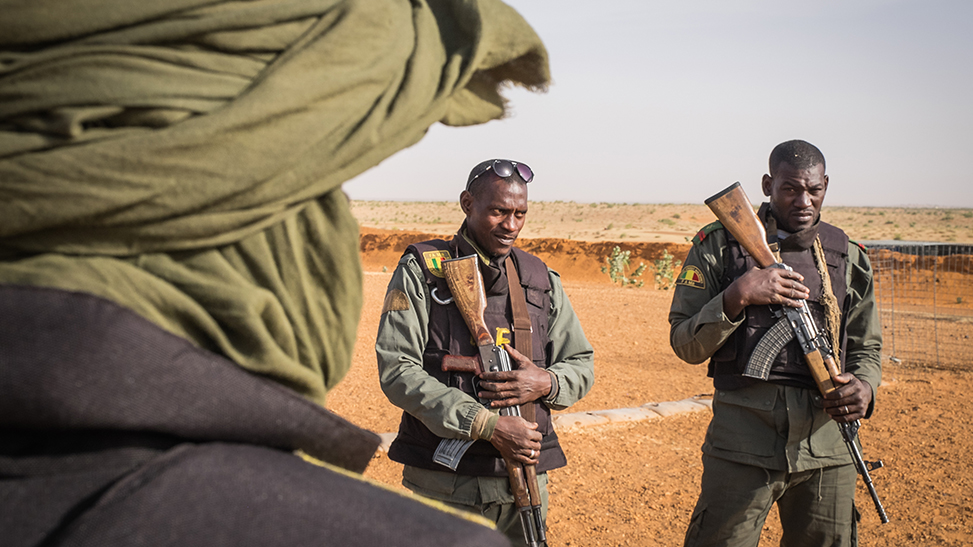

Daily a life of french soldiers of Barkhane military operation in Mali (Africa) launch against terrorism in the area.
Thankfully, both the number of deaths caused by terrorism around the globe as well as the number of terrorist attacks have been gradually trending downward since they peaked in 2015. However, the progress has been uneven. And in Africa, the trend has, sadly, been in the opposite direction.
The continent is in the grip of mounting violence, with the Sahel being the most affected region globally. According to the 2025 Global Terrorism Index, it accounted for over half of all deaths from terrorism and one-fifth of all attacks in the world. [1] And while the Sahel remains the epicenter of terrorist activity, the phenomenon has spread across Africa, with notable upticks in terrorist attacks recorded from Cameroon on the continent’s west to the Democratic Republic of the Congo (DRC) in Central Africa to Mozambique in the east.[2]
Overall, Africa has overtaken the Middle East as the region with the most deaths from terrorism. That condition, moreover, is expected to persist. Analysts now forecast that some 60-70 percent of terrorists attacks globally in 2026 will occur in African countries.[3]
The spiraling violence flies in the face of the other prevailing narrative about Africa, one that is no less true: that of an emerging region with significant economic gains powered by profound, long-term trends. Demographically, the continent is in the midst of a massive expansion, and by 2050 one in four workers in the world will be an African. Additionally, Africa has some of the world’s fastest-growing urbanization rates, which means lower basic infrastructure costs and concentrated consumer markets. It is also an emerging technology hub and market, with the rapid expansion of mobile telephony and internet usage growth rates five times global averages over the last decade.
These trends have set Africa on a path of sustained, and explosive, growth. In the decade leading up to the COVID-19 pandemic, seven of the twenty fastest-growing economies in the world were in Africa, including Ethiopia, Rwanda, Côte d’Ivoire, Tanzania, Djibouti, Ghana, and Guinea.[4] This year, six of the ten fastest-growing economies will be African: South Sudan, Guinea, Ethiopia, Rwanda, Libya, and Uganda.[5] Moreover, many African countries are either already benefiting from burgeoning global demand and, indeed, competition for access to the continent’s abundant natural resources or are poised to do so. This is so for good reason; Africa holds approximately 30 percent of the world’s known reserves of critical minerals, including approximately 90 percent of its chromium and platinum and more than 50 percent of its cobalt.
It is in the unresolved tension between the promise of being “the world’s next major economic success story,” as the Obama administration’s 2012 strategy for Sub-Saharan Africa described it, and the reality of surging jihadist violence, political instability, and geopolitical competition that Africa’s strategic landscape is being forged today.
Expanding Threats
Outbreaks of jihadist violence are certainly not new to Africa. Recall the early 19th century Fulani Jihad led by Usman dan Fodio, which resulted in the establishment of the Sokoto Caliphate in what is now Nigeria, or the eruption of violence in late 19th century Sudan that accompanied the rise of self-proclaimed Mahdi Muhammad Abdullah, famously played by Sir Laurence Olivier in the 1966 Academy Award winning film Khartoum. Still, these instances have hitherto been largely local or perhaps regional affairs. In contrast, the current century has seen a growing connection between terrorist violence on the continent and global movements and ideologies.
Twenty years ago, in the early days of the “War on Terrorism,” the magazine of al-Qaeda in Saudi Arabia ran a remarkably prescient article entitled “Al-Qaeda is Moving to Africa.” In it, the author wrote that the terrorist network and its members “appreciate the significance of the African region for the military campaigns against the Crusaders” and predicted that “this continent has not yet found its proper and expected role and the next stages of the conflict will see Africa as the battlefield.” [6] He went on to enumerate and evaluate what he saw as the significant advantages to shifting operations to Africa, including: jihadist doctrines having already spread throughout many African countries; the political and military weaknesses of African governments; the easy availability of a wide range of weapons; the geographical position of Africa vis-à-vis international trade routes; the proximity to old conflicts against “Jews and Crusaders” in the Middle East; the poverty of Africa, which “will enable the holy warriors to provide some finance and welfare”; the technical and scientific skills that potential African recruits would bring; the presence of large Muslim communities, including ones in conflict with Christians or other Muslims; the links to Europe through North Africa “which facilitates the move from there to carry out attacks”; and Africa’s wealth of natural resources.[7] All of this, of course, remains just as true today, if not even more so.
Nowadays, the direst terrorism challenge on the African continent lies in the Sahel. What started in late 2011 with the attempt by heavily armed ethnic Tuareg recruits, returning from the ruins of Muammar Gaddafi’s Libya, to carve out a separate homeland in northern Mali has metastasized into violence across the vast region linking the Maghreb with Sub-Saharan Africa. Over the last decade, it has spread into a complex conflict involving not only al-Qaeda in the Islamic Maghreb (AQIM), already a longtime presence in the region, but also two affiliates of ISIS, the Islamic State Greater Sahara (ISGS) and Islamic State West Africa Province (ISWAP).
This ferment has defied easy resolution. It drew in a 5,000-strong French counterterrorism force operating across the region until that detachment was unceremoniously ejected following a series of coups that began in 2020. A 15,000-strong United Nations peacekeeping mission in Mali that was deployed between 2012 and 2023, albeit to rather limited effect. The United States operated two airbases in Niger from which intelligence, surveillance, and reconnaissance (ISR) and other missions were staged until maladroit post-coup diplomacy by the Biden administration led the junta in Niamey to order their closure and the withdrawal of about 1,000 American military personnel in 2024.[8]
Despite these outside interventions, militant groups proved adept at capitalizing on the frailty of national governments and exploiting local grievances and ethnic tensions. Embedding themselves in local communities, especially marginalized ones, they carried out repeated attacks on both national and international forces, as well as civilian populations not under their sway. As the violence increased, the numbers of refugees and internally displaced persons (IDPs) expanded, sometimes with astonishing speed. In Burkina Faso, for example, the number if IDPs increased from just 87,000 in January 2019 to more than one million in December 2020, before leveling off at slightly more than 2 million by the end of 2023.[9] Nowadays, out of a population of roughly 24 million, roughly one in four Burkinabè require humanitarian assistance on account of insecurity, displacement, and lack of food.[10]
In Africa’s east, meanwhile, Somalia has long struggled with a different jihadi challenge. In that failed state, whose fortunes have waxed and waned, al-Qaeda affiliate al-Shabaab has successively seized and held shifting territories for two decades. There is also growing evidence that the Somali insurgent group has developed systemic cooperation with the Houthis in Yemen just across the Gulf of Aden, including arms transfers, training exchanges, and financial links.[11]Another, more recent phenomenon has been the expansion of Islamist terrorist groups into Central and Southern Africa.
In March 2021, building on work begun during the first Trump administration, the newly installed Biden administration added ISIS affiliates operating in the eastern DRC and Mozambique to the State Department’s list of foreign terrorist organizations.[12] Some Washington-based analysts initially derided the designations, but the pundits fell mostly silent once the seriousness of the threat was underscored less than a month later, when attacks by the Mozambican group forced French energy giant Total to evacuate its staff and suspend work on a $20 billion natural gas project in northern Mozambique. Fortunately, a timely intervention by a small, well-trained Rwandan force turned the tide against the jihadists, at least for the moment.
As I repeatedly emphasized during my service in the first Trump administration as the inaugural U.S. Special Envoy for the Sahel—at times, to the great annoyance of some of our European allies—the heart of the crisis in many of these situations is the question of state legitimacy: that is, whether or not citizens perceive that their government is accountable, equitable, able, and willing to meet their needs. Ineffectual foreign interventions by Western countries (to say nothing of more recent ones by Russia via state-aligned private military companies) have hardly contributed to reinforcing the already-rickety legitimacy of those regimes.
The inability of African governments, especially in the Sahel, to provide basic security for citizens—to say nothing of fostering economic opportunity and social development—has enabled armed groups, whether insurgents with a jihadist ideology or simply bandits with more pedestrian motivations, to seize control of significant swathes of rural territory. The two ISIS affiliates in the West Africa, ISGS and ISWAP, have been major beneficiaries of this dynamic, significantly expanding their territorial dominion over rural areas where government forces have been unable to control or unwilling to venture.
Meanwhile, in late 2025 and early 2026, the al-Qaeda-affiliated Jama’at Nusrat al-Islam wal-Muslimin (JNIM, “Support Group for Islam and Muslims”) effectively laid siege to landlocked Mali’s capital of Bamako by ambushing the convoys of truck that supply food and fuel to its four million residents. The situation became so dire that United Nations Secretary-General Antonio Guterres reported to the Security Council that it was “a moment of profound urgency” that risked precipitating “a domino effect” across West Africa.[13] In fact, in neighboring Burkina Faso, JNIM has increasingly demonstrated its ability to mobilize across vast expanses of the country, attacking towns and garrisons in the northern and eastern parts of the country in rapid succession throughout 2025 and into early 2026.[14]
Moreover, both al-Qaeda- and ISIS-affiliated groups in the Sahel have increasingly targeted countries on the West African coast like Benin, Côte d’Ivoire, and Togo—states that previously have been largely or even entirely unaffected by terrorist activity. Although the number of casualties to date has been mercifully small, in relative terms, the increasing frequency of such attacks is worrisome. In mid-2025, for example, Togo’s foreign minister confirmed that his country, which borders Burkina Faso, had suffered fifteen cross-border attacks by JNIM during the first half of the year, resulting in the deaths of at least fifty-four civilians and eight soldiers.[15]
Similarly, even as the so-called Islamic State has lost ground in the Levant, groups that have aligned themselves to it have proliferated in Africa. In 2025, approximately two-thirds of ISIS’s global activity was recorded on the African continent.[16] This has happened not only in places like the Sahel or Somalia, where Islamist terrorist groups have found haven amid ungoverned geographies and Muslim populations, but more recently in places like the eastern Democratic Republic of the Congo or northern Mozambique, where ongoing conflict (or at least the weakness of government authority) creates a permissive environment. These new affiliates operate with greater operational autonomy since, with the loss of its so-called caliphate, ISIS has been forced to shift to a less hierarchical structure and adopt the equivalent of a “remote management model” in order to survive, Affiliates have thus developed their own “war economies” financially independent of central leadership, even as the latter’s ideology remains easily accessible online, and capable of radicalizing individuals across borders.
Defining American Interests
The most recent edition of the National Security Strategy of the United States of America, released in November 2025, charts a fairly limited approach to Africa. Discussion of the continent is limited to three short paragraphs, focused on partnering with select countries “to ameliorate conflict, foster mutually beneficial trade relationships, and transition from a foreign aid paradigm to an investment and growth paradigm capable of harnessing Africa’s abundant natural resources and latent economic potential,” while remaining guarded against “resurgent Islamist terrorist activity in parts of Africa while avoiding any long-term American presence or commitments.”[17] Similarly, the January 2026 National Defense Strategy mentions Africa only twice, stating that the Department of War’s priority on the continent “is to prevent Islamic terrorists from using regional safe havens to strike the U.S. Homeland” and that otherwise it would “seek to empower allies and partners to lead efforts to degrade and destroy other terrorist organizations.”[18]
To these objectives, one could add President Donald J. Trump’s public commitment to help Christians facing violence, persecution, or other abuses in Africa, especially Nigeria, which the Administration once again designated a “country of particular concern” for international religious freedom after the Biden-era State Department removed it from the list over the protests of the Congressionally-established bipartisan U.S. Commission on International Religious Freedom.[19] The Administration’s attention is apt. One well-regarded advocacy group for persecuted Christians, Open Doors, documented 4,849 Christians killed for their faith worldwide in the year covered by its most recent annual report, of whom 4,491 were in Africa, including 3,490 in Nigeria alone.[20]
Even setting aside the issue of persecution, attacks by jihadist groups in Africa against Christians have been on the rise, including in areas like the eastern Congo and Mozambique, where such terrorist targeting is a relatively new phenomenon. In late July 2025, for example, militants from the ironically named Allied Democratic Forces (ADF), an ISIS-linked group, attacked a Roman Catholic parish in the Congo’s Ituri province during a night vigil at the church, killing dozens.[21] A few months later, the jihadists massacred twenty more people, most of them bedridden patients, at a hospital run by Catholic nuns in neighboring North Kivu province.[22] As these assaults multiply, a reaction from American Christians will probably elevate the concern, as it has for Nigerian Christians.
However, even as the Administration charts a restrained course on Africa, its forward-leaning approach to reshaping the global market for critical minerals, including both rare earths and strategic bulk metals, necessitates a wider aperture on the African continent and its resource wealth. Seven African countries participated in the inaugural Critical Minerals Ministerial hosted by the Department of State in February 2026. While most the discussions at that conference focused on building partnerships to enable access to resources and preventing the weaponization of supply chains by a rival power such as China, the focus is imperative for another reason as well; as that al-Qaeda magazine writer recognized two decades ago, these raw materials could also prove “very useful for the holy warriors in the intermediate and long term.”[23]
To cite one example, the United States is entirely dependent on imports for tantalum, a metal used for superalloys in aerospace and other defense applications as well as in high-performance capacitators in advanced electronics. Not only is the DRC the world’s top producer of tantalum, which is mainly derived from coltan, accounting for nearly half of global output, but almost all of that mining occurs in areas where terrorist groups, both jihadist and other, are active.[24] In fact, the Congolese government recently designated the Rubaya coltan mine its eastern North Kivu province, one of the richest tantalum deposits in the world, as a “strategic asset reserve” offered preferentially to the United States under the bilateral mineral cooperation agreement between the two countries.[25]
Similarly, America, via the Export-Import Bank of the United States, has recommitted nearly $5 billion for an integrated liquified natural gas project developed by TotalEnergies in northern Mozambique. [26] The loan package to support the export of goods and services from almost seventy American companies in fourteen states was originally approved during the first Trump administration. But work on the $20 billion total investment in the northern Cabo Delgado region was halted in 2021 due to attacks by Islamist insurgents, who were only subsequently pushed back when Rwandan forces intervened at the invitation of the Mozambican authorities.[27]
In other words, counterterrorism in Africa is shaping up to be not only a question of American security, but also of its economic interests.
Striking A Balance
By the sheer number of attacks and their lethality, the African continent has clearly emerged as the global epicenter of the terrorist phenomenon in general and the jihadist variety in particular. True, the nature of the threat is markedly different than a decade ago, when militants imbued with ISIS’s apocalyptic ideology flocked from around the globe to borderlands of Syria and Iraq. Nevertheless, there are plenty of potential recruits among Africa’s abundant economically struggling and socio-politically marginalized youth for today’s militancy to flourish.
The second Trump administration’s apparent view that American interests in Africa are limited is in some measure understandable. After all, the White House has made clear that direct counterterrorism action will only be taken against those terrorists “who are both capable of and intent on striking the U.S. Homeland.” It has also emphasized the need to simultaneously empower “allies and partners to lead efforts to degrade and destroy other terrorist organization.”
Yet such a more limited approach risks an over-correction that fails to account for the broader national interests in supporting and securing African allies: preserving access to their strategic resources, many of which not only play critical roles in defense and other advanced technological applications, but whose supply chains are presently dominated by China and other rivals. Striking a better balance is essential.
-
[1] Institute for Economics and Peace, Global Terrorism Index 2025, March 2025, https://www.visionofhumanity.org/maps/global-terrorism-index/#:~:text=•%20Islamic%20State%20(IS)%20expands,where%20attacks%20doubled%20to%2067.
[2] Ibid.
[3] Rohan Gunaratna, “Global Terrorism Forecast 2026,” RSIS Commentary, January 5, 2026, https://rsis.edu.sg/rsis-publication/rsis/global-terrorism-forecast-2026/.
[4] Jason Mitchell, “IMF: African Economies are the World’s Fastest Growing,” fDi Intelligence, October 17, 2019.
[5] International Monetary Fund, World Economic Outlook Update, January 19, 2026, https://www.fdiintelligence.com/content/91345bb0-ce36-563a-9297-ce34b29b44ab.
[6] See J. Peter Pham, “Next Front? Evolving United States-African Strategic Relations in the ‘War on Terrorism’ and Beyond,” Comparative Strategy 26, 2007, 39-54.
[7] Ibid.
[8] Eric Schmitt, “U.S. Military to Withdraw Troops from Niger,” New York Times, April 19. 2024, https://www.nytimes.com/2024/04/19/us/politics/us-niger-military-withdrawal.html.
[9] United Nations Office for the Coordination of Humanitarian Affairs (OCHA), “Burkina Faso Situation Report,” February 2021, https://reliefweb.int/report/burkina-faso/burkina-faso-situation-report-1-feb-2021.
[10] UNICEF, “Burkina Faso Situation Report No. 4 (End of Year), January-December 2025,” February 18, 2026, https://reliefweb.int/report/burkina-faso/unicef-burkina-faso-humanitarian-situation-report-no-4-end-year-jan-dec-2025.
[11] Faisal Ali, “Al-Shabaab and Houthis Deepen Red Sea Alliance as Gulf Rivalries Intensify,” The Africa Report, February 17, 2026, https://www.theafricareport.com/409130/al-shabaab-and-houthis-deepen-red-sea-alliance-as-gulf-rivalries-intensify/.
[12] U.S. Department of State, “State Department Terrorist Designations of ISIS Affiliates and Leaders in the Democratic Republic of the Congo and Mozambique,” March 10, 2021, https://2021-2025.state.gov/state-department-terrorist-designations-of-isis-affiliates-and-leaders-in-the-democratic-republic-of-the-congo-and-mozambique/?safe=1.
[13] United Nations, “Secretary-General’s Remarks to the Security Council on Enhancing Regional Counterterrorism Cooperation in West Africa and the Sahel,” November 18, 2025, https://www.un.org/sg/en/content/sg/statements/2025-11-18/secretary-generals-remarks-the-security-council-enhancing-regional-counter-terrorism-cooperation-west-africa-and-the-sahel.
[14] Jessica Donati and Anait Miridzanian, “Islamist Militants Show ‘Unprecedented Coordination’ in Burkina Faso Attacks,” Reuters, February 19, 2026, https://www.reuters.com/world/africa/islamist-militants-show-unprecedented-coordination-burkina-faso-attacks-2026-02-19/.
[15] “Togo Confirms At Least 60 Killed in Al-Qaeda-linked Attacks,” Africa News, July 30, 2025, https://www.africanews.com/2025/07/30/togo-confirms-over-60-killed-in-al-qaeda-linked-attacks/.
[16] ACLED, “The Islamic State’s Pivot to Africa,” September 4, 2025, https://acleddata.com/qa/qa-islamic-states-pivot-africa.
[17] White House, National Security Strategy of the United States of America, November 2025, https://www.whitehouse.gov/wp-content/uploads/2025/12/2025-National-Security-Strategy.pdf.
[18] Department of War, 2026 NDS: National Defense Strategy, January 2026, 17, https://media.defense.gov/2026/Jan/23/2003864773/-1/-1/0/2026-NATIONAL-DEFENSE-STRATEGY.PDF
[19] U.S. Commission on International Religious Freedom, “USCIRF Appalled at Administration’s Removal of Nigeria from List of Violators of Religious Freedom,” November 17, 2021, https://www.uscirf.gov/news-room/releases-statements/uscirf-appalled-administrations-removal-nigeria-list-violators.
[20] Open Doors, “World Watch List 2026,” n.d., https://www.opendoors.org/en-US/persecution/countries/.
[21] “Scores Killed in DR Congo Attack on Catholic Church,” Vatican News, July 28, 2025, https://www.vaticannews.va/en/world/news/2025-07/drc-attack-catholic-church-islamist-extremists.html.
[22] “DR Congo: Terrorists Kill Civilians in Church-run Hospital in North Kivu,” Vatican News, November 16, 2025, https://www.vaticannews.va/en/church/news/2025-11/drc-kivu-massacre-north-kivu-sisters-hospital.html.
[23] J. Peter Pham, “Next Front? Evolving United States-African Strategic Relations in the ‘War on Terrorism’ and Beyond.”
[24] U.S. Department of the Treasury, “Treasury Department Designates Militant Groups in the DRC,” January 3, 2013, https://home.treasury.gov/news/press-releases/tg1815.
[25] Ange Adiho Kasongo and Maxwell Akalaare Adombila, “Congo Offers Tantalum Deposit under M23 Control to U.S. in Minerals Pact, Document Shows,” Reuters, February 18, 2026, https://www.reuters.com/world/africa/congo-offers-tantalum-deposit-under-m23-control-us-minerals-pact-document-shows-2026-02-18/.
[26] Export-Import Bank of the United States, “EXIM Board of Directors Votes to Proceed with $4.7 Billion LNG Equipment and Services Transaction After Four-Year Delay,” March 19, 2025, https://www.exim.gov/news/exim-board-directors-votes-proceed-47-billion-lng-equipment-and-services-transaction-after.
[27] Borges Nhamirre, “Are Rwandan Troops Becoming Cabo Delgado’s Main Security Provider?,” ISS Today, September 26, 2024, https://issafrica.org/iss-today/are-rwandan-troops-becoming-cabo-delgado-s-main-security-provider.