

THE NEW COUNTERTERRORISM TERRAIN
The “War of Ideas” to Come
Alberto M. Fernandez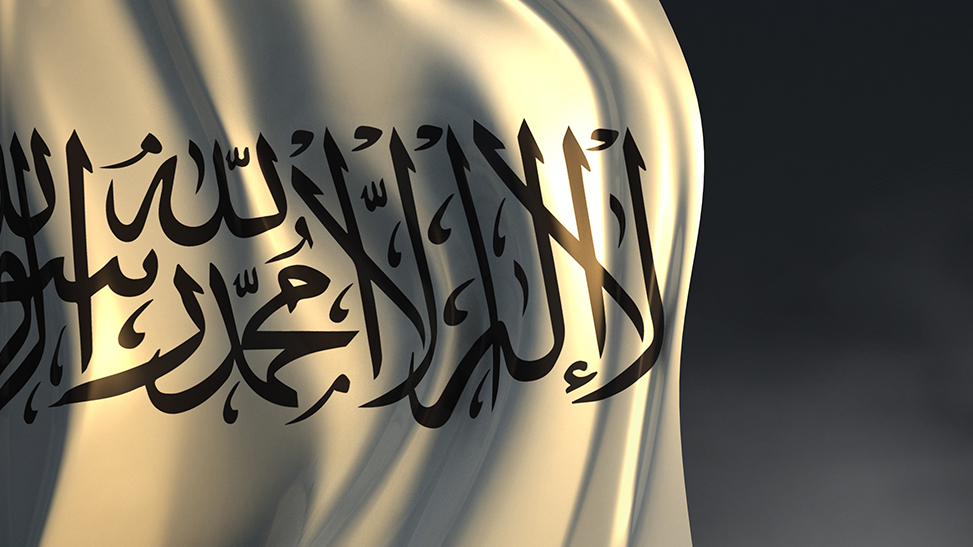

Taliban flag with dark background.
To a great extent, we rely on learned experience. That can be as true for nation states as it is for individuals. That is why, when conflict comes, states often find themselves succumbing to the temptation of “fighting the last war.” The questions of fighting the last war, and of anticipating the next one, are salient when it comes to the what was once called the Global War on Terrorism (GWOT) – the George W. Bush-era shorthand for the war fought by the United States and its allies against global Salafi-jihadism, most prominently al-Qaeda and its offspring, the Islamic State (ISIS).
September 2026 will mark a quarter-century since the terrible attacks of September 11, 2001, not to mention almost forty years since the founding of al-Qaeda and nearly a century since the founding of the Muslim Brotherhood. As such, it is an appropriate time not only to take stock of the past but also to look ahead, at the “war of ideas” to come in the Middle East.
The Recent State Of Play
In terms of concrete results against Salafi-jihadists in the Middle East, the overall record is positive. The past two decades have seen the decimation of most of the leadership of both of the world’s most notorious jihadist actors, al-Qaeda and the Islamic State. And after a brief, brutal rule, the latter’s self-declared caliphate in eastern Syria and western Iraq was demolished by the United States in concert with local allies on the ground. Over the past decades, jihadists also lost ground in Tunisia, Libya, Egypt, Saudi Arabia and Yemen.
Political Islam likewise took a beating in several countries in the region, many of them through a surprising dynamic: victory at the ballot box, but failure in governance. Indeed, across the region, Islamist political parties faltered after experiencing difficulties in actually ruling. In places like Egypt, Tunisia and Morocco, Islamists were in power – and then they were not.
Turkey under the Justice and Development Party (AKP) took a different course. Under the guidance of Recep Tayyip Erdogan, it became a beacon for Arabic-language Islamist propaganda aimed at overthrowing regimes in Egypt and elsewhere.[1] But over time, pressure built on it to reverse course. The propaganda offensive from Istanbul diminished or was shut down, as Islamist Turkey decided that improving relations with onetime adversaries in Cairo, Abu Dhabi and Riyadh was more important than being seen as openly promoting Islamist revolutionary subversion.
Meanwhile, military defeat, technical advances and social media censorship and policing greatly diminished the presence and scope of jihadist propaganda on major Western platforms. Jihad as an idea was never defeated, though. It was merely expunged from social media. The heyday of 2013-2014, when Islamic State “media knights” had tens of thousands of followers on Twitter and Facebook and daily posted the group’s latest snuff videos, are long gone. The old incendiary content still exists, including troves of the group’s “greatest hits” on the dark web. But it is harder for ordinary people, for casual or curious bystanders, to access easily. Those that do find it, even in the West, can still be radicalized by content depicting a ten-year-old reality which no longer exists.
But while American allies in the region did and still do engage in the propaganda war against Salafi-jihadism, one cannot say that it was a full-blown “war of ideas.” It was more tactical, opportunistic immediate propaganda than strategic messaging – that jihadist terror killed mostly Muslims, that it was counterproductive, and that it defamed all Muslims in the eyes of the world. It was more about reacting to the latest event and blunting the immediate appeal of the adversary than presenting a full-fledged political, ideological or religious alternative, something the West can’t do and most Muslim states really won’t.
Thus Salafi-jihadism was hurt in the public sphere in the Middle East mostly because it lost on the battlefield. It is hard to claim the mandate of heaven when you progressively lose not only Mosul and Raqqa, but the entirety of your statelet. So, while insurgent action by ISIS in the Middle East continues and even spikes, including in Syria and Iraq, it has been difficult for the group so far to match the panoply of spectacular acts from twelve years ago. Yet, although diminished, the Islamic State still seeks to make the big statement – and it occasionally succeeds in doing so, as in Iran (Kerman, January 2024), Russia (Crocus City Hall, March 2024) and Australia (Bondi Beach, December 2025). And globally, we see jihadist terror everywhere, but the most rapid growth is limited to some specific areas, particularly the African Sahel.
The authoritative IEP Global Terrorism Index for 2025 graphically illustrated the shift.[2] Of the ten countries most affected by terrorism, six were African (Burkina Faso, Mali, Niger, Nigeria, Somalia and Cameroon). Two were the traditional hotspots of Pakistan and Afghanistan. Only two were in the traditional Middle East: Syria and Israel. Syria is, of course, undergoing a major transformation, and the extremist terror against Israel is Palestinian terror, a brand going back many decades and, while often religiously based, one that also has deep nationalist “national liberation” roots grounded in the rhetoric of anti-colonial and anti-imperialist struggle.
Indeed, despite the ongoing war between Israel and its adversaries, 2024 actually saw a 7% reduction in terrorist attacks in the Middle East.[3] In terms of sheer carnage, of course, nothing in recent years has matched the terror campaign carried out by Hamas on October 7, 2023. That attack, and the war it touched off, has certainly caused turmoil in the Middle East. But its more lasting political impact will probably be in the West, among Americans and Europeans, rather than among Middle Easterners.
In the Middle East, positions for or against Israel are pretty well set, the fissures within societies and policy stances of regimes well known. The fact that the Gaza War was quickly subsumed into a larger conflict between Israel, Iran and Iran’s proxies in Lebanon, Yemen, Syria, Iraq and elsewhere fed into pre-existing concerns among the region’s majority Sunni Muslim population about Iranian and Shi’a ambitions in the region. This is an issue of greater concern among many Arab Muslims than it is to the average American or European rioting for Gaza on their university campus.
This is not to say that Israel or Palestinian nationalism aren’t issues in the Middle East – they certainly are. But they are nothing new, and regional governments have dealt with them for decades. While “Free Palestine” revolutionary activists in the West, with the zeal of converts, immediately denounced the October 2025 “Trump Plan” on Gaza, the same proposal was accepted by the governments in Egypt, Jordan, the United Arab Emirates, Saudi Arabia, Pakistan, Indonesia and even Hamas-supporting Turkey and Qatar.
The Shape Of Things To Come
These and other developments (such as the fall of the Assad regime in Syria and the current travails of Iran’s proxy network) have led the United States to “right-size” the Middle East in its strategic planning. The Trump administration’s new National Security Strategy, released in December of 2025, underscores this shift.[4] Its first mention of the Middle East is not in the context of extremism or terrorism, but with regard to preventing “an adversarial power from dominating the Middle East, its oil and gas supplies, and the chokepoints through which they pass while avoiding the ‘forever wars’ that bogged us down in that region at great cost.”
The Trump NSS does a good job outlining the challenges of a changing world and how America will address them. The emphasis on hemispheric security (the so-called “Trump Corollary” to the Monroe Doctrine) and the Indo-Pacific (in other words, China) mean that the broader Middle East will necessarily be downgraded. In American eyes, the region will not be unimportant, of course. But the document makes clear that it will not be a place where the United States is prepared to wage a “war of ideas” with a retrograde or reactionary Islam.
But if Washington isn’t, then who is? Despite the perception of perpetual turmoil, the Middle East – particularly the Arab Middle East – remains the same region with the same problems that it had when it gave birth to the Muslim Brotherhood, to the rise of al-Qaeda and the Islamic State, and to the development of the Velayat e-Faqih in Iran. The political and socio-economic “building blocks” that created that extremist world are still in place – authoritarianism, poor governance, persistent youth unemployment (historically, the highest in the world as a region), disinformation and incitement (including by regimes), and the weaponization of Islam as a tool (including by authoritarian regimes themselves).
But while much in the region remains the same, the world – the global landscape – is changing in ways that we do not yet fully understand. You might call them the Four Horsemen of the New Apocalypse, beginning in the West and spreading uncertainly elsewhere:
- The burgeoning technological revolution, from artificial intelligence (AI) to robotics and beyond, which is accelerating and promises to radically up-end, if not entirely eliminate, the contemporary workplace within a decade.
- The remorseless rise of global public debt, which – while also threatening developing countries – represents a massive economic threat to the West, including the United States, France, Italy and the United Kingdom. Runaway public debt is also a risk factor in regional states like Egypt, Jordan, Lebanon and Tunisia.
- Connected to both tech and economics, an unprecedented social revolution is also unfolding before us: the so-called “birth dearth” which has hit the West and East Asia particularly hard, but which represents a global phenomenon.
- At the same time, a political revolution is unfolding as well, as the old Western confidence about the triumph of liberal democracy and free market capitalism seems increasingly irrelevant in the face of rising populist anger from both the political right and left.
How and if these trends will affect the Middle East and the region’s ideological discourse is not yet known. In some of these trends, the region is an outlier – for instance, the Middle East birth dearth is predicted to come later than it did in the West, while liberal democracy never really took hold and has long been discredited (something that both authoritarian regimes and Islamist revolutionaries can agree upon). Arab populations are still considerably younger than those in the West. Looming Western problems like “elite overproduction” and imploding governance leading to extreme inequality hit the Arab Middle East long ago. They are, in a sense, a political bomb which has already exploded but the lasting effects of which are still being felt.
Yet despite the uncertainty about the impact of broader global trends, we can nevertheless trace the future Middle East ideological battlefield with some clarity, based on certain given realities.
The Middle East’s authoritarian regimes will remain more or less the same. There is simply no liberal, western-style democratic alternative ready-made and waiting in the wings. Existing regimes will do all they can to survive and, depending on changing circumstances, either fight Islamism or use elements of it to bolster their hold on power. The Egypt of Abdel Fatah al-Sisi, where the Muslim Brotherhood is demonized and persecuted while Salafism flourishes, is one model. An older example would be the Jaafar al-Nimeiry regime in Sudan (1969-1985), which began as a nationalist/leftist regime and ended as an Islamist one. Indeed, an appeal to Islam, to the legitimizing power of posing as authentic guardians of the faith, is a tool that almost all Arab Muslim regimes will utilize if circumstances warrant.
With the exception of non-Muslim Israel, every regime stretching from Morocco to Pakistan is authoritarian. Some are freer than others; they may have more press freedom or allow opposition parties, and those parties may sometimes even win local elections. But at bottom, these regimes are more alike than they are dissimilar. Most survived intact the upheaval of the Arab Spring, and those that did not and actually fell (Tunisia, Libya and Egypt among them) were in relatively short order replaced by other authoritarian regimes. There is no future guarantee that the current regimes will survive intact, but the idea that they will radically change into something very different in terms of governance is unlikely.
That is not to say that the nature or style of the authoritarianism itself won’t change. It certainly can. One can say that the authoritarianism of dictator Ali Abdullah Saleh was “less bad” than the Houthi rule we see today in Yemen, or that the authoritarianism of Ahmed al-Sharaa in Syria today might turn out to be a considerable improvement over the rule of the Assad regime. We will need to wait and see.
Political or Salafi-jihadist Islam will remain the default language of revolution. Islam as the voice of rebellion, as the call of the oppressed and poor, will remain a powerful weapon. Since existing states also know this, they will seek to misdirect and appropriate it for the sake of regime survival. This leads to a kind of political one-upsmanship by both regimes and rebels, where each seeks to outdo the other and prove the authenticity of their political-religious bona fides. This is why many ostensibly anti-Islamist authoritarian regimes, like Egypt, will zealously police public morality; it is a way to show that they are “enjoining good and forbidding wrong,” as the Qur’an commands.
Such a reality also means that well-intentioned attempts at “reforming” Islam by watering down what to Westerners are radical or extreme elements are bound to be difficult – albeit not impossible. Indeed, there is a long record of attempts at internal reform by Muslims throughout Islamic history. Islam is no monolith, although to outsiders it may seem that way. The 20th century saw reformers like Muhammad Abdu, Rashid Ridah, and Mahmud Muhammad Taha (Taha was killed as an apostate for his reform efforts).[5] But the concept of Islamic reformers doesn’t only mean “liberals.” One can make the case that extremists like Muhammad Abdul Wahhab and Sayyid Qutb also represented a type of reformer, seeking to reform the status quo and move the religion toward a more rigorous, militant direction.
Efforts at religious reform often came from above, from authoritarians in power, such as Ataturk in Turkey, Amanullah II in Afghanistan, or Habib Bourgouiba in Tunisia. The subsequent Islamic history of all three countries shows that their reform efforts didn’t stick. In our era, we have seen more recent efforts at reform from above by the UAE (the “Abrahamic Family House” and the 2019 Abu Dhabi Declaration) and by Saudi Arabia under Crown Prince Muhammad Bin Salman.
The rise of Islamism and sectarian conflict in the West will be a wild card. High levels of migration, conversion, economic crisis, and political realignment in Europe and North America could ignite levels of societal conflict in the West not seen for more than fifty years. The result could be a violent iteration of today’s so-called Red-Green Alliance of migrants, Islamists and leftists pitted against local nativist nationalists. In turn, the rise of Western Islamism could lead to new levels of cross-fertilization, as these “Westernized” forms of Islamism head back to the Middle East. UAE Foreign Minister Abdullah Bin Zayed’s famous 2017 warning that in the future there would be more radical extremists and terrorists coming out of Europe than from the Middle East will not only turn out to be true, but will not even be the whole story.[6] The subversion and infiltration that authoritarian Middle East regimes won’t allow the Muslim Brotherhood to do back home, the organization and its proxies and fronts will do in the West – even if it is banned in Europe and North America.
Westernized Islamism could include new variations repackaged for Middle Eastern audiences primed for change. In 2025, for example, we have already seen a raft of so-called “Islamotubers” preaching a Western-oriented type of Salafism in Western languages to European audiences.[7] Information and ideological flows will move in both directions. And it won’t be hard to do so, since over 70% of people in the Arab World are internet users, while in the Gulf that figure is 99%.[8]
As far as the West is concerned, the “Islamic Moment” is only just arriving, and it will have far-reaching ramifications that we cannot yet foresee. Current migration patterns alone, particularly in some European countries, will lead to the growth of Muslim political clout in the West, and become an inevitably destabilizing feature. Some Christian scholars believe that the West, however you define it, can only survive if it has a dominant spiritual core moving forward. And they believe that there are only two real candidates for such an organizing principle – either the revival of Western Christianity or the rise of Islam in the West.[9]
The emergence of a somewhat “domesticated” model of Islamist governance seems likely. This is even more likely if HTS-ruled Syria “succeeds” with the help of Islamist Turkey and Qatar, while Afghanistan under the Taliban remains more or less intact. A third example of this model could emerge in the near future in Africa, where the al-Qaeda aligned JNIM (Jama’at Nusrat ul-Islam wa al-Muslimin) may succeed in establishing its own state in the Sahel and seems to be willing to politically distance itself from its extremist connection.
At the same time, ideological regimes have their own set lifespan. They run down and are discredited over time. If the rise of new-style Sunni Islamist regimes might attract new followers in the future, others may wane in popularity. For instance, the Shi’a Islamist regime in Iran, now almost fifty years in power, looks ideologically spent even if its coercive powers could keep it in place for years to come.
Western (i.e., American) counterterrorism will focus on kinetic strikes against jihadists and transactional engagement with willing Islamist interlocutors. The Trump administration, either by design or by chance, has hit on the minimalist sweet spot of counterterrorism. There are those in the Islamist constellation who will have to be killed, and others who will necessitate engagement. Post-Assad Syria provides one template in this regard. Transactional diplomacy based on perceptions of national interests, not ideology, will be the order of the day.
A third pillar, not directed principally at the Middle East but at home, should be law enforcement and bureaucratic action aimed at dismantling subversive Muslim Brotherhood-aligned support networks in the West, including non-governmental organizations, media outlets and businesses. This is an urgent need, especially in Western Europe. But it is not at all clear, despite recent encouraging pronouncements by the current Administration,[10] that Western countries have both the political will and the long-term patience to implement such measures.
Whose War, And Whose Ideas?
With the United States firmly set on disengagement from the region, Europe supine and authoritarian Middle Eastern regimes still seemingly firmly in charge, one might think that a war of ideas will be irrelevant. Not at all. The intellectual and ideological ferment of a faith held by more than two billion souls will continue. But the role of Western states, as states or as propagandists or influencers, will be marginal at best. There are many Islamists working hard to bring about the fulfillment of their agendas in both east and west, but they don’t all agree as to the best way to do so.
In Syria, the ruling Islamist government finds itself fighting its one-time masters turned bitter rivals in the Islamic State. In the African Sahel, al-Qaeda and the Islamic State fight each other. Sunni Islamists oppose Shi’a Islamists, except when they don’t, as Iran’s support for al-Qaeda’s leadership (still based in Iran) and Sunni Islamists in Gaza amply demonstrates. Some Islamists and jihadists seek to follow or restore the well-worn paths of the Muslim Brotherhood or al-Qaeda or the Islamic State and some, like the influential Qatar-backed Libyan radical Ali al-Sallabi, seek to come up with a powerful new synthesis in order to gain power.
The most effective thing the West can do in this struggle has nothing to do with Arabs or with Islam. Rather, it is to put its own ideological and intellectual house in order. Today, it is hard to say what the West actually stands for or believes in. Liberal internationalism seems ragged and exhausted. America seems more self-assured than Europe and Canada, but that is only a matter of degree. Where is the “civilizational self-confidence and Western identity” that the 2025 Trump National Security Strategy refers to?
These are hard questions. In an era of accelerating technological and economic change, what precisely do we stand for? Public diplomacy tools and strategies are mostly useless if they are not at least tenuously connected to an attractive and compelling core narrative nested in reality. The authenticity and genuineness of the real world will still matter in an age of digital trickery.
Going forward, whoever can convincingly model that sincerity and conviction – whether jihadist, communist or fascist – will hold a powerful weapon in a world where the fake seems to dominate. There will be the world of the distracted and the world of those searching for meaning, and this will be the new war of ideas. And in this culture clash, all too often we focus on the latest shiny new propaganda tool while missing that we lack a real message. Quite simply, we have nothing meaningful to say at the moment.
That is a fatal shortcoming. You can’t fight for something or defend yourself if you stand for or believe in nothing. Much of the West seems to have lost confidence in itself, and most of its old symbols have been hollowed out by those who should have defended them. At the end of the day, a flourishing West is the most powerful tool we can have at our disposal in the war of ideas to come.
Ambassador Alberto M. Fernandez is Vice President of the Middle East Media Research Institute (MEMRI) and a retired career Senior Foreign Service Officer. He was also President of Middle East Broadcasting Networks (MBN), the US Government-funded Arabic language media corporation, from 2017 to 2020.
-
[1] Alberto M. Fernandez, “The Arabic Propaganda War From Istanbul,” MEMRI, July 17, 2020, https://www.memri.org/reports/arabic-propaganda-war-istanbul.
[2] Institute for Economics and Peace, “Global Terrorism Index 2025,” 2025, https://www.economicsandpeace.org/wp-content/uploads/2025/03/Global-Terrorism-Index-2025.pdf.
[3] Ibid.
[4] The White House, National Security Strategy of the United States of America, November 2025, https://www.whitehouse.gov/wp-content/uploads/2025/12/2025-National-Security-Strategy.pdf.
[5] George Packer, “The Moderate Martyr,” New Yorker, September 4, 2006, https://www.newyorker.com/magazine/2006/09/11/the-moderate-martyr.
[6] Sapir Benjamin and Daniel Edelson, “Arab leader’s prescient warning gains renewed attention amid US campus turmoil,” Yediot Ahronot, April 29, 2024, https://www.ynetnews.com/article/hy5dtth11r.
[7] Alberto M. Fernandez, “Objective Al-Andalus: The ‘Islamotuber’ Campaign in Spain,” MEMRI, December 9, 2025, https://www.memri.org/reports/objective-al-andalus-islamotuber-campaign-spain.
[8] Arun Shankar, “Internet penetration reaches 70% in the Arab world finds Orient Planet Research,” Intelligent CIO, April 19, 2025, https://www.intelligentcio.com/me/2025/04/19/internet-penetration-reaches-70-in-the-arab-world-finds-orient-planet-research/.
[9] “The West’s Ideological Future: Islam, Christianity, and Wokeism,” Jerusalem and Athens, September 23, 2024, https://jerusalemandathens.com/2024/09/23/the-wests-ideological-future-islam-christianity-and-wokism/.
[10] Jeff Breinholt, “The Muslim Brotherhood and the Limits of Terrorist Designations,” War on the Rocks, December 23, 2025, https://warontherocks.com/2025/12/the-muslim-brotherhood-and-the-limits-of-terrorist-designations/.