

GLOBAL VIEW
BELGRADEAmerica’s Oldest Balkan Friend Is Also Its Most Valuable
Marko Djuric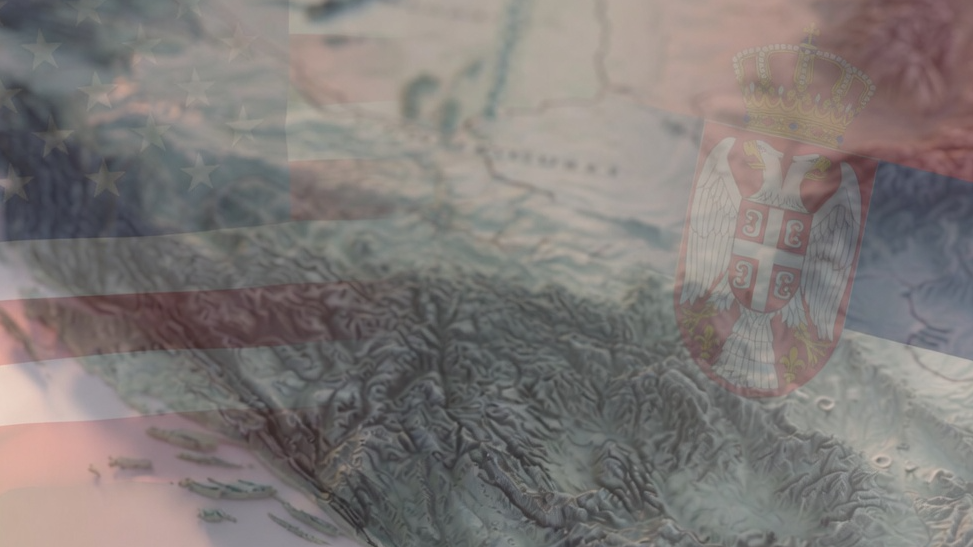

The flags of the US and Serbia overlayed over a mountain range.
There is a tendency in Washington foreign policy circles to treat the Balkans as a problem to be managed, rather than an asset to be cultivated. This is a strategic mistake, and one that grows more costly by the day.
The Western Balkans sit at the crossroads of Europe, bridging NATO’s eastern and southern flanks, threaded through by energy corridors, migration routes, and supply chains that matter to the entire transatlantic community. Stability here is not a regional nicety. It is a prerequisite for European security. But when attention drifts elsewhere, that stability comes under strain.
In Bosnia, efforts to centralize political authority well beyond what the 1995 Dayton Peace Accords envisioned have fueled dangerous tensions. It is worth remembering what Dayton actually was: the agreement that stopped a war. Its carefully balanced architecture, imperfect as any compromise must be, is not a relic to be discarded, but a foundation to be respected. Attempts to override it risk reopening wounds that took a generation to close.
In Kosovo, the situation remains unresolved in ways that demand honesty rather than diplomatic euphemism. Kosovo’s unilateral declaration of independence in 2008 remains unrecognized by more than half the world’s countries, including five EU member states. Serbia cannot and will not recognize that declaration. This is not intransigence on our part; it is a position grounded both in international law and in the sovereignty of our state. At the same time, however, Belgrade seeks normalized relations with the authorities in Pristina. We want functional coexistence. And we want people on both sides to live better lives.
For nearly a decade, Serbian President Aleksandar Vučić and Albanian Prime Minister Edi Rama have led the most consequential reconciliation process in history between Serbs and Albanians. Two neighbors whose relationship has been defined for too long by rivalry and mistrust are now choosing dialogue over hostility. Their partnership recently culminated in a joint op-ed in the Frankfurter Allgemeine Zeitung arguing that the EU should admit Serbia, Albania, and the rest of the Western Balkans without the veto mechanisms that too often have paralyzed the continent’s decision-making.
It was a bold proposal, and one that was attacked by political opponents on both sides. That was predictable. Leaders who take risks for peace rarely receive thanks in the short term. History, on the other hand, tends to be more generous.
For Serbia, EU membership remains a strategic objective. Progress, however, has stalled, although not primarily because of rule of law deficiencies, as Serbia’s detractors claim. When Romania and Bulgaria joined the EU, they did so under standards the Western Balkans have long since surpassed in many measurable respects. The bar has been raised, selectively and significantly, for our region. The EU’s own internal divisions and enlargement fatigue are the primary impediments to Serbia’s accession. We know this, and we are patient. But we will not pretend that the obstacle is entirely on our side.
In the meantime, Serbia is not standing still. Non-membership means flexibility, and we are using it. Serbia offers American companies something increasingly rare in Europe: a friend-shoring destination with deep transatlantic ties, a highly skilled workforce, and a regulatory environment that is business-friendly without the red tape that has accumulated over decades inside the EU. The results speak for themselves. Our technology sector now accounts for nearly 10% of national GDP, among the highest ratios in all of Europe, and it is growing fast.
But Serbia’s independence of action is not just an economic advantage. It is a moral one as well. Nowhere is this clearer than in our relationship with Israel.
On the evening of October 8, 2023, the day after the worst massacre of Jews since the Holocaust, Serbia received a message from Israel: it needed military materiel, and needed it quickly. President Vučić responded, and within four days Serbia delivered. “I am the only one in Europe today dealing in military ammunition with Israel,” Vučić has said plainly. “And it is why I am often criticized by colleagues.”
He is right on both counts. Serbia has provided security assistance to Israel at a moment when European solidarity with the Jewish state has been conspicuously lacking. When Israeli sports teams needed a home away from home, driven out of their own venues by security concerns and the creeping boycott culture infecting European football, they chose Belgrade. They knew they would be welcomed there, and they were right. Not a single antisemitic slogan was heard. Instead, the yellow flag recalling the badge Jews were forced to wear under Nazi occupation was flown alongside the Serbian flag over our presidential palace, an act of memory and of moral clarity.
That memory runs deep in Serbia. According to Yad Vashem, the Ustasha, the Croatian fascist movement that ruled a Nazi puppet state during World War II and carried out the extermination of Croatian Jews as part of the broader Holocaust, also exterminated over 500,000 Serbs, expelled another 250,000, and forced 250,000 more to convert from Orthodox Christianity to Catholicism. We know what it means to be targeted for who you are. It is why our solidarity with Israel is not a policy position, but a moral reflex.
Some European capitals hold Serbia’s position on Israel against us. Let them. We consider it to be one of our finest hours.
This brings me to something too many American policymakers seem to have forgotten. For most of the history of relations between our two countries, Serbia and the United States were allies, and close ones at that. During the First World War, the Serbian flag was flown over the White House, one of only two foreign flags ever granted that distinction. Our nations bled together against the same enemies.
Subsequently, during the Second World War, that alliance was highlighted in individual acts of extraordinary courage. Operation Halyard, the largest rescue operation of American airmen in history, saw ordinary Serbian villagers shelter, feed, and protect hundreds of downed U.S. pilots at great personal risk from Nazi reprisals. These were farmers and shepherds who had nothing to gain and everything to lose. A memorial now stands in Serbia shaped like the C-47 transport plane that eventually carried those airmen to safety.
Serbia wants to see the transatlantic relationship thrive. We are a European country (and in a meaningful sense so is the United States) because it has been shaped by European civilization, thought, and sacrifice. Neither of us is in the European Union, but both of us have a stake in its success and in the stability of the continent it is meant to anchor.
Washington should see the Balkans not as a post-conflict waiting room but as a region of strategic consequence, one where a reliable, growing, independent-minded Serbia is a genuine partner. We have shown that we stand by our friends, even when it costs us. And we have demonstrated that we can drive reconciliation, even at political risk. That is not the profile of a problem. That is the profile of an ally.
The United States and Serbia have been on the right side of history together before, and the foundation of that alliance has never gone away. It is time to build on it.