

GLOBAL VIEW
MANAMABahrain Beyond The Iran War
Abdulla Alahmed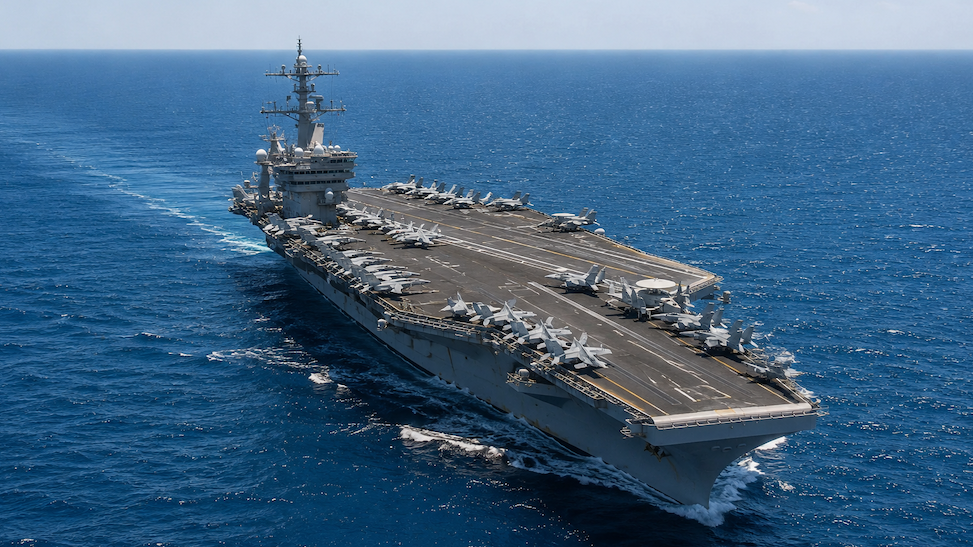

An aircraft carrier sails in the Gulf.
For those on the ground in the Gulf Cooperation Council (GCC), watching the Iran conflict up close has been nothing short of a life-changing experience. Each interception of an Iranian missile or drone reflected not just a triumph of defensive technology, but a testament to sustained human effort: military personnel, civil protection units, and operation teams. Their continuous work to monitor threats, to coordinate responses, and to protect civilians demonstrated unprecedented discipline and a high level of national preparedness rarely seen in real time.
The consequences are far-reaching. The conflict with Iran (stuck in an uneasy ceasefire as of this writing) is compelling Gulf states to reassess regional dynamics and question the reliability of the previous regional status quo. There is now a growing recognition across the GCC regarding the need for a dual-track strategy that integrates strong defense capabilities with active engagement in multilateral diplomacy. Bahrain is at the center of this new balance.
The Kingdom’s Strategic Posture
Bahrain’s approach to Iran is grounded in realism. The difference in scale is clear: Bahrain, with a population of about 1.5 million, is facing a neighbor of over 90 million. To address this imbalance, Bahrain has historically relied on diplomacy and strategic alliances. These twin pillars continue to define Bahrain’s engagement today.
Diplomatically, the Kingdom consistently assumes responsibilities that exceed the expectations placed on small states. It has contributed to numerous peace and stabilization efforts, promoted tolerance and coexistence in international forums, and engaged actively in multilateral initiatives aimed at de-escalation, including participation in the Board of Peace initiative following the recent Gaza war. Bahrain also holds a long-standing reputation as a central partner in efforts to protect freedom of maritime navigation in regional and international waterways, an issue with clear global economic and security implications.
This activism was on display in April 2026, when Bahrain held the rotating presidency of the United Nations Security Council, during which time it spearheaded the adoption of Security Council Resolution 2817 condemning Iran’s unjustifiable attacks on the Gulf states and Jordan with an unprecedented 136 votes. Bahrain also holds the rotating presidency of the Arab League Ministerial Council and chairs the current session of the Gulf Cooperation Council. These overlapping roles have amplified the Bahraini perspectives on Iran and regional security, one that is informed by geography, history, and direct exposure to risk.
Strategically, Bahrain has taken on an increasingly proactive role in recent years. The signing of the Comprehensive Security Integration and Prosperity Agreement (C-SIPA) with the United States in 2023 marked a significant step in that regard, and the United Kingdom’s decision to join the arrangement in 2025 further strengthened this structure. The value of this approach became clear when Bahrain secured support from the UK during the conflict in the form of fighter jets to provide defensive air cover.
Iran has repeatedly claimed that Bahrain and other GCC states have enabled military operations from their territories. But in Bahrain, the naval presence of our allies and partners began well before the 1979 Iranian Revolution. The naval base in Juffair has long served as a hub for Bahrain’s cooperation with the United Kingdom and the United States, and today it is the headquarters of the U.S. Fifth Fleet. This arrangement is the result of decades of institutional collaboration and reflects the logical evolution of longstanding alliances. Tehran’s depiction is intended to defend the indefensible: its attacks on civilian and energy infrastructure in the Gulf. Moreover, the timing of those strikes, followed attacks on Iran by only minutes, points to a deliberate, premeditated strategy on the part of Tehran to target and disrupt the region’s infrastructure.
Two Imperatives for What Comes Next
The future trajectory of the region remains uncertain. Multiple theaters of tension persist, and an unprecedented volume of disinformation has greatly complicated sober analysis. From a Gulf perspective, though, two conclusions are clear and unambiguous.
First, GCC states must be directly involved in shaping any future security arrangements in the region. The exclusionary dynamics that characterized the 2015 Joint Comprehensive Plan of Action should not be repeated. Securing maritime navigation through the Strait of Hormuz is an international responsibility; geography alone cannot justify shifting that burden exclusively onto the Gulf states.
Second, Iran’s behavior must be constrained. Decades of accommodation have enabled Tehran to project power through asymmetric networks, proxy forces, missile and drone capabilities, and coordinated information warfare. This conflict has once again demonstrated the Iranian regime’s willingness to endanger civilians in pursuit of strategic leverage. Restoring confidence will take time, and will require tangible limits on Iran’s destabilizing capabilities.
Yet however destructive they are, all wars eventually end. The question is what follows. For Bahrain, the objective is clear: a regional order defined by peace, prosperity, integration, and tolerance. These are principles that the Kingdom has consistently advanced, and which it will continue to uphold long after the current crisis recedes.