


THE BIG QUESTION
Managing The North Korean Problem
Andrei Lankov Peter Ward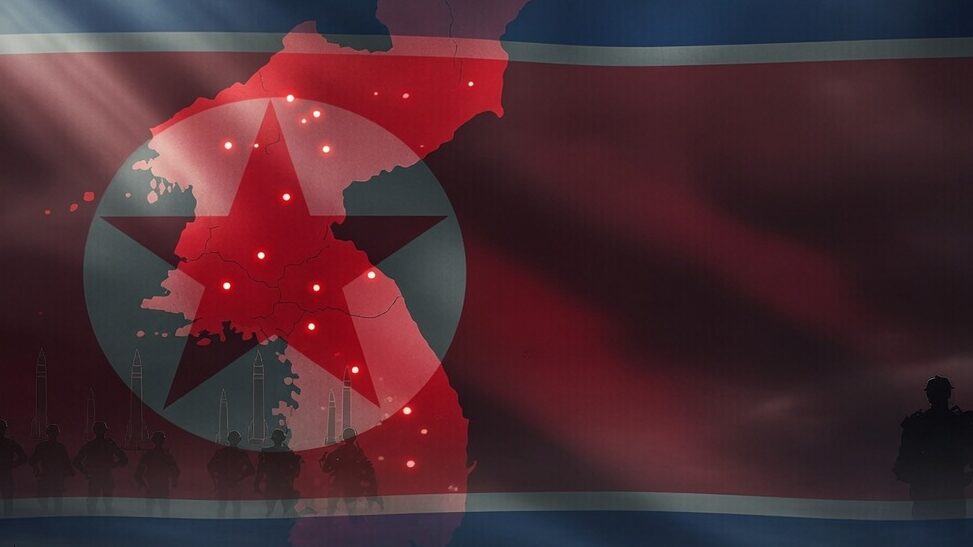

The flag of North Korea overlayed on the Korean peninsula, with shadowy military figures visible.
Is North Korea a strategic threat to the United States? For the time being, probably not.
To be sure, North Korea is an adversary—one that is hostile, heavily armed, and prone to inflammatory rhetoric. It possesses both nuclear weapons and long-range missiles. Yet to describe North Korea as a real danger to the American homeland in peacetime is to misunderstand both the logic of the North Korean regime and the nature of its strategic behavior.
How Pyongyang Thinks
Back in the early 1990s, North Korea lost both its primary economic sponsor (the Soviet Union) and its major military protector when China established diplomatic relations with South Korea. At the time, the DPRK’s “Dear Leader,” Kim Jong Il, famously told the country’s top elite that “if North Korea disappears, we’ll take the rest of the world with us.”[1]
This was and remains the fundamental logic of the North Korean nuclear program. And while it might sound scary, it’s less so than it first appears. North Korea’s nuclear weapons are often portrayed as proof of the threat to the U.S. Potentially, they are. But other considerations are also at play.
From the outset, North Korea’s nuclear program has been a multipurpose undertaking. It was designed to serve a number of goals whose relative importance has changed over time. However, its principal objective is to serve as a deterrent.
Recent history has confirmed this priority. The country’s decisionmakers saw what happened to Iraq, whose nuclear program had been destroyed in its early stages by an Israeli airstrike in 1981. They also took note of Libya, whose decision to abandon its nuclear program eventually made possible NATO’s intervention in the civil war that ended with the fall of the Gaddafi regime. North Korean scientists likewise were believed to be in the Syrian desert when the Assad regime’s military nuclear reactor was destroyed by the Israeli air force in 2007. Regardless of what they said officially, officials in Pyongyang likewise have not failed to notice what happened to Ukraine, which, after signing the 1994 Budapest Memorandum, assumed (wrongly, as it turned out) that it would receive meaningful protection from the U.S., and which has paid the heavy price for this illusion. Finally, they are watching what is happening to Iran right now.
The conclusions that North Korea’s leaders have arrived at are easy to reconstruct: in the modern world, for small and medium-sized powers, going nuclear is one of the most reliable ways to ensure security.
Admittedly, the North Korean nuclear program has other purposes as well. For instance, it has served as a highly effective tool of diplomatic extortion. Without it, the Kim dynasty would have had considerably more difficulty surviving in the face of hostile global politics. In addition, the nuclear program has proven useful for building the DPRK’s prestige, both domestically and internationally. Its existence also provides a plausible justification when the country’s propagandists have to explain to common folk why their lives are so difficult, and the country so poor.
Nuclear weapons thus provide much-needed deterrence and serve a number of other goals. None of them, however, would require attacking the U.S.
Pragmatic, Not Messianic
All this matters because a country represents a true threat to the United States only when there is a serious possibility that it might deliberately and preemptively attack. That is not the case here; North Korean officials understand all too well that any direct attack on the United States, especially a nuclear one, would trigger massive retaliation and very likely result in the destruction of the North Korean state and the death of its ruling class.
For their part, North Korean leaders have never been suicidal ideologues. Unlike Islamists or “classical” communists, they do not dream of converting all of humanity to their creed or bestowing a supposed paradise upon a suffering world. Their aims are far more modest, and largely limited to their national borders. Unlike Iran, with its declared goal of destroying Israel, they do not have clocks counting down to the destruction of South Korea, the U.S., or any other nation.
The DPRK is also a secular state. Neither Kim Jong Un nor any other North Korean leader has ever claimed a religious duty to embrace self-sacrifice in order to cleanse the world of “evil forces” (such as U.S. imperialism). Indeed, Kim Jong Un has repeatedly asserted that if the U.S. were to rescind its “hostile policy,” there is no reason why the two countries cannot get along. (In practice, of course, such a change would require Washington to abandon South Korea as a military ally, potentially leaving it open to nuclear coercion or worse.)
Nonetheless, nothing in North Korean ideology, whether in its officially declared form or in the views of the elite (to the extent these are known to us) indicates that North Korea harbors any kind of irrational offensive designs. The country’s semi-hereditary elites live a life of modest luxury and hope to remain in control of their state until their physical death and, with some luck, to pass that control on to their children and eventually grandchildren.[2]
That brings us back to Kim Jong Il’s formulation. The only scenario in which a North Korean nuclear attack against the outside world, including the United States, can plausibly be imagined is one in which North Korea has been invaded, is on the brink of defeat, and its top leadership is being targeted by decapitation operations while being denied any possibility of escape to China or another friendly country. The likelihood of such a scenario is low, and in any case the United States has full control over whether such a circumstance would arise in the first place.
Seoul as an Unwelcome Comparison
To be sure, North Korean leaders likely also still harbor at least some ambitions of subduing South Korea, whose extraordinary economic and social success represents a major threat to North Korean political stability in the long run. The per capita income gap between North and South Korea is estimated at roughly 1:29, the largest between any two neighboring countries in the world.[3] The North Korean ruling class has so far protected itself by keeping the country as isolated from the outside world as possible. In the longer run, however, eliminating South Korea as a point of comparison might appear to them a better way of mitigating this problem.
This goal might be achieved by persuading the North Korean public that the South, contrary to what has been claimed for so long, is not really a country populated by the same nation of people. The DPRK has already embarked on this path; in 2023, Kim Jong Un asserted that North and South Korea are two different states and should be seen as such.[4] As such, a military strike against the South, or nuclear coercion short of actual use, is doubtless tempting for Pyongyang.
At present, however, the DPRK is not ready for such an undertaking, especially given the continued presence of a large U.S. military force south of the DMZ. It appears to lack reliable tactical nuclear weapons for battlefield and theater use, and North Korea’s conventional armed forces are significantly inferior to those of the South. Hence, the regime would only be able to attack cities or other large targets in South Korea, which could easily provoke a massive retaliatory intervention from other nuclear powers not willing to let large-scale nuclear use go without a response. Fundamentally, a North prepared to use nuclear weapons in a large-scale preemptive attack on South Korea would be intolerable to regional and international security.
This is well understood in Pyongyang, which is why the DPRK is trying to alter the current balance of power on the peninsula by developing low-yield tactical nuclear weapons and long-range strike capabilities (principally precision-strike cruise and short-range ballistic missiles). These are weapons that could potentially be used against South Korea to offset Seoul’s current strategic superiority.
To be sure, the North is also developing intercontinental ballistic missiles, which could be used not only for deterrence but also as a tool to blackmail the United States into reneging on its alliance commitments to the South if and when Pyongyang decides to attack. But such blackmail would be highly risky and, if invoked, would create a precedent in which Washington would likely be forced to respond (given the implications for America’s other alliance commitments if it fails to do so).
The Logic of New Negotiations
For now, however, North Korea’s nuclear weapons are better understood not as a sword intended to enable the eventual subjugation of South Korea, but rather as a shield protecting the regime. It is still possible to ensure that these weapons remain such. The North Korean nuclear problem cannot be “solved,” but it can be managed. That is why negotiations with North Korea remain necessary.
The basic outline of a possible solution was already visible in the discussions that surrounded the U.S.-DPRK summit in Hanoi, Vietnam back in 2019. There, the two sides considered a possible compromise under which North Korea would dismantle most of its nuclear facilities in exchange for substantial sanctions relief.[5] It would have been implicitly understood, of course, that North Korea would retain a limited number of weapons and some associated facilities, sufficient for it to carry out successful deterrence. There are some indications that Pyongyang may still be interested in such a deal.
There is no question that such an agreement, if it does materialize, would be far from perfect. Among other things, North Korea would almost certainly cheat. Yet if it were deprived of a substantial part of its nuclear research and production infrastructure, the pace of its nuclear development would likely slow considerably. Pyongyang would thus probably continue to produce some nuclear weapons in secret, but in much smaller numbers and perhaps with more limited capabilities than would otherwise be the case.
On the other hand, sanctions relief would give North Korea renewed access to international markets. That, in turn, could encourage the regime to resume the economic reforms that it pursued with some success between 2012 and 2018. And, if such reforms produced meaningful economic gains, it is possible that the North Korean leadership might gradually lose interest in further accelerating their nuclear buildup.
New talks are necessary, but must be built around a clear objective: not to neutralize a major threat, but to make sure such a threat does not emerge eventually.
Portraying North Korea as an imminent and direct threat to the United States can be harmful. It narrows diplomatic space and pushes U.S. policy toward unrealistic goals. Illusions are dangerous. A clearer understanding of North Korea as a regime driven, above all, by survival supports a more prudent approach grounded in deterrence, containment, pressure (where necessary), and diplomacy (where possible).
-
[1] You can read more about the background to this in Tae Yong Ho’s book Passcode to the Third Floor: An Insider’s Account of Life Among North Korea’s Political Elite (Columbia University Press: 2024).
[2] Some of North Korea’s top elites actually live worse than South Korea’s middle class, unable to get housing for their adult children, three generations living in cramped apartments meant for a single family. See the memoirs of ex-North Korean diplomat Ryu Hyun-woo, The Hidden Safe of Kim Jong Un’s Secrets [김정은의 숨겨진 비밀금고] (Donga-ilbosa, 2025).
[3] Republic of Korea, Ministry of Data and Statistics, 2025 Statistical Indicators of North Korea, 2025, https://sri.kostat.go.kr/boardDownload.es?bid=11772&list_no=443786&seq=1.
[4] “Report on 9th Enlarged Plenum of 8th WPK Central Committee,” KCNA.kr, December 31, 2023, https://kcnawatch.org/newstream/1704014527-622062548/report-on-9th-enlarged-plenum-of-8th-wpk-central-committee/.
[5] Lee Chi-dong and Lee Haye-ah, “North Korea says it wants partial sanctions relief,” Yonhap News, March 1, 2019, https://en.yna.co.kr/view/AEN20190227014060315.