

THE BIG QUESTION
Fear And Loathing In Pyongyang
Daniel A. Pinkston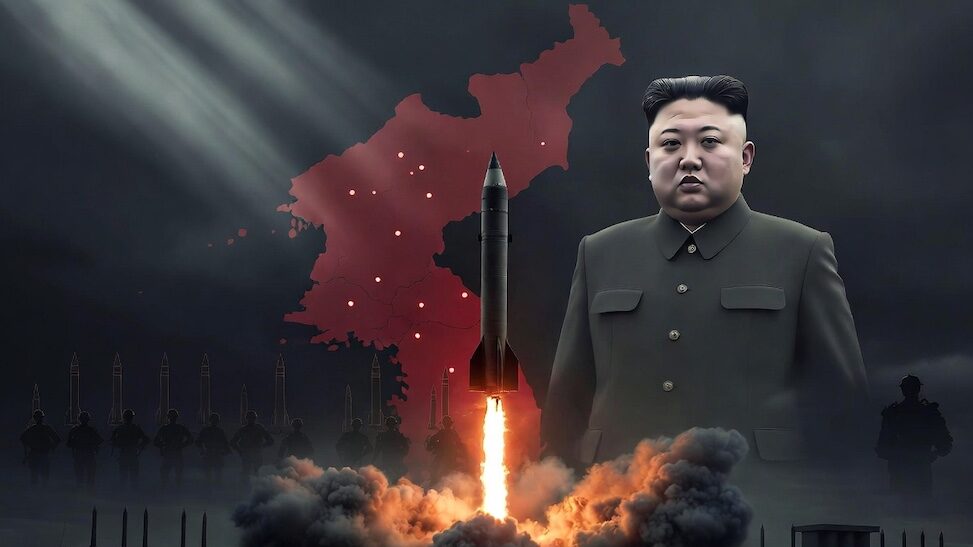

Kim Jong Un watches a nuclear missiles take off, overlayed over an image of the Korean penninsula.
The Democratic People’s Republic of Korea (DPRK, or North Korea) has maintained an adversarial relationship with the United States for over seven decades. Throughout its history, the DPRK has been a dissatisfied revisionist state that has actively challenged the liberal international order and regional security architecture established by the U.S. and its allies after World War II.
While the legacy of the Korean War has shaped the views of the North Korean leadership, those with direct personal memories of that conflict are passing away. Nevertheless, enmity toward the U.S. is sustained through the Kim regime’s ideological indoctrination and information control. North Korea’s worldview is heavily influenced by Lenin’s theory of capitalist imperialism and realist politics, which in turn affect Pyongyang’s posture and threats vis-à-vis Washington.
The Logic of Militarism
Although the DPRK does not cite Lenin or other theoreticians on capitalist imperialism, North Korean literature clearly depicts the international system as a menacing one in which imperialists seek to exploit Korea and enslave the Korean people.[1] North Koreans are depicted as innocent victims who have been forced to repel armed invasions for centuries.[2] According to Pyongyang, the Korean people have been fighting against Western imperialism since Christian missionaries arrived as “agents of imperialism” in the early 1800s.[3]
When the merchant ship General Sherman sailed up the Taedong River in 1866, North Korean historical accounts (though unsubstantiated) claim that Kim Ŭng-u, Kim Il-sung’s great grandfather, led the attack to destroy the “American pirate ship” and its crew. In the popular telling, this incident, and the subsequent arrival of American and other foreign missionaries in the 1880s, “proves” that Korea has been the target of American imperialism “generation after generation.”
Kim Il-sung and Kim Jong-il are widely credited with coining the terms Juche (roughly, “self-reliance”) and Sŏngun (“military first”) as “revolutionary new ideas” for the unique circumstances of the Korean revolution. But these concepts are nothing more than an amalgamation of rehashed ideas to serve the interests of the Kim regime. North Korea’s strategic culture is imbued with elements of ethnic nationalism, neo-Confucianism, Christian religious symbols, fascism, and realism. Militarism and realism are important pillars of Pyongyang’s threat perceptions and its military posture, and they make up the foundations of North Korea’s strategic threats against the U.S.
From Pyongyang’s perspective, the international system is a self-help Hobbesian world whereby survival can only be guaranteed by military might. For North Koreans, the apocryphal legend of Kim Hyŏng-jik, Kim Il-sung’s father, resisting Japanese imperialism and leaving two pistols before his death for Kim Il-sung to continue fighting inculcates a timeless lesson: that force is the only way to achieve political objectives. That narrative, and similar ones, are as familiar to North Koreans as the story of George Washington chopping down the cherry tree, or the legend of Paul Bunyan, are to Americans.
That helps to explain North Korea’s dogged pursuit of nuclear weapons, long-range delivery systems, and a vast array of conventional arms, despite the staggering costs of doing so. The North Korean leadership does not think in those terms; instead, the elites in Pyongyang view the Kim party-state with a nuclear arsenal as stronger and, therefore, more capable of pursuing other goals, including economic development. In other words, military power is viewed as a necessary condition not only for political survival, but also for economic prosperity.[5]
Still, given the balance of forces between Pyongyang and Washington, how could North Korea possibly pose a national security risk to the United States? The U.S. has almost thirteen times the DPRK’s population of 26.6 million, and about 960 times its economic output. America also possesses technologically superior and numerically larger military capabilities, including a robust nuclear arsenal. Furthermore, the North Korean leadership is rational, having demonstrated the ability to survive for decades despite extraordinary adversity, suggesting Pyongyang is clearly not interested in starting a conflict it almost certainly would lose.
Nevertheless, North Korea’s revisionist agenda has opposed a number of traditional American values grounded in the liberal rules-based international order, including the rule of law, the peaceful settlement of disputes, human rights, and the international institutions underpinning these values. And today, under the Trump administration, those traditional principles are receiving far less attention from the United States, thereby creating an international environment where authoritarian states like the DPRK can feel emboldened to act more aggressively to achieve their goals.
This shift in global political dynamics might be interpreted by Pyongyang as an opportunity to further its nuclear ambitions and conventional military build-up as it capitalizes on its emerging military cooperation with Moscow.[6] Meanwhile, shrinking American global leadership under Trump and the resulting weakening of global alliances could give the North Korean leadership greater confidence to engage in coercion and the use of force in Northeast Asia.
A Present Danger?
North Korea’s military capabilities are well-documented, with a significant emphasis on nuclear weapons, ballistic missiles, chemical weapons, long-range artillery, cyberwarfare, and special forces. But which of these capabilities pose a strategic threat, and which are more manageable? The former category is reserved for something that can cause significant harm to a state’s long-term security, sovereignty, or core national interests. In other words, it could affect a country’s military balance, political independence, critical infrastructure, national economy, or social stability. The difference is magnitude and scale.
In conventional military terms, Pyongyang’s forces are overmatched by Seoul and its allies across all relevant domains. As a result, in the case of conflict, North Korea would seek to employ asymmetric capabilities to gain an advantage. Here, North Korea has demonstrated advanced cyber warfare capabilities that could cause damage in the U.S. or potentially disrupt an allied response to North Korean military aggression in Northeast Asia.[7] However, North Korean cyber operations alone do not pose a strategic threat to the United States.
Rather, the primary strategic danger posed by Pyongyang derives from its increasingly sophisticated nuclear arsenal and associated delivery systems, including intercontinental ballistic missiles (ICBMs) capable of reaching the U.S. mainland. These capabilities complicate U.S. deterrence strategies, as well as Washington’s calculations in fulfilling its commitments under its bilateral security treaty with South Korea.
The DPRK’s strategic programs pose another problem as well. North Korea’s advancing nuclear and missile technology, its domestic economic privation, and a fragmenting world order are creating the supply and demand conditions for North Korean nuclear proliferation. Authoritarian regimes like North Korea are plagued by commitment problems in both domestic and foreign transactions, but Pyongyang has been able to surmount those in the past. It began extensive ballistic missile cooperation with Iran in the 1980s,[8] and the two sides have maintained a long-term bilateral scientific cooperation agreement since 2012.[9] Pyongyang also acquired and provided nuclear technology and materials through the clandestine network of Pakistani nuclear scientist AQ Khan,[10] and now is developing closer military ties with Russia.[11]
In the shadow of a fracturing global order and an apparent American retrenchment to the Western Hemisphere, Pyongyang could feel it has a free hand to market its nuclear technology to foreign customers. North Korea already has experience with such services, having contracted to provide a small nuclear reactor to Syria (which Israel bombed in 2007, while it was under construction).
International cooperation in the realms of export controls, intelligence sharing, and counter-proliferation is critical to prevent such a recurrence. But fading American commitment to alliances and international security cooperation increases the risk of Pyongyang transferring nuclear and missile technology. In turn, this could increase the likelihood of an accidental or deliberate use of nuclear weapons themselves, with catastrophic geopolitical, humanitarian, economic, and ecological effects. And, while a low probability event, this dynamic truly represents a strategic threat to the United States.
Complicated Calculations
Over the decades, the North Korean leadership has amply demonstrated both its rationality and its survival instinct. Therefore, the possibility of a North Korean preventive nuclear strike “out of the blue” is practically zero, since it would assuredly amount to a suicidal move. Instead, the authorization for a nuclear strike, which is solely retained by Kim Jong-un himself, would most likely be issued in response to an imminent perceived threat to regime survival, or as a desperate attempt to alter the strategic calculus in a conventional conflict where Pyongyang faces imminent defeat.
Even so, geographic proximity, misperception, and cognitive biases in a crisis could result in nuclear use even if the U.S. and its allies signal that they will exercise restraint. The ruling Korean Workers Party maintains tight control of the North’s military through the party’s Korean People’s Army (KPA) Committee, which oversees the General Political Bureau and its political officers. The Military Security Bureau (also known as the Defense Security Bureau) is another channel of monitoring military units to ensure they follow the directives of the supreme commander.
North Korea’s centralized control and institutional design ensure that the leadership maintains firm negative controls of all military capabilities. The movement of troops or use of any weapons system during an exercise, for example, requires the approval and signatures of three separate channels to reduce the risk of a coup. This arrangement is good for coup proofing, but it can be problematic in a conflict with external adversaries.
All nuclear-armed states have had to struggle with command and control relating to those weapons. State leaders want to maintain negative controls to ensure that weapons are never used without their explicit authorization. However, they also need to maintain positive controls to ensure they will be launched by military commanders if ordered to do so. Positive controls are critical for the credibility of North Korea’s nuclear deterrent, but this could be tricky given that they contradict the robust negative controls designed for coup prevention.
While North Korea’s nuclear command and control system is opaque, there is evidence to suggest that its leadership maintains highly centralized authority over nuclear weapons to ensure their effective deployment and use under certain specified conditions. In the event of a crisis or conflict on the peninsula, U.S. efforts to degrade or eliminate Pyongyang’s ability to execute a nuclear strike would lead to pressure on North Korea’s leadership to “use or lose” their nuclear missiles. In this scenario, the risk of nuclear use is substantial, given that every KPA military officer has been indoctrinated with the story of the General Sherman, Kim Hong-jik’s two pistols, and the understanding that the American imperialists have sought to “enslave the Korean people, generation after generation.” Moreover, now that an American leader has blustered about destroying a civilization (as President Trump did with regard to Iran) a decision to launch would likely be even easier for North Korea’s leaders and subordinate commanders to make.
-
[1] Ri Chol, 위대한령도자김정일동지께서 밝히신 선군혁명령도에관한 독창적사상 [The Original Ideas on Songun Revolutionary Leadership Articulated by the Great Leader Comrade Kim Jong Il (Pyongyang: Social Sciences Publishing House, 2002), 12.
[2] Kim Jae-hong,조선인민의 반침략투쟁사 [A History of the Korean People’s Struggle Against Aggression (Pyongyang: Encyclopedia of Science and Technology Publishing House, 1988); Jong Song-chol, 주체사상에 기초한 사회혁명리론 [The Theory of Social Revolution Based on the Juche Idea] (Pyongyang: Social Sciences Publishing House, 2010), 108.
[3] “선교사들을 제국주의 침략의 앞잡이로 왜곡하는 것 곤란 [‘It’s difficult to distort missionaries as the forefront of imperialist aggression’],” Kookmin Ilbo, June 6, 2016, https://www.kmib.co.kr/article/view.asp?arcid=0010678738.
[4] Kim Hui-bong, 선군정치문답 [Questions and Answers on Songun Politics] (Pyongyang: Pyongyang Publishing House, 2008), 3-4; Pak Hyok-chol, Ri Hong-su, and So Song-il, 우리당의 선군사상 [Our Party’s Songun Ideology] (Pyongyang: Social Sciences Publishing House, 2010), 15-16.
[5] Kim Hui-nang, “산군정치와 사회주의경제건설,” [“Songun Politics and the Construction of a Socialist Economy,”] in 우리민족끼리 선군정치학습 [Uriminzokkiri: Study of Songun Politics], n.d..
[6] Jung Min-kyung, “N. Korea, Russia signal next step in military ties with 5-year plan,” Korea Herald, April 27, 2026, https://m.koreaherald.com/article/10726547.
[7] Ed Caesar, “The Incredible Rise of North Korea’s Hacking Army,” New Yorker, April 19 2021, https://www.newyorker.com/magazine/2021/04/26/the-incredible-rise-of-north-koreas-hacking-army; Adam Weidemann, “Countering threats from North Korea,” [Google] Threat Analysis Group, March 24, 2022, https://blog.google/threat-analysis-group/countering-threats-north-korea/.
[8] “Iran & North Korea: Proliferation Partners,” United Against Nuclear Iran, June 2024; Paul Kerr, “Iran, North Korea Deepen Missile Cooperation,” Arms Control Association, n.d., https://www.armscontrol.org/act/2007-01/iran-nuclear-briefs/iran-north-korea-deepen-missile-cooperation.
[9] “North Korea and Iran sign tech agreement,” Al Jazeera, September 2, 2012, https://www.aljazeera.com/news/2012/9/2/north-korea-and-iran-sign-tech-agreement; John S. Park, “The Iran Secret: Explaining North Korea’s Rocket Success,” The Diplomat, October 2013, https://thediplomat.com/2013/10/the-iran-secret-explaining-north-koreas-rocket-success/.
[10] Nitya Singh, “The Khan Proliferation Network,” World Affairs: The Journal of International Issues 13, no. 4, Winter 2009, 112-123; Molly MacCalman, “A.Q. Khan Nuclear Smuggling Network.” Journal of Strategic Security, 9, no. 1, 2016, 104-118.
[11] Jung Min-kyung, “N. Korea, Russia signal next step in military ties with 5-year plan,” Korea Herald, April 27, 2026, https://m.koreaherald.com/article/10726547.