

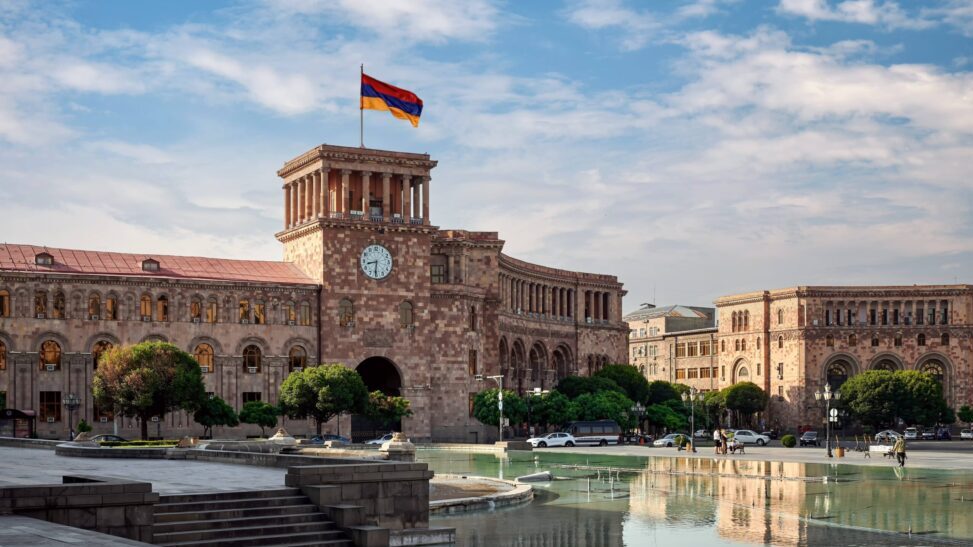

Although it passed mostly unnoticed in the West, Armenia’s June election was a seminal moment, the importance of which extends well beyond Armenian domestic politics. It demonstrated that the country’s strategic reorientation has survived its first serious electoral test. It has also created an opening for the United States to turn its growing involvement in Armenia into a durable regional strategy.
In the election, incumbent Prime Minister Nikol Pashinyan’s “Civil Contract” party won 64 of 105 parliamentary seats, securing a ruling majority. The outcome was a clear disappointment for his opponents and for Moscow. Russian-aligned political forces had entered the election with significant financial, political and informational resources behind them, yet failed to produce the change of government they desired.
That outcome matters because Armenia’s foreign-policy transformation can no longer be billed as simply the product of decisions by one government. It now has a clear electoral constituency. The question for Washington now should be: “what comes next?”
For decades, Armenia occupied an awkward position in the South Caucasus. It was deeply integrated into Russia’s economic and security structures, while maintaining increasingly close relations with the West. That model became unsustainable after Russia’s failure to provide Armenia with the security it expected during the attacks on its sovereign territories in 2021 and 2022, and in the collapse of Nagorno-Karabakh in 2023.
Ever since, Armenia has been seeking a different strategic environment. What is different now, however, is that the United States is no longer simply encouraging this process from the outside. Washington is becoming directly invested in the outcome.
The clearest example is the Trump Route for International Peace and Prosperity, or TRIPP. The project emerged from the August 2025 Washington agreement between Armenia and Azerbaijan and represents something much larger than a transportation project. It gives the United States a direct economic and strategic stake in the connectivity of the South Caucasus.
Under the Armenia-U.S. framework, the planned TRIPP development company is to be controlled by the U.S. side, with Armenia holding 26 percent. At the same time, Armenian sovereignty over its territory, border management, customs, security, and other state functions remains intact.
That combination is strategically important. For Armenia, TRIPP offers a path out of its geographic isolation and toward becoming a transit and logistics hub between Europe, the Black Sea, the Caspian, and Central Asia. For the United States, it creates a physical and commercial presence in a region that has traditionally been treated as Russia’s sphere of influence.
It is also potentially one of the most consequential U.S.-backed investment initiatives ever undertaken in the South Caucasus. The U.S. government itself has described TRIPP as an opportunity to expand American business, open new markets, and strengthen the connectivity of supply chains across the region.
In other words, Washington now has a concrete stake in the success of Armenia’s peace and connectivity agenda. The country has become increasingly connected to American commercial interests, infrastructure, and regional economic strategy.
This is precisely why the outcome of the Armenian election matters. Russia has not disappeared from Armenia. It retains substantial economic influence and has demonstrated that it is willing to use that leverage politically. But Moscow’s ability to shape Armenian political outcomes has clearly weakened, as the results of the June election show.
The inevitable Russian response will be to focus on disrupting the political and economic environment in which Armenia’s new orientation is developing. Here, Washington should pay close attention. The objective should not be to help Armenia “defeat Russia.” That would misunderstand both Armenia and the region. Rather, the goal should be to make Armenia’s sovereign choices economically and politically sustainable.
The distinction is important. If Armenia remains dependent on a single market, a single energy system, or a single external security provider, its foreign-policy choices will always be vulnerable to pressure. On the other hand, if Armenia becomes connected to multiple markets, multiple infrastructure networks, and multiple sources of investment, Moscow’s ability to reverse Armenian policy becomes much more limited.
TRIPP can serve as the centerpiece of that transformation. Moreover, its importance is not limited to the Armenia-Azerbaijan connection; the route has the potential to become part of a wider network linking Central Asian trade with European markets and creating new opportunities for American companies. Washington should therefore resist the temptation to treat Armenia primarily as a small country that needs assistance. Armenia should increasingly be viewed as a platform through which the United States can pursue larger objectives: regional connectivity, supply-chain diversification, private investment, energy cooperation, and a stable corridor between Europe and Asia.
The geopolitical stakes are hard to overstate. For decades, Russia benefited from the fragmentation of the South Caucasus. Closed borders, unresolved conflicts and competing regional interests made the countries of the region dependent on external powers to manage their security and connectivity. Peace between Armenia and Azerbaijan, combined with new transportation links, fundamentally threatens that model, which is why the Kremlin can be expected to oppose it with all its might.
True, the failure of Russian-aligned forces to meaningfully sway the recent election results is evidence that Armenia’s political center of gravity has changed. Still, the challenge for the Armenian government is now to convert that nascent political mandate into durable institutions and tangible economic results. The challenge for Washington, meanwhile, is to ensure that the alternatives being created in Yerevan are real enough for Armenia to survive the inevitable political pressure headed its way.