

THE CHALLENGE OF PUTIN'S RUSSIA
Moscow And The Middle East
Anna Borshchevskaya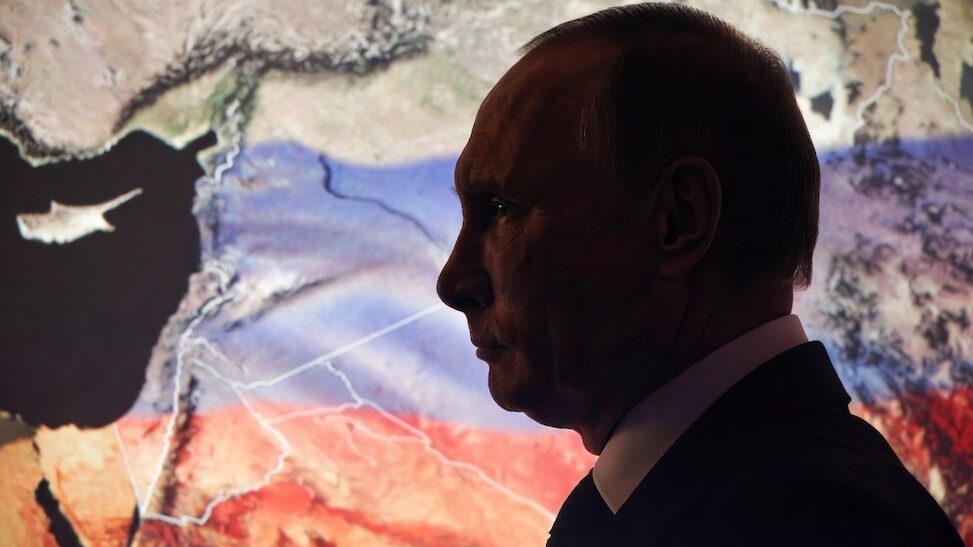

Putin stands in front of Russian flag.
No matter when and how the war in Ukraine ultimately ends, an aggressive Russia will remain a challenge for the United States and the broader West. In December 2025, NATO Secretary General Mark Rutte said as much in his speech before the Munich Security Conference. “We are Russia’s next target,” he warned, “NATO’s own defenses can hold for now but with its economy dedicated to war, Russia could be ready to use military force against NATO within five years.”[1]
Yet the challenge Russia poses is not confined to the European continent. Despite the mounting costs and international isolation incurred by its aggression against Ukraine, Russia’s government in recent years has articulated a global vision, and increasingly positioned itself as a major geopolitical player in various global theaters.
In this calculus, the Middle East figures prominently. Moscow’s approach to the region, centered on its ongoing strategic partnership with Iran, is designed to provide it with strategic options, and to enable Moscow to take advantage of any missteps Washington makes in the region.
Geared for War
This past April, Russian President Vladimir Putin ordered the spy academy of the Federal Security Service, Russia’s internal security agency, to be renamed in honor of Felix Dzerzhinsky.[2] Dzerzhinsky is a notorious figure in Russian history; he was the founder of the Cheka, the feared Soviet secret police, and the architect of the “Red Terror” that followed the 1917 Revolution and which brought the Bolsheviks to power in Moscow. During the Soviet era, the statue of Dzerzhinsky in front of the KGB headquarters in Moscow became a potent symbol of the torture, terror, and brutality of the era. When the Soviet Union collapsed in 1991, the toppling of the statue by pro-democracy protestors came to symbolize the fall of the Soviet system itself. As such, Putin’s rehabilitation of Dzerzhinsky’s name and likeness serve as an ominous indicator of his plans for Russia’s future.
Indeed, Russia is now a country geared for war, both literally and figuratively. The Kremlin’s current, massive focus on investment in its military-industrial complex is a product of the Ukraine war in more ways than one. Just as the invasion of Ukraine was about more than Ukraine for the Kremlin, so is the current Kremlin drive for militarization. Putin portrays Russia as being under attack from the West, and argues that the West was using Ukraine to invade and undermine his country. As a result, militarization is about not only the current war in Ukraine, but, as Moscow sees it, in the service of a broader confrontation with the West.
In fact, there are signs that Russia’s defense-industrial base has learned from the country’s failures in Ukraine, and those lessons have informed its efforts to modernize Russian military capabilities.[3] That modernization, according to recent U.S. intelligence assessments, is impressive. It includes, among other initiatives, the development of hypersonic glide vehicles, nuclear powered cruise missiles, and nuclear-capable underwater platforms.[4] Analysts have also noted Russian advances in space sensing and maneuverability, suggesting major investments in that domain as well.[5]
All of this has been undergirded by major capital infusions. The country’s military spending now represents nearly 7.5% of its GDP, for a total of $190 billion. That represents the highest level of military expenditure ever recorded in Russia and Ukraine, according to Lorenzo Scarazzato of the Stockholm International Peace Research Institute.[6]
Those expenditures, moreover, are only expected to grow. Privately, Western officials have long acknowledged that Russia now produces more munitions than all of NATO combined. Just under 4 million Russian citizens are employed by the country’s defense-industrial complex, according to 2024 and 2025 statistics, which is a record for modern Russia.[7] Meanwhile, Russian elites profit handsomely from the war through lucrative military contracts, the exploitation of resources in Ukraine’s occupied territories, and either the outright seizure of assets from departing Western companies or their purchase at heavily discounted prices.[8] Indeed, since the invasion of Ukraine started, and despite a widening array of Western sanctions, the number of Russian billionaires has actually grown. In its annual tally of the world’s wealthiest people earlier this year, Forbes listed a record 155 Russians, marking the fourth consecutive year that the number has increased.[9]
That means Russian militarization ranks as a matter of domestic stability for the Kremlin. Any reduction of jobs in the country’s military sector is likely to cause civil unrest. In a manner of speaking, therefore, Putin simply cannot afford peace. In addition, Russia is now receiving an added influx of revenue from the Trump administration’s temporary lifting of sanctions, as Washington works to stabilize global markets against the backdrop of its conflict with Iran. Those resources, however, will inevitably go toward guns rather than butter, and will help Russia to reconstitute its military forces.
Iran as Centerpiece
This martial focus naturally translates into an activist foreign policy, beginning with Moscow’s deep and longstanding strategic partnership with Iran.[10]
“Neither East nor West but Islamic Republic,” became a defining slogan of Iranian revolutionaries in 1979, led by Ayatollah Ruhollah Khomeini. But with Khomeini’s death a decade later, some Iranian officials sought to improve ties with Moscow. Ayatollah Ali Akbar Hashemi Rafsanjani even traveled to Moscow in June 1989 to explore rapprochement between Tehran and Moscow. By the late 1990s, Russia had emerged as Iran’s main conventional arms supplier and began assisting its nuclear program.
With Vladimir Putin’s ascent to power, the Russia-Iran relationship continued to grow. The arms trade between the two countries expanded further, and the Kremlin’s diplomats vocally supported Iran’s nuclear program as a peaceful endeavor and worked diligently to dilute Western sanctions on Tehran. By a decade ago, high-level meetings of the countries’ top officials became practically routine.
For Russia, this support carried a deeper and more strategic character than many acknowledged or understood. Moscow and Tehran both sought a new, multipolar world order in which Western influence would be diminished. Influential Russian thinkers and intellectuals, such as Eurasianist ideologue Alexander Dugin, came to see Iran as a key link in a Eurasian arc of influence that stretched all the way to China. Those views, moreover, were mirrored in Tehran.[11]
In January 2025, this relationship culminated in a strategic agreement that details cooperation on defense, intelligence sharing, energy and other trade, nuclear energy, as well as media/information and cultural exchanges. Perhaps most importantly, the bilateral agreement stipulates a shared commitment to refrain from aiding an aggressor if either country is attacked.[12]
Against this backdrop, it is no wonder that Russia increased cooperation with Iran following the June 2025 “Twelve Day War,” and that it further stepped up its support to the Iranian regime after the U.S. and Israeli strikes against Tehran in March 2026. This assistance reportedly includes providing Iran with intelligence about the locations and movement of American troops, ships and aircraft.[13] Ukrainian intelligence, for its part, has said that Russia’s intelligence helped Tehran to strike Israel’s energy sites.[14]
Russia is also said to have sent drones to Iran—upgraded versions of the unmanned platforms that Iran originally provided Russia for its war machine in Ukraine, American and European officials say.[15] Analysts likewise observed that Iranian strike patterns appeared very similar to Russian operations, which suggests that Russia provided Iran with tactical advice as well.[16]
This support is hardly a departure from Russia’s previous assistance to Iran. It simply builds on the Kremlin’s longstanding backing for the Iranian regime. For years, Moscow has engaged in major military cooperation with Tehran, providing it with systems like the S-300, with trainer jets and attack helicopters, and with light arms.[17] Iran has likewise relied on Russia to launch satellites into orbit, providing the Islamic Republic with a space-based capability to surveil targets in the region and beyond.[18] Russia has also assisted Iran with domestic repression. For instance, Tehran reportedly used Russian Spartak armored vehicles to suppress protests in 2025, and Russian jamming technology to keep Iranian citizens offline during the course of the most recent war.[19]
That help is logical. Any weakening of the current regime in Iran would hurt Moscow’s interests, and Russian leaders have long feared a pro-Western turn in Tehran. This is not just because such a shift would take a strategic ally off the board for the Kremlin. It is also because Iran is an integral member of an axis of revanchist states that, together with Russia and China, support one another against the West. In other words, Iran is a core pillar of a multipolar (or, as the Russians describe it, “polycentric”) world order that Putin has pursued since coming to power more than a quarter-century ago.
This assistance, meanwhile, has paid dividends for Putin. Even as his government does everything short of intervening militarily to make sure the Iranian regime remains in power, Russia’s president is publicly positioning himself as a neutral mediator. The Kremlin, for instance, has repeatedly offered to play an active role in brokering a peace agreement between Iran and the U.S. by removing Iran’s highly enriched uranium.[20] U.S. officials have thus far ruled out turning to Russia to help secure Iran’s nuclear program. But Putin continues to repeat the offer in hopes that he might eventually be taken up on it.
Meanwhile, Moscow is clearly benefiting from the economic effects of the current conflict. Rising global energy prices, and a temporary lifting of U.S. sanctions, has sent fresh funds flowing into Russian coffers, with potentially transformative results.[21] At the same time, Iran’s closure of the Hormuz Strait helps Russia on another front as well, given its role as the world’s second largest exporter of fertilizer. Moscow is now well-positioned to earn additional revenue in this domain, as well as to improve its standing among many nations in the Middle East and Africa, which are deeply dependent on Russian wheat and fertilizer. All of which is likely to strengthen perceptions of Russia in the Global South as an indispensable actor in time of a global crisis.
Still Relevant in Syria
Russia’s Mideast activism is not confined to partnership with Iran, however. It also entails an ongoing commitment to a presence in Syria. Early assessments assumed the fall of that country’s Kremlin-backed dictator, Bashar al-Assad, in late 2024 would end up being a major blow to Russia. But while Russia did suffer a significant setback with the ouster of the Assad regime, it immediately began positioning itself for the future in the former Ba’athist state.
In doing so, Putin has astutely judged that Syria remains deeply reliant on Russian assistance. As both Syria’s current president, Ahmed al- Sharaa, and its Foreign Minister, Assad al-Shaibani, have said in public interviews, if the Kremlin let Assad fall (which it did), there would be a place for Russia in post-Assad Syria.[22]
That represents a significant turnaround. Moscow had bombed al Sharaa and his HTS forces in previous years as part of its backing for the beleaguered Assad. But al-Sharaa has shown no qualms making a practical deal with the Russian government to secure his position in power. This is so for practical reasons. Just as Russia’s promise to give up support for Assad was crucial to helping al-Sharaa secure his victory, Russia’s role in post-Assad Syria remains important for Damascus.
This is particularly the case in the country’s security sector, as recent episodes demonstrate. For instance, following the outbreak of sectarian violence in western Syria in March 2025, Russia let many families take refuge at its Kheimim airbase, an event that was widely publicized by the Russian foreign ministry at the time. As many as 8 thousand refugees sheltered in Khmeimim, according to official Russian sources.[23] Whether or not those numbers were exaggerated, the incident demonstrated to Damascus that Russia could serve as a stabilizing security force moving forward.
By the end of 2025, Russia had briefly redeployed its military police to southern Syria, ostensibly to act as a mediator and buffer between Israeli forces and Damascus. Reports in November 2025 indicated that Russia may play a role in supporting and developing Syria’s civil security and police sectors as well, possibly through joint security agreements.[24]
Indeed, Moscow has moved quickly to consolidate its position in Syria’s new order. Here, it has clear advantages. Given Syria’s decades-long dependence on Soviet and then Russian military equipment, Damascus will continue to remain reliant on Russian arms, especially in the absence of other alternatives.
Russia likewise remains Syria’s primary oil supplier and prints Syrian currency. Russian companies like Tatneft have been invited back into the country over the past year. Moreover, the Kremlin retains ties to all of the country’s political factions (SDF, Alawites, Druze) and, therefore, can exploit ethnic tensions to keep Syria weak and dependent while positioning itself as a protector of Syria’s minorities.
Putin has hosted al-Sharaa himself twice since Assad’s ouster: first in October 2025 and again in January 2026. These meetings aimed to improve ties between Moscow and Damascus. They not only ensured that Russia’s military bases in the country remained operational, but also preserved the energy and reconstruction contracts that the Assad regime had previously awarded to Russian companies. This outcome suggests that, rather than “redefining” the relationship with Russia, as Sharaa had previously pledged, many of the core elements of Syria’s dependence on Russia established during the Assad regime remain in place.
Building a Broader Base
Meanwhile, Putin’s restraint on Iran serves a larger purpose in the rest of the Middle East. It allows Moscow to simultaneously retain good ties with the Arab states, Turkey, and Israel, even if those actors are unhappy with Russia’s support for Iran. Indeed, no country has taken steps to move away from Russia since the start of the Iran war, just as they didn’t when Russia invaded Ukraine several years earlier.
With the Gulf States, the Kremlin has engaged in extensive diplomacy to maintain its contacts. With the UAE, Putin has offered to serve as mediator, and to relay Abu Dhabi’s security signals directly to Tehran. [25] Similarly, with Bahrain, Putin has emphasized Russia’s diplomatic role in a solution to the conflict.[26] And with Saudi Arabia, there appears to be recognition that Russia could leverage its unique ties with both Iran and the Gulf states to play a stabilizing role in the crisis.
Moscow has also managed its relationship with Israel carefully. With the outbreak of hostilities this Spring, Moscow coordinated with the IDF to evacuate its personnel from Iranian nuclear sites[27], even as Putin used international platforms to pressure and criticize Israel publicly. Moscow’s nuanced engagement with the Jewish state has distinctly political dimensions, because Israel is home to a large Russian speaking population, a constituency which represents a significant factor in the Kremlin’s calculations about its regional policies.[28] That, in turn, has allowed policymakers in Jerusalem to remain relatively sanguine about Russia, and rebounded to Moscow’s benefit since it has muted Israeli moves toward closer partnership with Ukraine.
Beyond this general willingness to engage with Russia diplomatically, the region remains interested in engaging the Kremlin for another reason as well: weaponry.[29] Russia’s continued militarization and innovation, meanwhile, will ensure that it has more arms and technology to offer to weapons-hungry Mideast states.
More Than Simply a Spoiler
Russia’s posture in the Middle East is often portrayed as a mere series of ad hoc responses to unfolding crises. That, however, significantly underestimates the extent of the Kremlin’s plans. In recent years, under Putin’s direction, Moscow has been pursuing a nuanced, consistent, and calibrated approach—one that does not seek direct confrontation with the United States, but which strives to erode Western influence, expand its own leverage, and shape outcomes across the region.
The stakes are high. If Iran eventually takes a pro-Western turn, it will hurt Russia’s interests in the Middle East,and by extension Moscow’s global ambitions. Even in that eventuality, however, Russia can be counted on to find a way to work with the new regime. For the time being, though, the conflict surrounding Iran is paying clear dividends for Russia while reinforcing to Iran’s remaining regime the importance of continued alignment with the Kremlin. Simply put, however the Iran crisis ends, Russia seems well positioned for the aftermath.
That, in turn, should be instructive to Western policymakers. Russia clearly sees its role in the region as structural, deliberate, and deeply intertwined with its own global ambitions. Accounting for it will be a necessity for Washington.
-
[1] North Atlantic Treaty Organization, “Keynote speech by NATO Secretary General Mark Rutte and moderated discussion with Minister for Foreign Affairs of Germany Johann Wadephul,” December 11, 2025, https://www.nato.int/fr/news-and-events/events/transcripts/2025/12/11/keynote-speech-by-nato-secretary-general-mark-rutte-and-moderated-discussion-with-the-minister-for-foreign-affairs-of-germany-johann-wadephul.
[2] “Putin Renames FSB Academy After Red Terror Architect Felix Dzerzhinsky,” The Moscow Times, April 22, 2026, https://www.themoscowtimes.com/2026/04/22/putin-renames-fsb-academy-after-red-terror-architect-felix-dzerzhinsky-a92567.
[3] Dara Masicott, “How Russia Recovered,” Foreign Affairs, November/December 2025, https://www.foreignaffairs.com/russia/how-russia-recovered?check_logged_in=1; See also Michael Kofman, “Ukraine’s War of Endurance,” Foreign Affairs, February 16, 2026, https://www.foreignaffairs.com/russia/ukraines-war-endurance.
[4] Anya Fink, “Russia’s Nuclear Weapons,” Congressional Research Service Report, April 22, 2026, https://www.congress.gov/crs-product/IF12672#:~:text=According%20to%20a%202025%20estimate,and%20nondeployed%20strategic%20nuclear%20warheads.
[5] Mike Wall, “‘Whatever Russia is testing, it’s sophisticated’: 2 Russian satellites get within 10 feet of each other in orbit,” Space.com, May 6, 2026, https://www.space.com/space-exploration/launches-spacecraft/whatever-russia-is-testing-its-sophisticated-2-russian-satellites-get-within-10-feet-of-each-other-in-orbit.
[6] Stockholm International Peace Research Institute, “Global military spending rise continues as European and Asian expenditures surge,” April 27, 2026, https://www.sipri.org/media/press-release/2026/global-military-spending-rise-continues-european-and-asian-expenditures-surge.
[7] “Численность кадров, задействованных в ОПК России, достигла 3,8 млн человек [The number of personnel involved in the Russian defense industry has reached 3.8 million people],” RIA-Novosti, August 12, 2024, https://nvo.ng.ru/economics/2024-08-12/4_9069_news4.html. “Российский ОПК выполнил все задания по гособоронзаказу в 2025 году [The Russian defense industry has completed all the tasks under the state defense order in 2025],” Luganski Informatsionni Tsentr, January 12, 2026, https://lug-info.ru/news/rossijskij-opk-vypolnil-vse-zadanija-po-gosoboronzakazu-v-2025-godu/.
[8] See for example the case of Danone. Sonya Bandouil, “Danone finalizes sale of assets and exits Russia,” Yahoo! Finance, May 18, 2024, https://finance.yahoo.com/news/danone-finalizes-sale-assets-exits-234939709.html?guccounter=1&guce_referrer=aHR0cHM6Ly93d3cuZ29vZ2xlLmNvbS8&guce_referrer_sig=AQAAAEzGPEDKAyNE5TtnDF9Up4ePC9ak4WXuRde0EBcq2q3SE9pDZPeR95m14WU4c3wzVIKaHk1wy9Iz4aJ0q8npJFtYNBD4fyUrsnHhWtXiXvwBjxgnQVbTiD6xoAW8ccvRJyI3i3hYz1jHpaYGAkeQv9JeTwlIiXnJJbntd4XqMhQ7; See also the case of Carlsberg. Alexander Marrow, “Russia approves $320 mln management buyout of Carlsberg assets, document shows,” Reuters, December 3, 2024, https://www.reuters.com/markets/deals/russia-approves-320-mln-sale-carlsberg-assets-local-businessmen-document-shows-2024-12-03/.[9] “Record 155 Russians Make Forbes Billionairs List,” The Moscow Times, March 11, 2026, https://www.themoscowtimes.com/2026/03/11/record-155-russians-make-forbes-billionaires-list-a92193.
[10] Anna Borshchevskaya, “Can Trump Break up the Russia-Iran Alliance?” The Tower, February 2017, http://www.thetower.org/article/can-trump-break-up-the-russian-iranian-alliance/.
[11] For more details, see Ilan Berman, testimony before the Commission on Security and Cooperation in Europe, April 21, 2026 https://www.csce.gov/wp-content/uploads/2026/04/Berman-CSCETestimony-April-2026-FINAL.pdf.
[12] Full text of Iran-Russia Comprehensive Strategic Partnership Treaty, January 17, 2025. Available from: https://president.ir/en/156874
[13] Warren P. Strobel, “Russia is Providing Iran with Intelligence, US officials say,” Washington Post, March 6, 2026, https://www.washingtonpost.com/national-security/2026/03/06/russia-iran-intelligence-us-targets/.
[14] Sasha Vakulina, “Russia provided Iran with intelligence on Israeli energy sites, Ukraine says,” EuroNews, June 4, 2026, https://www.euronews.com/2026/04/07/russia-provided-iran-with-intelligence-on-israeli-energy-sites-ukraine-says.
[15] Emma Burrows, “Russia is sending upgraded drones used in the Ukraine war to Iran, officials say,” Associated Press, March 27, 2026, https://apnews.com/article/russia-iran-drones-shahed-war-israel-ukraine-840b4f885d99714bdb7813c0d56213cf.
[16] Alex Raufoglu, “As Iran Conflict Escalates, Ukraine Tells US: We’ve Seen This Before,” Radio Free Europe/Radio Liberty, March 25, 2026, https://www.rferl.org/a/iran-ukraine-us-drones/33716140.html; See also Thomas Grove, “Why Russia Is Stepping Up Its Support for an Embattled Iran,” Wall Street Journal, March 29, 2026, https://www.wsj.com/world/why-russia-is-stepping-up-its-support-for-an-embattled-iran-e3dcf8ee.
[17] April Brady, “Russia Completes S-300 Delivery to Iran,” Arms Control Association, December 2016, https://www.armscontrol.org/act/2016-11/news-briefs/russia-completes-s-300-delivery-iran; See also Mansur Mirovalev, “How extensive is Russia’s military aid to Iran?” Al Jazeera, March 27, 2026, https://www.aljazeera.com/news/2026/3/27/how-extensive-is-russias-military-aid-to-iran.
[18] “Russia sends 3 Iranian satellites into orbit, report says,” Associated Press, December 28, 2025, https://www.npr.org/2025/12/28/nx-s1-5659773/russia-iranian-satellites; See also “Russian rocket successfully launches an Iranian satellite,” PBS News, April 9, 2022, https://www.pbs.org/newshour/world/russian-rocket-successfully-launches-an-iranian-satellite.
[19] Roman Pryhodko, “Iran Armed its Border Guard Units with Russian Spartak Armored Vehicles,” Militarnyi, November 24, 2025, https://militarnyi.com/en/news/iran-armed-its-border-guard-units-with-russian-spartak-armored-vehicles/; See also Brandon J. Weichert, “Did Iran Just Use Russia’s ‘Kalinka’ Jamming System on Starlink?” The National Interest, January 20, 2026, https://nationalinterest.org/blog/buzz/did-iran-just-use-russias-kalinka-jamming-system-starlink-bw-012026.
[20] “Putin offers to store Iran uranium as US rejects plan,” MSN, May 10, 2026, https://www.msn.com/en-in/news/insight/putin-offers-to-store-iran-uranium-as-us-rejects-plan/gm-GMC8DEED25?gemSnapshotKey=GMC8DEED25-snapshot-11&uxmode=ruby; https://www.themoscowtimes.com/2026/04/20/russia-says-it-can-take-irans-enriched-uranium-will-that-happen-a92547.
[21] “Exclusive: Iran war doubles Russia’s main oil revenue to $9 bln in April, Reuters calculations show,” Reuters, April 9,2026, https://www.reuters.com/business/energy/iran-war-doubles-russias-main-oil-revenue-9-bln-april-reuters-calculations-show-2026-04-09/.
[22] “Sharaa says Syria, Israel negotiating deal that would see pullback of Israeli forces,” Times of Israel, September 13, 2025, https://www.timesofisrael.com/sharaa-says-syria-israel-negotiating-deal-that-would-see-pullback-of-israeli-forces/; See also Ibrahim Hamidi, “Asaad Shaibani on how Syria untangled its Russian knot,” Majalla, November 18, 2025, https://en.majalla.com/node/328370/politics/asaad-shaibani-how-syria-untangled-its-russian-knot.
[23] “Over 8,000 Syrians find refuge at Russia’s Khmeimim airbase — diplomat,” TASS, March 13, 2025, https://tass.com/society/1927465.
[24] Dmytro Shumlianskyi, “Russian Troops Arrive at the Border Between Syria and Israel,” Militarnyi, November 17, 2025, https://militarnyi.com/en/news/russian-troops-arrive-at-the-border-between-syria-and-israel/.
[25] President of Russia, “Telephone conversation with UAE President Mohamed bin Zayed Al Nahyan,” March 2, 2026, http://en.kremlin.ru/events/president/news/79242.
[26] “Putin Holds Talks With Leaders Of Bahrain, Qatar, Saudi Arabia & The United Arab Emirates,” Russia’s Pivot to Asia, March 3, 2026, https://russiaspivottoasia.com/putin-holds-talks-with-leaders-of-bahrain-qatar-saudi-arabia-the-united-arab-emirates/
[27] “Russia said coordinating with IDF on evacuation of workers from Iran nuclear plant,” Times of Israel, April 4, 2026, https://www.timesofisrael.com/russia-said-coordinating-with-idf-on-evacuation-of-workers-from-iran-nuclear-plant/.
[28] See, for instance, “Putin points to Israel’s huge Russian-speaking demographic,” TASS, June 20, 2025, https://tass.com/politics/1977955
[29] For more details on this issue, see Anna Borshchevskaya and Matt Tavares, “After Ukraine: Prospects for a Russian Resurgence in the Middle East,” Washington Institute Policy Note, January 23 2026, https://www.washingtoninstitute.org/policy-analysis/after-ukraine-prospects-russian-resurgence-middle-east.