

THE CHALLENGE OF PUTIN'S RUSSIA
Russia Eyes Europe’s “Unquiet Frontier”
Robert Hamilton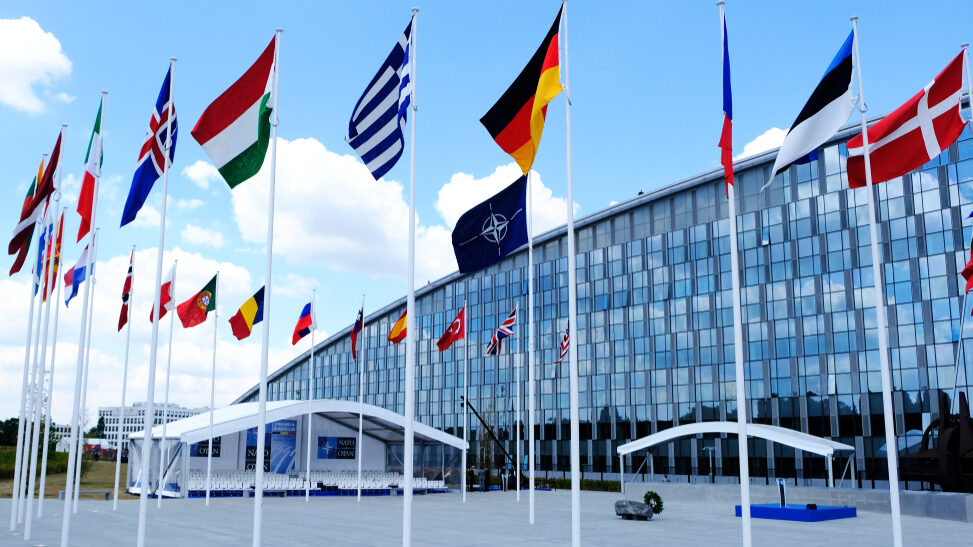

Flags of the NATO countries in front of a building.
Nearly a decade ago, the scholars Jakub Grygiel and Wess Mitchell labeled the areas of the world where U.S. power meets those of its rivals Russia, China, and Iran as the “unquiet frontier.”[1] There, Grygiel and Mitchell observed, America’s frontline allies were the key to stability, calling them “the first responders to the revisionist forays of their predatory neighbors.” What these allies need, in turn, are “U.S. support and guarantees. Without these, it is likely that some of these allies will buckle, and seek a deal with the revisionist neighbor.”[2]
Under the second Trump administration, the United States is putting that argument to the test, especially in Europe. President Trump has moved past his long-held critique of America’s European allies for spending too little on their own defense and has begun openly suggesting that the U.S. will not defend them, and that it might in fact leave the NATO alliance altogether. Whether this results in European states bandwagoning with Russia or attempting to balance against it without the U.S. is as yet unclear. What is, however, is that the shape of the European security order is changing faster than it has at any time since NATO’s founding over 75 years ago.
Since the end of the Second World War, Eurasia has been a central focus of U.S. national security thinking and policy. For some eight decades, there was a consensus within the U.S. policy community that, given Eurasia’s geographic size, population, and concentration of resources, its domination by a hegemonic power would represent a grave threat to American interests. U.S. policymakers also generally agreed that “Eurasia is not dependably self-regulating in terms of preventing the emergence of regional hegemons.”[3] What this meant was that Washington needed to remain engaged in Europe to prevent the emergence of a state with such absolutist aspirations.
None of these assumptions currently undergird American policy toward Eurasia, however. Instead, what were long-held, generally agreed upon premises have now become the object of debate in the U.S. These include: that NATO is critical to U.S. national security; that Russia is the only existential threat to Europe and the United States; and that Ukraine’s defeat of Russia is the most important shared security goal between Europe and the U.S. In various ways, the transatlantic consensus over all three of these objectives has broken down—with dramatic potential consequences.
Russia’s Full Spectrum Threat
While periodically re-examining the assumptions that guide national security policy is useful and important, the policy reformulation undertaken by the Trump administration risks gravely damaging U.S. and European security by ignoring the threat Russia poses to both. Indeed, Russia today is in many ways a more dangerous adversary than the Soviet Union was during the Cold War. Like its Soviet predecessor, today’s Russia works to destabilize the political and social fabric of its adversaries, poses a conventional military threat, and represents an existential nuclear danger. Where Putin’s system differs from the Soviet one is in the personalization of power around the leader. In the Soviet era, at least after the death of Josef Stalin, the system was far more institutionalized than the current one in Russia is.
In the Soviet system, institutions—that is, the military, the security services, the foreign affairs and economic ministries, and other players like the Politburo and the Central Committee—all vied for influence. While it was far from democratic, this arrangement ensured the country’s leadership was presented with a multitude of views on any issue. By contrast, Putin’s system concentrates power around the person of the president, not around institutions. This means that access to Putin represents the most valuable currency in Russia today. And for those in the system, preserving that access means not telling Russia’s leader uncomfortable truths. This makes miscalculation by the Kremlin far more likely than it was during the Cold War.
The 2022 full scale invasion of Ukraine offers an example here. Attempting to subdue a country the size of Ukraine with a population of more than 40 million using an invasion force of fewer than 200,000 troops speaks to a set of planning assumptions that were wildly off base. Quite simply, this was not a plan that any professional military organization would have produced. A key tenet of military planning is to clearly list the assumptions that undergird the plan, and to have a back-up plan in case any of these proves inaccurate. Two key assumptions in the 2022 Russian invasion plan appear to have been that the Ukrainian military would not put up much of a fight, and that Russian troops would be greeted as liberators, at least in the Russian-speaking areas of Ukraine. When these assumptions were proven false, the Russian military appeared to become paralyzed.
The most likely explanation for the poor quality of Russian planning for its Ukraine invasion is that the plan was prepared by the Kremlin and the security services, with far less input from the Ministry of Defense and the General Staff than would be the case in a less personalized system. To preserve their access to Putin—again, the most valuable currency in the current Russian system—the military likely swallowed hard and accepted the orders it was given to carry out, though it harbored serious reservations about them. This incentive of preserving access to the leader despite serious reservations is a hallmark of personalized authoritarian regimes like Putin’s and explains why they so often miscalculate.
But Putin’s system has its advantages as well, and Ukraine is also showing where these lie. One is the streamlined decision-making process they display. In democratic or institutionalized authoritarian systems, a miscalculation like the invasion of Ukraine might have been followed by attempts to assign blame for the decision, change course, and take steps to assure it does not occur in the future. But in Putin’s Russia, the leader is not only committed to the course he chose; his very ability to retain power hinges on the perception of his infallibility. Instead of trying to understand the reasons for a miscalculation and rectify it, therefore, the entire system is committed to ensuring it is not seen as a miscalculation in the first place. So, Russia will sacrifice millions of its citizens, kill hundreds of thousands of Ukrainians, and drain its treasury in the pursuit of a victory in a war of choice that has now become existential to its leader.
This is what makes Russia so dangerous to Europe and the U.S. Its personalized decision-making system lends itself to serious miscalculations about the use of military force, and that same system means the leader—and therefore the entire system—are existentially invested in the course they choose, no matter how disastrous it may have become. This means not only that a Russian miscalculation which leads it to attack a NATO state is possible, but also that, if this occurs, the Kremlin will be willing to escalate to levels its adversaries are not. As long as Russia remains a personalized authoritarian regime, this is the danger it will present to the West. No amount of attempting to integrate it into Western structures, satisfy its professed security needs, or build economic interdependence with it will change these facts.
A Bear at the Door
All facets of the contemporary threat posed by Russia—hybrid, conventional, and nuclear—are present along NATO’s eastern flank. Some of Russia’s hybrid or gray zone activities there are the same as Moscow undertakes against all NATO states: cyber-attacks, disinformation and malign influence campaigns, support for extremist political movements, and intelligence operations. But Russia’s geographic proximity to NATO’s frontline states gives it opportunities there that it lacks elsewhere in the Alliance.
For instance, Russia—via its proxy Belarus—has weaponized migration against both Poland and Lithuania. Moscow has also sent drones and manned aircraft to violate the airspace of Finland, the Baltic States, Poland, and Romania. Finally, it has engaged in sabotage activities against warehouses, railways, undersea cables, and logistics hubs all along NATO’s eastern flank.
After declining in the immediate aftermath of the full-scale invasion of Ukraine, Russia’s conventional threat to NATO’s eastern flank is rising anew as well. Early in the war, many Russian forces deployed along NATO borders were sent to Ukraine. But Russian units facing NATO have been reconstituted, and the Kremlin plans to significantly increase their number in coming years.[4] Military analysts have estimated that Russia had some 250,000-300,000 forces in its Western Military District before the war. After dropping in 2022-2023, their number began rising again, and estimates now assess they equal the strength they had prior to the war.[5] Moreover, this does not include the over 600,000 Russian troops engaged in the Ukraine war—which theoretically could be sent elsewhere thereafter.
Russia’s future plans should be even more concerning to NATO. The Kremlin has announced an ambitious rearmament and restructuring program for its military, designed with one goal in mind: to win a war against NATO. Plans call for an increase in Russia’s active military to some 1.5 million, with about 500,000 of these forces arrayed against NATO’s eastern flank. Several brigades are being expanded to divisions, and new divisions are being formed near Finland and the Baltic States. In addition, Russia has re-established the Moscow and Leningrad Military Districts, enhancing its ability to command, control, and supply the new and expanded units it is forming. Finally, it is refurbishing and expanding railways and other military infrastructure along its western borders.[6]
If war with NATO appears likely, Russia has demonstrated an ability to mobilize that few NATO members can currently match. To wit, Moscow’s August-September 2022 “partial mobilization” added over 300,000 soldiers to the Russian military’s rolls in only 37 days.
Russia’s nuclear arsenal likewise threatens all of NATO, but the danger to frontline NATO states is particularly acute. First, these nations are most at risk of a fait accompli, in which Moscow undertakes a rapid but limited land grab against a NATO member and then threatens nuclear escalation unless NATO accepts the new status quo. Next, Russia has already deployed non-strategic nuclear weapons and nuclear capable missiles and aircraft to Belarus.[7] This extends the range of Russian nuclear weapons and lowers the reaction time for NATO states. Taken together, Russia’s hybrid, conventional, and nuclear threat to NATO’s eastern flank is now the most acute and dangerous it has been since the Cold War.
The Great Capabilities Debate
NATO was slow to awake to the threat Russia posed to its eastern flank. Despite persistent warnings throughout the 1990s and early 2000s from vulnerable countries like Poland and the Baltic Republics, most of the Alliance labored under the illusion that Russia could be integrated into the prevailing European security order. Indeed, especially after the Alliance became engaged in the Afghanistan conflict, the de facto NATO motto became “out of area or out of business.” The idea here was that since there was no military threat in Europe, NATO needed to develop deployable military capability to help tamp down conflict and increase security farther afield, or it would have no reason to exist.
Even Putin’s 2007 Munich Security conference speech, which declared the West led by the U.S. to be Russia’s primary adversary, and the Russian invasion of Georgia some 18 months later, did little to change minds about Russia in NATO capitals. Thus, only five months after Russian troops attacked Georgia and occupied its two breakaway regions of Abkhazia and South Ossetia, the Obama administration launched its ill-fated “reset” with Russia. It was only after Moscow annexed Crimea and fomented a separatist conflict in eastern Ukraine in 2014 that NATO minds began to change, and even then, the process was uneven. NATO did deploy battle groups to Poland and the Baltic states to act as a deterrent to Russian aggression there. But it left the Black Sea region—the site of Russia’s 2008 invasion of Georgia and subsequent 2014 foray into Ukraine—essentially unprotected. At their 2014 summit, NATO heads of state agreed to each raise their level of defense spending to 2% of GDP, but they gave themselves a decade to reach that mark. (At the time, only three of NATO’s 28 members—the U.S., UK, and Greece—were spending 2% or more on defense.[8]) And as late as 2021, many European NATO members were still far too reliant on Russian oil and gas, despite Moscow’s demonstrated penchant for weaponizing its role as an energy supplier. Indeed, Germany and Russia had completed the Nord Stream 2 gas pipeline in September 2021, only five months before Moscow’s full-scale invasion of Ukraine.
That February 2022 offensive finally focused minds in NATO capitals. The Alliance immediately began taking steps to assist Ukraine and to bolster its own security against Russia. At the 2025 NATO summit, partner nations agreed to collectively raise their defense spending to 5% of GDP by 2035, with 3.5 % of that on “core defense” capabilities (essentially personnel and equipment) and the other 1.5% on security-related capabilities like infrastructure, cyber, and resilience. President Trump likes to claim credit for convincing NATO members to spend more on defense, and his incessant criticism and thinly veiled threats certainly played a role. But while Trump may be the Godfather of increased NATO military spending, Vladimir Putin is the father. Consider this: when Trump took office for his first term in 2017, three NATO members were meeting the 2% mark; when he left office in 2021, six were; by the time he returned to office in 2025, 31 of 32 members of the bloc were spending 2% or more on defense.[9]
But while the percentage of GDP spent on defense is a useful benchmark and serves to frame the debate, it is less useful as a measure of actual capabilities that each Alliance member can bring to bear. This is because there is a fundamental difference between the U.S. and the rest of NATO. The United States is the only global power in the Alliance. This means that while, for instance, essentially all of what Poland spends on defense is available to NATO, only a fraction of what the U.S. spends is—or ever will be. The United States has security and economic interests around the world, and its military is structured and deployed to protect these. U.S. forces available to NATO are assigned primarily to U.S. European Command, with some forces from U.S. Northern Command also available for certain missions. But far more American forces are assigned and deployed outside the North Atlantic area, in the U.S. Southern Command, U.S. Africa Command, U.S. Central Command, and U.S. Indo-Pacific Command.
The Trump administration’s reorientation of America’s national security posture has hammered home this fact. The 2025 National Security Strategy makes clear that Europe is, at best, the third priority among the five regions of the world it discusses, after the Western Hemisphere and Asia. The Trump strategy deprioritizes the threat from Russia and assigns Europe primary responsibility for dealing with Moscow. Indeed, where the 2022 Biden National Security Strategy mentioned Russia 71 times, the Trump strategy does so only ten.[10] And where the Biden strategy made clear that Russia was the primary imminent threat facing the U.S., the Trump strategy outsources that assessment to Europe, noting that “Europe now observes Russia as an existential threat” while expressing a U.S. desire to “re-establish strategic stability with Russia.”[11]
But the Trump administration’s actual decisions make clear that it sees U.S. interests in Europe as even less important. Shortly after the fourth anniversary of the full-scale Russian invasion of Ukraine, and after effectively ending U.S. assistance to Kyiv, the Trump administration and Israel launched a war against Iran. Both the rationale for the war and its objectives have been shifting and unclear. More tellingly, though, the U.S. embarked on a war of choice against a second-tier threat after walking away from confronting the only imminent and existential threat to its security, Russia. And even if the U.S. does later decide it needs to confront Moscow’s aggression more resolutely—or respond to Chinese aggression against Taiwan or another American partner—the furious rate at which the U.S. has expended scarce resources on its Iran war will invariably make that more difficult to do.
Can NATO Survive the Challenge?
This leaves America’s European allies with the uncomfortable prospect of having to go it alone, both in supporting Ukraine and in defending themselves against Russia. The question is whether they can. On paper, even without the U.S., NATO possesses advantages over Russia in active duty military personnel (1.9 million to 1.1 million), combat capable aircraft (2429 to 1377) and main battle tanks (6652 to 2000).[12] But without the U.S., European states would face serious shortages of the enablers of modern war, including intelligence, surveillance, reconnaissance (ISR), command and control (C2), strategic lift (air/sea), air-air refueling, integrated air defense, and long range precision strike.
Europe’s defense industrial base has suffered from chronic underinvestment, fragmented defense industries, and lack of coordination for decades. Fixing these problems and addressing Europe’s capability gaps will take time and sustained political will. If these prove lacking, some European states may seek cheaper ways to deter Russia without the U.S., and here nuclear weapons are the obvious answer. Several European states, including Germany and Poland, have expressed interest in having French or British nuclear weapons stationed on their soil as a deterrent, and France has obliged by unveiling a “forward deterrence” concept.[13] Russia would certainly see this as provocative and would likely forward deploy more of its own nuclear weapons to Belarus, further eroding what tenuous stability still exists between NATO and Russia.
But this is probably the least provocative way that European states could use nuclear weapons to seek to guarantee their security without the U.S. A more provocative option would be to pursue independent nuclear deterrents. In the past year, representatives from several have told the author in off-the-record forums that their countries are thinking along these lines. The effect of such efforts on strategic stability would be unpredictable, but in a world where arms control is dead, NATO is defunct, and the rules-based order is in tatters, the incentives for arms racing and the chances of war by miscalculation would certainly rise.
Seeing Russia Straight
The Trump administration’s current fantasy that Russia poses no threat and indeed can serve as a partner for the U.S. is no more likely to bear fruit than the decades-long collective fantasy harbored by some European states that economic integration could turn the Kremlin into a reliable, predictable, non-predatory partner. Unless Russia is comprehensively defeated in Ukraine, something that requires a collapse of Putin’s personalized authoritarian system, it will continue to pose a threat that is both existential and unpredictable.
This is so because of Moscow’s impossibly high bar for its security needs (which NATO could not meet without fatally undermining its own), its outsized perception of threat, its almost limitless tolerance for risk, and its penchant for miscalculation. The sooner the United States and Europe come to this joint understanding, the safer both will be.
-
[1] Jakub J. Grygiel and A. Wess Mitchell, The Unquiet Frontier: Rising Rivals, Vulnerable Allies, and the Crisis of American Power (Princeton, NJ: Princeton University Press, 2017), xvi.
[2] Ibid., xvii.
[3] Ronald O’Rourke, “Defense Primer: Geography, Strategy, and U.S. Force Design,” Congressional Research Service, December 8, 2025, 1, https://www.congress.gov/crs-product/IF10485
[4] Andrew S. Bowen, “Russian Military Performance and Outlook,” Congressional Research Service, May 28, 2025, https://www.congress.gov/crs_external_products/IF/PDF/IF12606/IF12606.5.pdf
[5] Benedict Tetzlaff-Deas and Athena Dawson, “Russia massing ‘over 360,000 troops’ near Europe’s borders as Putin ‘plans next move’”, Daily Express, December 16, 2025, https://www.the-express.com/news/world-news/193634/russia-massing-over-360-000-troops-near-europe-s-borders-putin-plans-next-move/amp.
[6] “A new front? Russia’s troop surge near Finland sparks fears of wider conflict,” Global Watch, May 27, 2025, https://globalwatch.info/en_GB/articles/gc7/features/2025/05/27/feature-02/A-new-front-Russias-troop-surge-near-Finland-sparks-fears-of-wider-conflict?; “Russia forms Moscow, Leningrad military districts amid NATO expansion,” TASS, December 21, 2023, https://tass.com/defense/1724853.
[7] “Lukashenko: Russian nuclear-capable Oreshnik missiles now in Belarus,” Associated Press, December 19, 2025, https://www.defensenews.com/global/europe/2025/12/19/lukashenko-russian-nuclear-capable-oreshnik-missiles-now-in-belarus/
[8] “Defence Expenditure of NATO Countries (2014-2025)”, NATO Public Diplomacy Division, June 2025, https://www.nato.int/content/dam/nato/webready/documents/finance/def-exp-2025-en.pdf
[9] Ibid. NOTE: Iceland was the only country not meeting the 2% mark as of 2025, because it does not have armed forces or a traditional defense budget.
[10] Ronald O’Rourke, “National Security Strategy: Potential Implications for DOD of Prioritizing the Western Hemisphere and China,” Congressional Research Service, December 18, 2025, https://www.congress.gov/crs-product/IF13137
[11] White House, National Security Strategy of the United States of America, November 2025, https://www.whitehouse.gov/wp-content/uploads/2025/12/2025-National-Security-Strategy.pdf
[12] Sean Monaghan et al, “Is NATO Ready for War? An Assessment of Allies’ Efforts to Strengthen Defense and Deterrence since the 2022 Madrid Summit,” Center for Strategic and International Studies, June 11, 2024, https://www.csis.org/analysis/nato-ready-war?
[13] Sophia Khatsenova, “Macron orders nuclear warhead increase and unveils ‘forward deterrence’ plan for Europe,” Euronews, March 2, 2026, https://www.euronews.com/2026/03/02/macron-orders-nuclear-warhead-increase-and-unveils-advanced-deterrence-plan-for-europe.