


THE CHALLENGE OF PUTIN'S RUSSIA
The Limits of Russia’s “No Limits” Partnership with China
Ilan Berman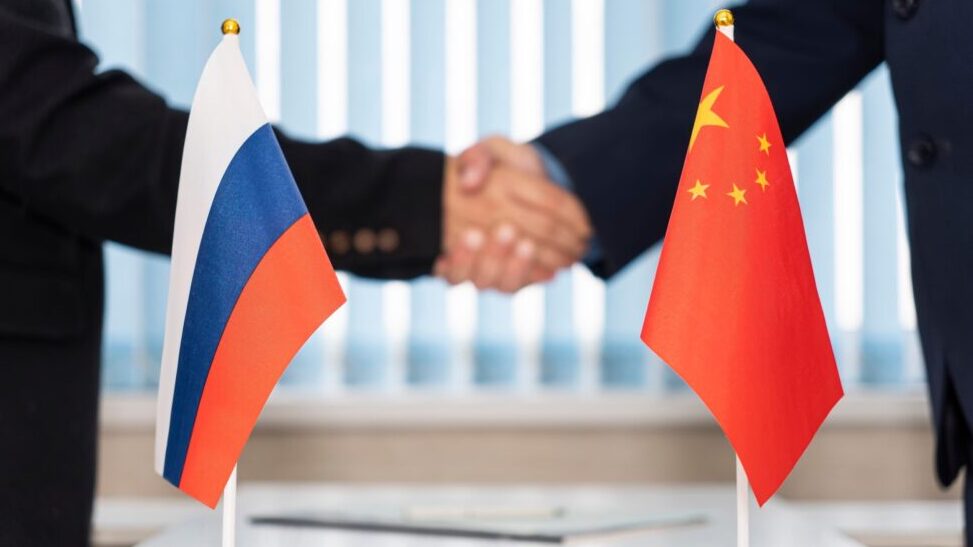

The flags of Russia and China in front of a handshake.
On February 4, 2022, just hours before the opening ceremony of the Winter Olympics in Beijing, Russian President Vladimir Putin joined his Chinese counterpart, Xi Jinping, to publicly unveil a new era in bilateral relations between their two countries. In a lengthy joint statement, the two leaders declared that “friendship between the two States has no limits” and proclaimed that there were now “no ‘forbidden’ areas of cooperation” between Moscow and Beijing[1] It was a carefully choreographed moment of solidarity, and a public signal that the two powers planned to stand shoulder to shoulder against the West.
Since then, the concept of a Sino-Russian alliance has dominated world headlines, and for good reason. Ties have warmed markedly over the past several years, as Moscow and Beijing have increasingly joined forces to oppose the perceived hegemony of the United States in world affairs. This rapport has been reinforced by the close personal ties between Putin and Xi; the two have met more than 60 times, and carried out nearly a dozen state visits to one another’s nation so far. Russia’s full-scale invasion of Ukraine, moreover, has only accelerated this convergence, with China becoming a critical enabler of Moscow’s ongoing aggression against its western neighbor.
Yet for all of its warmth, the Sino-Russian partnership is far more fragile than its architects might care to admit. Longstanding historical grievances, profound ideological differences, simmering territorial disputes, glaring economic asymmetries, and pervasive distrust all persist. These factors suggest that, for all the public fanfare, the “no limits” partnership rests on decidedly rickety foundations.
Imperial Competition
For much of their shared history, Russia and China were adversaries. For centuries, both empires viewed the vast, sparsely populated regions stretching from Mongolia to the Pacific as strategic buffers critical to their security. The Romanov Empire, therefore, pushed eastward across Siberia, while the Qing Dynasty looked north and west, seeking to consolidate control over Manchuria and the Mongol territories. Clashes over the Amur River Valley in the 17th century underscored the inherent incompatibility of these agendas. China’s victory over Russian forces at the time culminated in the 1689 Treaty of Nerchinsk, which recognized Chinese sovereignty over large swaths of what is today the Russian Far East and parts of eastern Siberia, and at least temporarily checked Russia’s eastward expansion.[2]
But those boundaries did not hold indefinitely. In the 19th century, as the Qing Empire weakened as a result of the Opium Wars (1839-1860) and successive internal rebellions, Russia saw (and seized) the strategic opportunity. It applied diplomatic and military pressure along its common frontier with imperial China, rolling back Beijing’s territorial control. Through the 1858 Treaty of Aigun and the subsequent Treaty of Peking in 1860, Russia annexed vast stretches of territory north of the Amur and east of the Ussuri River. These lands, including what is now Vladivostok and much of Primorsky Krai, remain part of the Russian Federation to this day.
During the same timeframe, Russia was also pushing deep into Central Asia. This created an additional layer of friction to Russo-Chinese relations, because the Qings were striving to exert their own control over that general area. The result was a zone of overlapping imperial ambition and a Chinese perception that Russia was encroaching on a broader frontier it viewed as vital to both its security and prestige.
In Chinese historical memory, these events make up part of the so-called “century of shame and humiliation,” a period during which external powers imposed unequal treaties, seized territory, and subordinated China’s rightful sovereignty. China’s leaders, Xi Jinping foremost among them, are now attempting to correct these affronts.[3] That’s why public discourse, academic writing, and nationalist commentary in China today all regularly reference “lost territories,” underscoring that the memory of lands lost to Moscow remains alive, even if it is dormant for the moment.
But it won’t always be. A recent analysis by the Robert Lansing Institute has argued that the “reinvigoration” of China sought by Xi will invariably prompt the PRC to take a more assertive stance toward these territories, and heighten tensions with Russia in the process. “China currently claims, first of all, the Amur Region, the Jewish Autonomous Region, the south of the Khabarovsk Territory, the Primorsky Territory, the Republic of Tyva [sic], parts of the Trans-Baikal Territory and Buryatia,” the Institute’s analysis notes. That state of affairs, in turn, will lead to an inevitable revival of Chinese claims to those areas.[4]
Cold War Rivals
Following the establishment of the People’s Republic of China in 1949, the two communist juggernauts initially entered a period of ideological solidarity. During this time, the Soviet Union provided extensive economic assistance, technical support, and military aid to the fledgling PRC.[5]
But the alignment quickly proved fragile. By the mid-1950s, personal, ideological, and geopolitical frictions had already begun to accumulate. China’s leadership resented Soviet attitudes, which portrayed China as a junior partner in world affairs, while Soviet leaders were uneasy with Mao Zedong’s rule, which they saw as unnecessarily radical and reckless. [6] Moreover, each side believed that it, rather than the other, possessed the correct interpretation of Marxism-Leninism and, therefore, was entitled to lead the forces of world communism.[7]
These tensions culminated in the Sino-Soviet split of 1961, one of the Cold War’s decisive geopolitical ruptures. Thereafter, the PRC and USSR engaged in a pitched competition for leadership of the global communist movement, one that occasionally broke out into confrontation. That was the case in 1969, when the two powers clashed along the Ussuri River over Damansky Island (known in China as Zhenbao Island).[8]
The frictions would persist for years, with both Moscow and Beijing fortifying their respective sides of the border and planning for the possibility of large-scale war with the other. It also prompted significant foreign policy shifts. Beijing cultivated ties with Washington as a strategic counterweight to Moscow, thereby enabling President Nixon’s famous “opening to China.” The Kremlin, meanwhile, began treating China as a significant security threat. And while relations thawed somewhat following Mao’s death in 1976, neither side fully trusted the other. As late as the 1980s, ties between the two countries were still tentative and superficial.
A New Era
The 1991 Soviet collapse, however, profoundly transformed the global geopolitical landscape, and relations between Russia and China along with it. Both Beijing and Moscow were suddenly faced with a unipolar world dominated by Washington, leading them to gravitate to the idea that political alignment, however limited, had become a necessity. The result was a series of confidence-building measures, border demarcations, and increased diplomatic contacts during the 1990s. Both countries also embraced the idea of “multipolarity” in world affairs, thereby positioning themselves (both separately and together) as counterweights to U.S. power.
This thaw culminated in the Treaty of Good-Neighborliness and Friendly Cooperation, signed in 2001 by Putin and then-Chinese Premier Jiang Zemin. That arrangement helped establish a new political framework for relations between Moscow and Beijing, entrenched military contacts between the two, and demarcated (albeit temporarily) their disputed border.[9] It represented an important symbolic shift, marking the formal end of decades of simmering hostility and laying the groundwork for what would become a new strategic partnership.
Geopolitics were also helping drive the two countries together. Russia had progressively turned away from the West, leading to deepening frictions with NATO and growing disputes with the United States over everything from arms control to regional policy in the Middle East. China, meanwhile, had expanded its global profile and its global ambitions. This convergence created the basis for the two countries to increase their joint military exercises, arms sales, and to coordinate diplomatic initiatives in multilateral forums such as the United Nations. Over time, the two also increased their security coordination in the Eurasian space, using the Shanghai Cooperation Organization, the successor bloc of the China-led “Shanghai Five,” as a vehicle to do so.
Integration accelerated in the wake of Russia’s 2014 invasion of Ukraine and annexation of the Crimean Peninsula. More and more isolated from the West, Moscow turned to alternative partners for economic and political support. As a result, Beijing gained preferential access to Russian energy resources and expanded its footprint in Russia’s geopolitical “backyard” of Central Asia. The Kremlin, meanwhile, took pains to deconflict its vision for Eurasia with China’s emerging foreign policy project known as the Belt & Road Initiative.
The culmination was the declaration, on the eve of Russia’s full-scale invasion of Ukraine, of their “no limits” partnership. Though largely aspirational, that agreement represented a shared ambition to assume a larger role on the world stage, and to do so in opposition to the prevailing world order. In other words, it represented a “pledge to stand shoulder to shoulder against America and the West, ideologically as well as militarily,” the New Yorker noted at the time.[10]
Since then, Russia’s ongoing war on Ukraine has served as a crucial test of the partnership. Despite China’s declared commitment to sovereignty and non-interference, Beijing has refused to condemn Russia’s ongoing aggression against its western neighbor, supplied the Kremlin with drone and missile technology, as well as battlefield intelligence and machine tools used for the manufacturing of ordinance. At the same time, Chinese companies have engaged in extensive gray market trade with Russia, selling it everything from restricted chips to critical minerals for high-tech electronics and precision-guided weaponry. In this way, Western officials say, the PRC has turned into a “decisive enabler” of Russia’s war of aggression.[11]
Competing Visions
Given this evolution, it would be easy to conclude that Russia and China, one-time imperial rivals, have now drifted into significant geopolitical alignment. Such an assessment, though, fails to account for the significant differences that still exist between the two sides.
Those differences begin with ideology. During the 1990s, Russia’s comparative weakness and China’s emphasis on a “peaceful rise” in global affairs led both countries to adopt essentially pragmatic foreign policies. Over the past dozen years, however, ideology has reemerged as a core driver in both Moscow and Beijing. And while their worldviews and activities are largely aligned for the moment, the underlying ideological frameworks are starkly different.
In Russia, the past few years have seen prominent thinkers articulate a worldview in which Russia represents a “civilizational state” distinct from both East and West. Alexander Dugin, the most visible and vocal champion of this ideology of “Eurasianism,” has argued that Russia “cannot exist outside of its essence as an empire, by its geographical situation, historical path and fate of the state.”[12] But Dugin is hardly alone. Sergei Karaganov, the dean of Russian foreign policy studies, has articulated a “Putin doctrine” that requires the “constructive destruction” of the Western-led order and the articulation of a separate civilizational mission.[13] And Fyodor Lukyanov, the Editor-in-Chief of Russia in Global Affairs (Russia’s answer to Foreign Affairs), has laid out that the Kremlin needs to embrace its role as a “change agent” and reshape the world order according to its own preferences and prerogatives.[14]
In this conception, China isn’t some peripheral actor. Rather, it represents a central reference point against which Russia’s civilizational claims are defined. Scholarly articles caution against Russia being forced into a subordinate role via its alliance with China[15], while Russian public discourse is rife with fears of Chinese encroachment, whether by creeping “colonialization” or by the outright loss of territory to the PRC. All this bespeaks persistent, and pervasive, Russian distrust.
Meanwhile, Chinese ideology has evolved markedly since Xi Jinping assumed the Chairmanship of the Chinese Communist Party in late 2012. For nearly four decades following Mao’s death in 1976, Chinese foreign policy had sought to follow the path laid out by Deng Xiaoping, who sought to deemphasize ideology to create a more technocratic, high-functioning authoritarian regime. However, since Xi’s rise to power in 2012, China has embarked upon a more overtly aggressive, expansionist, and imperial vision, one that posits the PRC as the centerpiece and most significant driver of an alternate world order.[16]
A 2018 analysis by the Finnish Institute for International Affairs (FIIA) laid out what this means, in practical terms. China under Xi, the study explained, is “aiming to construct a Tianxia-based global order.” That is, a hierarchical system similar to the one that existed during the imperial period, in which “other kingdoms could secure trade and peace with the Chinese empire in return for their symbolic obeisance.”[17] Clearly, in such a system, Russia would serve as little more than a supplicant, in spite of its own great power ambitions.
Trouble Spots
All this has set the stage for tension, or even outright conflict, between Moscow and Beijing in several concrete areas.
One is Central Asia. After centuries of imperial dominion and decades of formal control by the Soviet Union, Russia sees itself as the traditional guarantor of politics and security in the region. Russian media reports and analyses therefore often express concern about China’s growing inroads into the region, framing Beijing as a potential future challenger.[18] Numerous assessments, moreover, reflect worries among Russian experts and scholars regarding the strategic balance emerging in Russia’s historic “near abroad,” where, through investment and economic engagement, China today is advancing while Russia is receding.
Another is the Arctic. As part of its expanding global vision, China in recent years has positioned itself as a “near-Arctic state” and mapped out a “polar silk road” to pave the way for its economic and political entry into the region.[19] That has generated considerable unease in the Kremlin, which has long situated itself as the dominant player and “first mover” in Arctic affairs. As a result, official Russian documents and statements stress the need to exclude extra-regional actors from the Arctic, a description that implicitly encompasses the PRC.[20] Russia, in other words, already grasps the long-term incompatibility of Russian and Chinese designs over the Arctic. And while for the moment Moscow has welcomed Chinese interest (and investment) in the area, the stage is set for future competition.
A third is the inherent economic imbalance between Moscow and Beijing. Over the past dozen years, the increasingly authoritarian nature of Putin’s regime has profoundly chilled both investment and innovation, even as it has accelerated capital flight and “brain drain.” Since the start of the Ukraine war, the situation for Russia has gotten significantly worse, as Russia’s economy has been squeezed by successive rounds of Western sanctions and the exit of numerous Western firms and businesses. This has pushed Russia into an unprecedented economic dependency on China. It has also fanned fears in Moscow that growing weakness makes the country vulnerable to potential predation by an economically superior China.
Then, there are differences over technology and intelligence. Although Russia and China now regularly engage in joint military exercises and political coordination, there are clear signs of distance in these spheres. Russia, for instance, has refused to transfer certain categories of advanced defense materiel to China (including hypersonics and next generation aircraft), worried that China could reverse engineer them.[21] For its part, China (while assisting Russia both politically and economically in the Ukraine war) has been careful not to run afoul of Western “red lines” by giving the Kremlin lethal aid, something that has generated considerable frustration in Moscow. Similarly, Russia’s intelligence services harbor deep distrust of China, and fret over its espionage activities. A leaked 2025 FSB memo, for instance, outlines that China had been found to be spying on Russian military operations in Ukraine, and that Chinese intelligence agents are known to be carrying out espionage operations in the Arctic. The document outlines what has become a “tense and dynamically developing” espionage contest between the two countries.[22]
The most prominent potential point of friction between Russia and China, however, is centered on Siberia and the Russian Far East. Although ostensibly settled via the 2001 Treaty of Friendship and Good Neighborliness, persistent concerns remain that the issue could once again become a flashpoint in bilateral relations. Fanning those fears, in prior years, official Chinese maps depicted large swathes of the Russian Far East as being “Chinese territories invaded and occupied by Tsarist Russia.”[23] Worrisome as well is Russia’s protracted national demographic decline, which has helped to steadily depopulate the country’s eastern reaches over the past three decades.
The economics there likewise cut in Beijing’s favor. By 2017, the PRC had already become the largest foreign investor in the Russian Far East.[24] Since then, Chinese investment in the area has surged further, and as of May 2023, Russian officials were confirming that the overwhelming majority of foreign direct investment into the region (over 90%) came from Chinese state firms.[25] For the moment, these changes have not precipitated significant changes. But in Russia, suspicions linger that Beijing still covets the Far East, and that the PRC is simply waiting for an opportune moment to reassert its claims (and perhaps even its control) over the area.[26]
Whither the Partnership?
As the foregoing suggests, the relationship between Russia and China is far more fragile than commonly understood. Historical grievances, emerging arenas of competition, economic asymmetry, and institutional distrust all suggest clear limits to today’s “no limits” partnership, whatever the outward warmth now visible between Russia’s Putin and China’s Xi.
Which, in turn, suggests that, as the United States fine-tunes its strategy for “Great Power Competition,” policymakers in Washington would do well to explore the faultlines that could enable them to fracture, or at least diminish, the contemporary partnership between Moscow and Beijing. They would do even better to act on them.
-
[1] President of Russia, “Joint Statement of the Russian Federation and the People’s Republic of China on the International Relations Entering a New Era and the Global Sustainable Development,” February 4, 2022, http://en.kremlin.ru/supplement/5770.
[2] See generally Vincent Chen, Sino-Russian Relations in the Seventeenth Century, 1st edition (Springer, 1966).
[3] David Brennan, “Russia Breaks Silence Over China Claiming Its Territory,” Newsweek, September 1, 2023, https://www.newsweek.com/russia-breaks-silence-china-map-disputed-islands-1823983.
[4] “China’s global triumph impossible without some parts of the Far East back,” Robert Lansing Institute, February 16, 2024, https://lansinginstitute.org/2024/02/16/chinas-global-triumph-impossible-without-some-parts-of-the-far-east-back/.
[5] U.S. Central Intelligence Agency, “Soviet economic assistance to the Sino-Soviet bloc: Loans, credits, and grants,” CIA- RDP79T00935A000400100003-7, August 25, 1998, https://www.cia.gov/readingroom/document/cia-rdp79t00935a000400100003-7.
[6] See generally Ronald C. Keith, “Revisiting Ideology’s Role in the Sino-Soviet Split,” Diplomatic History 34, iss. 3, June 2010, https://academic.oup.com/dh/article-abstract/34/3/619/372531?redirectedFrom=PDF&login=false.
[7] See, for instance, Lorenz M. Luthi, The Sino-Soviet Split: Cold War in the Communist World (Princeton University Press, 2008).
[8] For an exhaustive account of that conflict, see Harrison E. Salisbury, War Between Russia and China (W.W. Norton, 1969).
[9] Ministry of Foreign Affairs, People’s Republic of China, Treaty of Good-Neighborliness and Friendly Cooperation Between the People’s Republic of China and the Russian Federation, July 24, 2001, https://www.mfa.gov.cn/eng/zy/gb/202405/t20240531_11367098.html.
[10] Robin Wright, “Russia and China Unveil Pact Against America and the West,” New Yorker, February 7, 2022, https://www.newyorker.com/news/daily-comment/russia-and-china-unveil-a-pact-against-america-and-the-west.
[11] Didi Tang, “NATO allies call China a ‘decisive enabler’ of Russia’s war in Ukraine,” Associated Press, July 10, 2024, https://apnews.com/article/nato-china-pacific-washington-59876b88cad3ccf15cc5443912fe3d5b.
[12] As cited in Charles Clover, “Will the Russian Bear Roar Again?” Financial Times, December 2, 2000.
[13] Sergei Karaganov, “From the Non-West to the World Majority,” Russia in Global Affairs no 5, 2022, https://karaganov.ru/en/from-the-non-west-to-the-world-majority/.
[14] Fyodor A. Lukyanov, “Old Thinking for Our Country and the World,” Russia in Global Affairs no. 1, January/March 2022, https://eng.globalaffairs.ru/articles/old-thinking/.
[15] See, for instance, “Russian-Chinese Dialogue: the 2023 Model,” Russian International Affairs Council, No. 87, 2023, https://russiancouncil.ru/papers/Russia-China-2023-Report87En.pdf.
[16] See generally Michael Sobolik, Countering China’s Great Game: A Strategy for American Dominance (Annapolis: Naval Institute Press, 2024).
[17] Jyrki Kallio, “Xi Jinping Thought and China’s Future Foreign Policy,” Finnish Institute for International Affairs FIIA Briefing Paper no. 243, August 2018, https://www.fiia.fi/wp-content/uploads/2018/08/bp243_china_s_future_foreign_policy_1508.pdf.
[18] See, for instance, Myratbek Imanaliev, “Китай и Центральная Азия: постсоветское развитие [China and Central Asia: post-Soviet development],” Valdai Club, September 29, 2017, https://ru.valdaiclub.com/a/highlights/kitay-i-tsentralnaya-aziya-postsovetskoe-razvitie/.
[19] People’s Republic of China, State Council Information Office, “China proposes building ‘Polar Silk Road’ in Arctic,” January 26, 2018, http://english.scio.gov.cn/pressroom/2018-01/26/content_50313801.htm.
[20] See, for instance, “Russia Amends Arctic Policy Prioritizing ‘National Interest’ and Removing Cooperation Within Arctic Council,” High North News, February 23, 2023, https://www.highnorthnews.com/en/russia-amends-arctic-policy-prioritizing-national-interest-and-removing-cooperation-within-arctic.
[21] Paul N. Schwartz, The Changing Nature and Implications of Russian Military Transfers to China (CSIS, 2021), https://www.csis.org/analysis/changing-nature-and-implications-russian-military-transfers-china.
[22] Jacob Judah, Paul Sonne and Anton Troianovski, “Secret Russian Intelligence Document Shows Deep Suspicion of China,” New York Times, June 7, 2025, https://www.nytimes.com/2025/06/07/world/europe/china-russia-spies-documents-putin-war.html.
[23] Herman Pirchner, Jr. The Russian-Chinese Border: Today’s Reality (AFPC, August 2002), 9.
[24] I. Zuenko, S. Ivanov and A. Savchenko, “Chinese Investments in the Russian Far East,” MEMO Journal 63, no. 11, 2019, https://www.imemo.ru/en/publications/periodical/meimo/archive/2019/11-t-63/east-asia-prospects-of-development/chinese-investments-in-the-russian-far-east.
[25] Prithvi Gupta, “China’s steadily expanding investments in Russia since the Ukraine conflict,” Observer Research Foundation Raisina Debates, July 26, 2023, https://www.orfonline.org/expert-speak/chinas-steadily-expanding-investments-in-russia-since-the-ukraine-conflict.
[26] “Москва на краю: Китай и Северная Корея делят российский Дальний Восток [Russia on the brink: China and North Korea divide up the Far East],” KavkazCenter, October 17, 2025, https://www.kavkazcenter.com/russ/content/2025/10/17/123384/moskva-na-krayu-kitaj-i-severnaya-koreya-delyat-rossijskij-dalnij-vostok.shtml.