

THE CHALLENGE OF PUTIN'S RUSSIA
The Kremlin’s Long Game In Africa
Joshua Meservey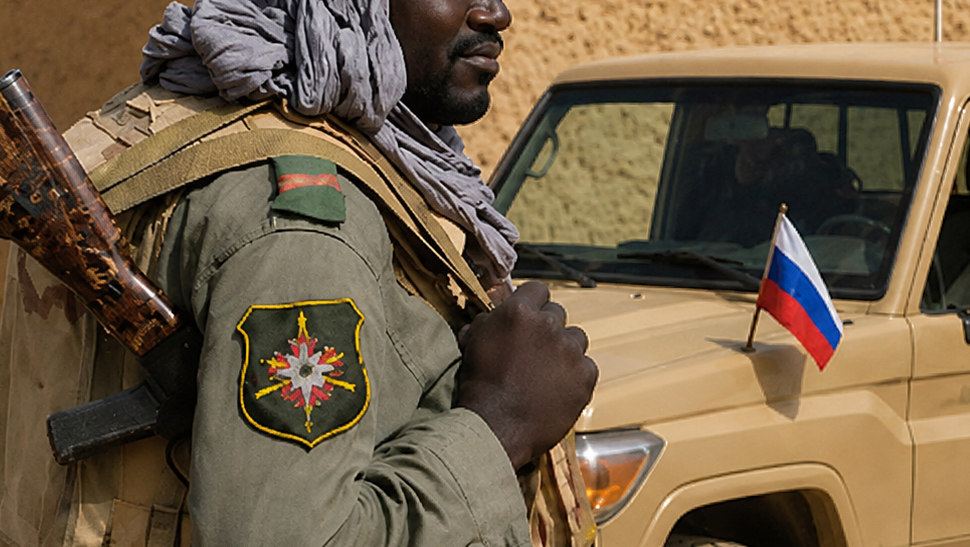

An African soldier stands in front of a truck with a Russian flag on the front.
During the decades of the Cold War, the Soviet Union was one of the most consequential foreign actors in Africa. Following the Soviet collapse in 1991, however, Russia’s profile receded. Resource constraints meant that Moscow was unable to continue the same scale and pace of activity on the continent. At the same time, ties with African nations slid down the list of priorities for the Kremlin’s post-Cold War leaders.
That has changed of late. Today, despite its difficult economic situation and limited military and diplomatic means, Russia has again become increasingly active and consequential on the continent. Its security interventions via the Wagner Group (now the Africa Corps) rank as its highest-profile activities. But the Kremlin is also running a range of diplomatic, economic, and intelligence activities among numerous nations across the length and breadth of Africa. This broad-based approach reflects the importance that Russia, under Vladimir Putin, has come to attach to the continent. It also signals Moscow’s determination to remain a player there for the long term.
The Soviets in South Africa
The USSR considered Africa an important front in its Cold War struggle for global influence. It saw the continent’s anti-colonial struggles as opportunities to weaken its great enemy, the free and capitalist countries of the West, and vied with China to lead the African component of the global communist revolution. It likewise recognized the usefulness of the continent for projecting power into the Atlantic and Indian Oceans, including over key maritime routes, and pursued trade and investment with African states as well.
During those decades, the USSR’s most dramatic interventions were security related. Its military advisors deployed across the continent, including to conflicts where they often coordinated with security personnel from other communist bloc countries, especially Cuba. The latter typically provided the bulk of foreign communist combat power; for instance, Havana deployed over 300,000 troops to Angola alone over the course of its 14-year involvement there.[1]
In close coordination with the Cubans, the Soviets provided other types of support as well, such as technicians and military advisers, including KGB officers. And while usually not front-line troops, these advisers were close enough to the action to suffer periodic mishaps. In 1988, for instance, Eritrean rebels captured three Soviets, including two colonels, during their resounding victory over the Ethiopian army at the battle of Afabet. Soviet advisers also died in combat in Ethiopia, as well as in Angola, Egypt, and likely Mozambique.
The total number of Soviets deployed to the continent during the Cold War remains hazy, but it likely numbered in the tens of thousands. All told, over 11,000 Soviets may have operated in Ethiopia alone (including against the Eritreans during their liberation struggle and against Somalia during the Ogaden War) with around 80 killed.[2] As with the number of Soviets deployed, the exact number of those killed while operating in Africa remains elusive.
At different points during this period, the USSR had use of naval facilities in, inter alia, Algeria, Angola, Egypt, Ethiopia (in the area that is now Eritrea), Guinea, and Somalia. Its vessels made regular calls to African ports on the Atlantic and Pacific Oceans and the Mediterranean Sea, and beginning in 1969, even maintained a continuous naval patrol in West African waters. The Kremlin also stationed various types of aircraft in countries such as Angola, Ethiopia, and Libya for reconnaissance and transport purposes.
The USSR was also a major supplier of weapons and military materiel to friendly countries and armed groups. Starting in 1958 and throughout the Cold War, the Soviet Union sent billions of dollars’ worth of military aid to Africa, though its help was concentrated and the scale of supply varied depending on the military and political circumstance. Between 1977 and 1978, for instance, it surged military assistance to Ethiopia,[3] and in two weeks in October 1973 sent nearly 10,000 tons of arms to Syria and Egypt after they suffered severe reversals following their attack on Israel.[4] In Angola, the Soviets sent an estimated 150,000 tons of military equipment to the MPLA in a few months in 1975 to take advantage of South Africa’s involvement in the war and the U.S.’s perceived weakness.[5]
While its security-related interventions were the most visible, Soviet activity in Africa included an array of traditional soft power activities—activities that continue to reverberate to this day. Tens of thousands of Africans received degrees or technical and military training from Soviet schools, often on Soviet scholarships. Among them were future presidents of Angola, Central African Republic (CAR), Comoros, South Africa, and Namibia, as well as a significant number of the elites of future ruling parties, such as the African National Congress (ANC), the People’s Movement for the Liberation of Angola (MPLA), and the South West Africa People’s Organization (SWAPO). In the late 1970s, in fact, the USSR hosted the most African students of any country after the U.S. and France.[6]
By 1991, the USSR also had built a resident diplomatic presence in nearly every independent African country. It likewise established cultural centers in key countries such as Algeria, Angola, Egypt, and Ethiopia, and signed scores of trade and economic assistance agreements with African partners.
Most of that infrastructure evaporated at the fall of the USSR. Consumed by the political and economic turmoil that followed, Russia for years had little presence in Africa. However, as its competition with the West sharpened, especially following its 2008 invasion of Georgia and then even more so after its 2022 full-scale invasion of Ukraine, Moscow refocused on Africa’s usefulness. Relying in part on the links and goodwill the Soviets had spent decades cultivating, Moscow is now trying to rebuild influence in Africa to stymie Western activity and influence, to reap economic benefits, and to avoid diplomatic isolation and international sanctions.
A Security Provider… Of Sorts
Those efforts are taking both traditional and non-traditional forms, though economic and military constraints have forced Russia to focus on a few key areas of engagement. Chief among them has been security cooperation, especially the deployment of the Wagner Group private military contractor.
Wagner arrived in Africa in 2017, when Sudanese dictator Omar al-Bashir hired it to guard mining sites and protect his regime. From there, Wagner operations spread to other African countries looking for similar services. It became deeply embedded in CAR by helping President Faustin-Archange Touadéra’s government fight off a variety of rebel groups. Wagner was rewarded primarily with gold and diamond mining concessions and export rights, logging concessions, and latitude to undertake local business activities such as selling alcohol.
Wagner’s involvement with African gold appears to have been of particular use to Moscow. The commodity can be used for direct payments that evade Western banking sanctions, and Russia has reportedly constructed a global gold laundering system that reaps hard currency. Wagner and Russia have earned over an estimated $2.5 billion from African gold primarily from CAR and Sudan—an important revenue stream given Russia’s current economic hardship.[7]
After Wagner founder Yevgeny Prigozhin died in a plane crash August 2023 following his abortive march on Moscow earlier that summer, Russia’s Ministry of Defense took over most of Wagner’s operations in Africa, rebranding the organization as the “Africa Corps.” Moscow has largely continued Wagner’s operations, but no longer tries to maintain the fig leaf of deniability that Wagner provided. It instead openly runs the Africa Corps.
While the Kremlin managed the transition smoothly, some of the resulting operations face serious headwinds, particularly in the Sahel region. In July 2024, for instance, a combined terrorist and rebel force demolished a Wagner and Malian army convoy in northern Mali, likely killing over a hundred Malian soldiers and Wagner fighters, including several senior commanders. And this April, Africa Corps evacuated from the important northeastern city of Kidal in Mali during a nation-spanning offensive by insurgents.[8]
Meanwhile, the Africa Corps likely exacerbates local governance problems and heightens the appeal of terrorist ideology. Its brutal presence almost certainly deepens people’s disillusionment with their governments and makes terrorists’ claims that their interpretation of Islam is the key to order and renewal all the more compelling.
While Africa Corps is the best-known form of Russian security cooperation in Africa, it is hardly the only one. Between 2018 and 2022, Russia became the largest supplier of arms to Africa.[9] Several countries (such as Algeria, Angola, and Egypt) accounted for the lion’s share of imports, but a broad range of African nations have acquired Russian weapons because they are relatively cheap and easy to operate, and because some African militaries are familiar with Soviet-era arms.
However, Russia’s full-scale invasion of Ukraine in 2022 limited the number of weapons it could ship to the continent. China is now the top arms supplier to Africa, though Russia’s willingness to sell weapons to authoritarian and abusive regimes ensures continued sales to Africa, albeit at a reduced level.
Moscow has also formalized security partnerships with various African countries. The details are murky, but in 2023 President Putin claimed that Russia had such agreements with 40 different African states.[10] These agreements likely cover the military training that Russia regularly conducts in places such as Mali, Burkina Faso, CAR, Equatorial Guinea, Libya, Madagascar, Republic of Congo, and Togo. And at least some of them include protection for the head of state or training for presidential guards.
Naval engagements make up a smaller part of Russia’s security cooperation with African states, but have followed the same pattern of growth. In the last few years alone, Moscow dispatched its navy for port visits to Angola, Benin, Cameroon, Djibouti, Equatorial Guinea, Eritrea, Kenya, Namibia, Sao Tome and Principe, and South Africa. The Russian navy also participated in joint or multilateral drills with Algeria, Egypt, Eritrea, and South Africa. The first such drills with Egypt, known as “The Bridge of Friendship,” have run routinely since 2015. In 2020, they for the first time included a visit to the Black Sea by the Egyptian navy.
Moscow likewise seems to covet a naval base in Africa, though some of its efforts in this regard may be designed at least partly to stir consternation in Western capitals. It already has the use of Tobruk in Libya, but in an unusually senior and powerful display for a typical African port call, a Russian delegation headed by the naval deputy commander in chief and featuring a modernized frigate visited Massawa, Eritrea, in 2024.
While nothing has materialized from that visit, Moscow has made more substantive progress with Sudan. Since at least 2017, Moscow has been discussing with Khartoum the possibility of establishing a naval base on the Red Sea. In 2025, the Sudanese Armed Forces (SAF) reportedly granted Russia its wish, offering it basing rights in Port Sudan.[11] The agreement, however, must be ratified by the Sudanese parliament, which hasn’t met since 2019 and is unlikely to do so any time soon.
Given the strategic interests involved, however, Russia and Sudan could treat that matter as a mere formality and proceed anyway. How quickly that might develop depends on Russia’s difficult economic and political situation. But because a naval base would facilitate several key goals on the continent, it will likely remain on the wish list for Russian strategic planners for the foreseeable future.
Small Investments, Outsized Returns
Moscow can be counted on to continue prioritizing its security cooperation in Africa. But it is simultaneously also running a range of diplomatic, economic, and intelligence activities there, signaling its determination to regain broad and lasting influence.
Russian economic activity with Africa is minor, apart from a few industries where it has carved out a meaningful role. Russian oil and gas companies such as Lukoil, Gazprom, and Rosneft have been active, especially in North Africa, for several decades now, though they also operate in sub-Saharan Africa. While sanctions have forced Lukoil to begin selling off its African assets, other Russian energy companies are continuing or expanding their African operations.[12]
Following European efforts to diversify away from its oil and gas, Russia turned to Asia and Africa to make up some of the lost revenue. From 2022 to 2023, its oil sales to Africa jumped more than 140%.[13] According to one Russian university analysis, Africa now buys around 15%of Russia’s total oil, gas, and petroleum products exports.
Meanwhile, Russia’s state-owned atomic agency, Rosatom, is a major, perhaps even the dominant, player in Africa’s nascent nuclear energy industry. It has signed cooperation agreements with at least 20 African countries, including recently with Mali and Niger. However, only around 15 of those agreements appear to be currently active.[15] And only one, Egypt’s El Dabaa project, has actually broken ground. Nevertheless, support for Russia’s nuclear energy expansion in Africa goes all the way to the top of the Kremlin, so it will inevitably remain a priority.
Other products that prominently feature in the Russia-Africa relationship include grain and fertilizer. Russia’s full-scale invasion of Ukraine badly hurt numerous African states that relied on wheat exports from the region. Since then, Russia has tightened its grip on the global market and now supplies about 40% of Africa’s imported wheat.[16] Russia’s provision of fertilizer to Africa tells a similar story. Between 2021 and 2024, exports to Africa increased by 50% and Russia now provides about 20% of Africa’s fertilizer, according to Russian sources.[17]
While small compared to that of many other countries, Russia’s trade with Africa is so concentrated on critical commodities that it gives Moscow outsized influence there. Countries that are reliant on Russian wheat, fertilizer, and oil wish to maintain good relations with Moscow as they fear the potential consequences of a diplomatic falling out. The Kremlin, for its part, is well aware of the leverage it possesses.
Open Diplomacy, Hidden Influence
Moscow clearly recognizes that there are diplomatic wins to be had in Africa. Well over half of the continent’s 54 countries voted against, abstained, or were absent on the most recent United Nations resolutions condemning Russia’s full-scale invasion of Ukraine. African leaders regularly visit Russia, including for the periodic Russia-Africa Summit that the Kremlin now hosts. The first, in Sochi in 2019, gathered more than 40 African heads of state. The second, in St. Petersburg in 2023, only brought together 17 due to diplomatic fallout from the Ukraine war. The third iteration of the event will probably be held in Moscow this October and is likely to draw more heads of state than the previous one. This sort of high-level and routine African diplomatic engagement is a valuable firebreak for Russia against international isolation.
While some of the hesitance by African states to condemn Russia, or their outright support for Moscow, stems from ideological affinity, Russia’s diplomatic surge might play a role as well. Foreign Minister Sergey Lavrov has been a frequent visitor to the continent and recently announced that Moscow will soon open 4 new embassies in Africa to complement the 45 already there.[18]
Russian diplomacy with Africa includes a variety of soft power initiatives, including sub-national engagements. According to Lavrov, 81 Russian regions cooperate in some form with African countries, though it is unclear how active these relationships are. Moscow has also built 25 “Russian Houses” on the continent. While these are purportedly centers for teaching Russian and promoting Russian culture, the country’s intelligence services also reportedly use them to identify potential recruits for the Russian military, to launch information operations, and to enroll intelligence assets.[19]
The presence of the Russian Orthodox Church, widely considered to be heavily influenced by the Kremlin, has also grown rapidly in Africa. The Church claims that at the end of 2021, there were only 4 priests in 4 countries operating in 5 parishes in all of Africa. But by August 2025, those numbers had risen to over 270 priests and deacons, in 36 countries and 32 parishes.[20] Critiques of the West as decadent and Godless by the Russian state and Orthodox Church likely appeal to Africans who are generally socially conservative, thereby making the Church a potentially valuable vector for Russian propaganda and image-burnishing. The Africa section of Russia’s official 2023 Foreign Policy Concept Paper, in fact, listed “protecting traditional spiritual and moral values” as one of its priorities for its Africa engagement.[21]
Moscow has also attacked Western influence in Africa with an array of influence operations. While the effectiveness of these is disputed, they are often tactically sophisticated, adaptable and tailored in nature. In the Sahel, for instance, Russian operatives have played upon anti-French and broader anti-Western sentiments to help drive Western counterterrorism forces from the region. Moscow likewise props up virulently pro-Russian and anti-Western African influencers. One, Kemi Séba, was recently arrested in South Africa for supporting a foiled coup in Benin. He attended the first Russia-Africa Summit and spoke at the second along with another prominent “pan-African” advocate, Swiss-Cameroonian Nathalie Yamb. The U.S. State Department links both to the Wagner Group’s network, and the EU sanctioned Yamb last year. And, just as Moscow subsumed the Wagner Group into its Ministry of Defense, its Foreign Intelligence Service, the SVR, inherited Wagner’s clandestine influence operations. A sister effort, the “African Initiative,” centralizes the public-facing Russian influence operations on the continent, from journalism training to cultural centers, as Moscow builds the infrastructure for long-term influence on the continent.[22]
Other elements of Russian intelligence operations in Africa occasionally emerge into public view. Recently, Russia’s Federal Security Service reportedly paid an Afrikaner separatist leader to try to help Kemi Séba escape into Zimbabwe.[23] Last year, South African police also opened an investigation into Duduzile Zuma-Sambudla, daughter of former South African president Jacob Zuma, who in the 1970s trained on military intelligence in the USSR, for tricking South African men into joining the Russian military.[24]
Russia has funded African political parties as well. In 2022, South Africa’s ANC accepted a large donation from close Putin ally Viktor Vekselberg, who has been sanctioned by the United States. A trove of leaked documents collected by opposition outlet Forbidden Stories revealed as well that the ANC sought and received help from Russian agents to influence elections in South Africa.[25] Moscow also at times allegedly paid monthly stipends to various senior ANC officials.
The pro-Russian stance of some of these factions is likely still influenced by Soviet-era ties. Coupled with the ideological alignment many still share with Moscow, they need few inducements to act in solidarity with Russia. But newer parties, such as the “United Patriotic Awakening of Madagascar” (RPMU) party formed in March 2026, are so pro-Russian that Moscow likely had a hand in their creation. The RPMU was formed, in fact, soon after the new leader of Madagascar’s coup government visited Moscow for a friendly meeting with President Putin.
In all these cases, Russia’s information and intelligence operations focus on buttressing “non-aligned” or pro-Russian entities and attacking the West. Depending on the specific context of each situation, Russia’s activities may seek to undermine Western-friendly governments (such as that of Angola), drive out or diminish Western influence throughout the continent, secure beneficial economic arrangements (including sweetheart deals for Putin cronies), or sow discord and confusion of the type that opens opportunities for Moscow.
Planning to Stay
Russia’s activism reflects the importance of Africa to its foreign policy goals. But the Kremlin’s aggressive posture carries risks. Failures in security cooperation (like the Africa Corps’ recent rout in Mali) will inevitably dent its image, while the effectiveness of its propaganda activities appears mixed at best. Moscow’s double-dealing may catch up to it as well. The Kremlin’s claims of “anti-imperialist” solidarity surely appeal to many African elites. But first the Soviets and now the Russians have run aggressive covert operations in African countries against the political opposition and sitting governments alike, leading to the arrest of Russian operatives in some cases.
Moscow is likewise fueling regional conflicts. Russian entities, for instance, have supported both sides of the ruinous civil war in Sudan. As these types of activities increasingly come to light, they could breed disillusionment among African governments.
Still, corrupt and authoritarian regimes of the type that value Moscow’s services are common. Many African elites also share Russia’s distaste for a U.S.-led world order, and Soviet nostalgia lingers in some African circles. Its potency will fade as the liberation era generation leaves the political stage, but for now it is likely to remain meaningful—especially in Southern Africa, where many struggle-era parties remain in power.
The continent’s political terrain, in other words, is still hospitable for Moscow for the moment. The Kremlin is seeking to make the most of this state of affairs, and to extract outsized benefits from the limited means it can deploy on the continent. The nature of this engagement, moreover, will only change when there is meaningful political transformation in Russia itself. Until then, those seeking a less violent, more prosperous future for Africa will need to contend with a Russia that is driving the continent in the opposite direction.
-
[1] Scott Kraft, “Cuban Troops Start Pullout From Angola,” Los Angeles Times, January 11, 1989, https://www.latimes.com/archives/la-xpm-1989-01-11-mn-212-story.html.
[2] Sam Wilkins, “To the Last Bullet: The Cold War’s Last Gasps and Enduring Impact in the Horn of Africa,” The Strategy Bridge, September 3, 2021, https://thestrategybridge.org/the-bridge/2021/9/3/to-the-last-bullet-the-cold-wars-last-gasps-and-enduring-impact-in-the-horn-of-africa.
[3] Central Intelligence Agency, Directorate of Intelligence, “Ethiopia: The Impact of Soviet Military Assistance,” January 1983, https://www.cia.gov/readingroom/docs/DOC_0000496797.pdf.
[4] Air Force Institute of Technology, “Soviet Strategic Airlift (U),” September 1983, https://apps.dtic.mil/sti/tr/pdf/ADA134279.pdf.
[5] “Soviet Tightens Grasp in Africa,” New York Times, December 14, 1975, https://www.nytimes.com/1975/12/14/archives/soviet-tightens-grasp-in-africa-150000-tons-of-military-aid.html.
[6] See, for instance, Constantin Katsakioris, “Return from the USSR: Soviet-educated Africans, politics and work, 1960s-2000s,” Canadian Journal of African Studies 55, iss. 2, February 2021, https://www.researchgate.net/publication/349372232_Return_from_the_USSR_Soviet-educated_Africans_politics_and_work_1960s-2000s.
[7] The Blood Gold Report: How the Kremlin is Using Wagner to Launder Billions in African Gold (The Blood Gold Report, December 2023), https://bloodgoldreport.com/wp-content/uploads/2023/12/The-Blood-Gold-Report-2023-December.pdf.
[8] “Russia’s Africa Corps confirms withdrawal from Mali’s Kidal,” Reuters, April 27, 2026, https://www.reuters.com/world/africa/russias-africa-corps-confirms-withdrawal-malis-kidal-2026-04-27/.
[9] Marion Douet, “Russia overtakes China as leading arms seller in sub-Saharan Africa,” Le Monde, March 28, 2023, https://www.lemonde.fr/en/le-monde-africa/article/2023/03/28/russia-overtakes-china-as-leading-arms-seller-in-sub-saharan-africa_6021018_124.html.
[10] “Russia, Burkina Faso talk military cooperation,” Reuters, October 8, 2024, https://www.reuters.com/world/russia-burkina-faso-talk-military-cooperation-2024-10-09/.
[11] Benoit Faucon, “Sudan Offers Russia Its First Naval Base in Africa,” The Wall Street Journal, December 1, 2025, https://www.wsj.com/world/africa/sudan-offers-russia-its-first-naval-base-in-africa-0748e810.
[12] “Gazprom to start hydrocarbon output at project in Algeria in 2026 – TASS cites minister,” Reuters, July 27, 2023, https://www.reuters.com/article/business/energy/gazprom-to-start-hydrocarbon-output-at-project-in-algeria-in-2026-tass-cites-m-idUSR4N36300J/.
[13] Gavin Maguire, “Oil demand in Asia, Africa boosted by cheap Russian crude,” Reuters, January 24, 2024, https://www.reuters.com/markets/commodities/oil-demand-asia-africa-boosted-by-cheap-russian-crude-2024-01-24/.
[14] “Andrey Federov: ‘There is no reason to expect a collapse in Russian hydrocarbon supplies to Africa, nor secondary sanctions against African countries,” Russian Academy of Sciences Institute for African Studies, August 13, 2025, https://web.archive.org/web/20260427204618/https:/www.inafran.ru/en/node/1690.
[15] Duggan Flanakin, “Russia Flexing Nuclear Muscles in Africa,” RealClearEnergy, August 12, 2025, https://www.realclearenergy.org/articles/2025/08/12/russia_flexing_nuclear_energy_muscles_in_africa_1128414.html.
[16] Salimata Kone, “Russia-Africa: Moscow becomes continent’s top grain supplier,” The Africa Report, March 17, 2025, https://www.theafricareport.com/379200/russia-africa-moscow-becomes-continents-top-grain-supplier/.
[17] V. Yu. Sviridov and T. A. Andreeva, “Russian Fertilizers as an Element of Strengthening Africa’s Food Sovereignty,” Journal of the Institute for African Studies no. 2, iss. 67, 2024, https://africajournal.ru/wp-content/uploads/2024/07/Sviridov-Russian-Fertilizers.pdf.
[18] “Moscow nearing full embassy coverage across Africa – Lavrov,” RT, April 8, 2026, https://www.rt.com/africa/637722-moscow-nears-full-embassy-coverage-africa/.
[19] “From Dostoevsky to Drone Strikes: The Double Life of Russian Houses,” INPACT, December 2025, https://alleyesonwagner.org/2025/12/12/from-dostoevsky-to-drone-strikes-the-double-life-of-russian-houses/; Léa Peruchon and Eloïse Layan, “In the Sahel, journalists, activists and NGOs in the crosshairs of Russian agents from ‘The Company’,” Forbidden Stories, March 27, 2026, https://forbiddenstories.org/sahel-journalists-activists-ngos-russian-agents/.
[20] The Russian Orthodox Church, “His Holiness Patriarch Kirill meets with delegation of the Patriarchal Exarchate of Africa,” August 27, 2025, https://mospat.ru/en/news/93502/.
[21] Ministry of Foreign Affairs of the Russian Federation, “The Concept of the Foreign Policy of the Russian Federation,” March 31, 2023, https://mid.ru/en/foreign_policy/fundamental_documents/1860586/.
[22] Léa Peruchon, “Propaganda Machine: Russia’s information offensive in the Sahel,” Forbidden Stories, November 21, 2024, https://forbiddenstories.org/propaganda-machine-russias-information-offensive-in-the-sahel/.
[23] “Bitterenders Youth Leader Arrest Exposes Russian Support for SA’s White Right,” The Common Sense, April 22, 2026, https://forbiddenstories.org/propaganda-machine-russias-information-offensive-in-the-sahel/.
[24] Mogomotsi Magome, “Daughter of ex-South African leader Zuma is accused of luring men to fight in Russia-Ukraine war,” Associated Press, November 24, 2025, https://apnews.com/article/south-africa-zuma-daughter-russia-mercenaries-f3eb0c8fa513610d4e9785037fb7c60b.
[25] Eloïse Layan and Léa Peruchon, “Maintaining friendly powers at all costs,” Forbidden Stories, March 13, 2026, https://forbiddenstories.org/russian-influence-south-africa-namibia-madagascar/.