

THE CHALLENGE OF PUTIN'S RUSSIA
Russia’s Tottering War Economy
Anders Åslund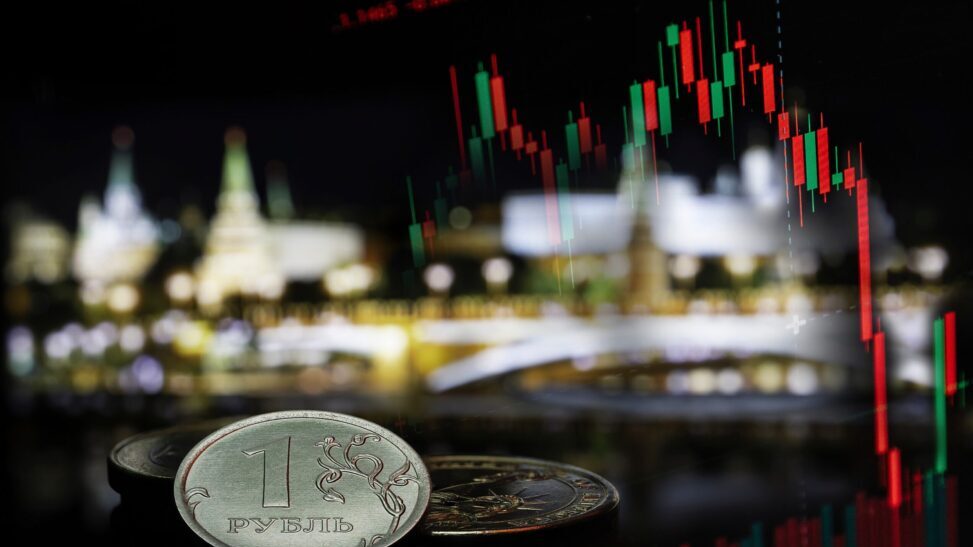

A pile of rubles in front of a blurry Moscow skyline, with a stock market indicator chart showing stock crash.
Contrary to the wishes of many in the West, Russia’s economy isn’t collapsing at present. Neither is it thriving, however. Rather, the picture is considerably more complex. The Russian “war economy” (those segments that have been repurposed to assist the country’s ongoing war of aggression against Ukraine) has expanded significantly, while the rest of its constituent parts have remained stagnant. The Russian population, meanwhile, is growing increasingly pessimistic, auguring potential instability ahead.
Stagnation and its Discontents
Vladimir Putin used to boast about Russia being an energy superpower. As late as 2023 and 2024, Russia’s president was still insisting that the national economy was strong, and that the raft of Western sanctions levied against it had been largely ineffective.
At first blush, there was reason for Putin’s bluster. Russia enjoyed two years of uncommonly good growth: 2023, when it grew by 4.1%, and 2024, when it expanded by 4.9%. Since October of 2024, however, the dominant assessment of the Russian economy has been one of “stagflation.”[1] The previous drivers of the country’s economic growth have been exhausted, and Russia’s growth rate has fallen back to 1% a year, which was the country’s long-term norm from 2009-2022.
This grim outlook now seems locked in. For 2026-2028, nearly all forecasters expect growth of between 0% and 1% a year as a result of factors like financing shortages, the effects of labor and modern technology, as well as high inflation. Russia’s public finances, meanwhile, are tightly constrained because of low taxes and a lack of access to international borrowing. As a result, Russia cannot sustainably run an annual budget deficit of more than 2% of GDP. In 2025, it reached a maximum of 2.6% of GDP, a figure which corresponds to $70 billion.
With GDP $2.6 trillion in 2025, Russia needs about $50 billion annually to finance its financial gap. But because of Western sanctions, it has had virtually no access to international financial markets for more than a decade. It must therefore rely on taxes, domestic borrowing, and drawdowns from the National Welfare Fund to stay solvent.
In ordinary times, this might be manageable. Ever since the severe financial crises of the 1990s, Russia’s economy has been managed by highly competent technocrats. These figures were once called reformers, later “systemic liberals,” and are now simply seen as apolitical technocrats. With few exceptions, Putin has given this cohort considerable autonomy in macroeconomic policy. The leading figures—among them Finance Minister Anton Siluanov (in office since 2011) and Central Bank Governor Elvira Nabiullina (in her post since 2013)—have long tenures, are considered competent, and remain loyal to the Kremlin.
Putin’s own views, meanwhile, were shaped by the chaos of the 1990s. During that period, he learned that a financial crisis can break apart any government. He therefore settled on a conservative fiscal policy: one of near-balanced budgets, minimal public debt (currently 15% of GDP), and high interest rates to contain inflation. Until the invasion of Ukraine, Russia maintained large central bank reserves and low foreign debt.
But war and sanctions have strained Russia’s public finances in many ways. Inflation has risen, international financing is blocked, capital flight continues, revenues are under pressure, and military demands keep growing. Moreover, Russia’s long-term campaign against Ukraine has caused two major currency crises: the first in 2014, and another in March-April of 2022. On both occasions, the ruble exchange rate plunged and inflation skyrocketed. Both times, however, the Central Bank of Russia responded with sharp interest rate hikes and managed to stabilize the situation.
Still, the ruble exchange rate remains quite volatile. Official inflation figures appear suspiciously low, and the Russian government has banned independent inflation surveys. Meanwhile, nearly three-quarters of the country’s banking assets are held by a few state-owned banks, mainly Sberbank and VTB. These institutions, in turn, have channeled vast credits to arms producers and bought up large volumes of government bonds. All of which helps to explain how, until quite recently, the Kremlin had managed to paint a comparatively rosy picture of the country’s fiscal health.
Have Russian Military Expenditures Peaked?
A closer examination, however, makes clear that all is not well. The Russian federal budget for 2026 is revealing in this regard. Until 2025, the country’s military spending rose sharply and regularly; between 2021 and 2025, it grew by 250 percent.[2] But then, it suddenly stopped. The Kremlin now plans to maintain the same military and security expenditures in this year as it did in 2025: about $183 billion. As a share of its total federal expenditures, this represents a slight decline, from 41% in 2025 to 38% in 2026.[3]
What does this tell us? One important takeaway is that the Kremlin is no longer hoping for a sudden, decisive victory. Instead, it is preparing for a long war of attrition. That shift will naturally disappoint the country’s ultra-nationalists, who have long anticipated some sort of dramatic breakthrough.
Another is that the costs of militarization are increasingly being passed on to ordinary Russians. Until recently, the Kremlin took pains to present its “special military operation” against Ukraine as a free benefit to the Russian nation. No longer. The 2026 budget hikes the country’s value-added tax from 20% to 22%, a move which constitutes a direct burden on ordinary Russian consumers. Taxation rules for small entrepreneurs are being tightened as well, while reductions in social benefits previously put in place by the Russian government as a belt-tightening measure continue. Effectively, the Kremlin is now telling the Russian people that they need to pay for its unsuccessful war.
Even so, Russia’s war economy now faces four critical constraints: financial reserves are running out, energy revenues are declining, there is an extreme labor shortage; and a shortfall of imported technology exists. All of these problems are linked to the war and Western sanctions.
Sanctions
The financial sanctions levied on Russia by the West have been extensive, and these measures have had far greater impact than generally understood. Beginning in 2014, following Russia’s initial invasion of Ukraine and annexation of Crimea, and then greatly expanding in 2022, following the launch of the full-scale invasion, they have cut off most of the Russian banking system from SWIFT, the Society for Worldwide Interbank Financial Telecommunication, and frozen some $300 billion of Russian assets abroad. (Those assets have been contemplated for seizure by European authorities as a means to support Ukraine. Resistance from some quarters, however, has led Europe to opt to use only the interest generated by them instead.)
The impact has been substantial. Russia has been locked out of international borrowing and forced to pay back its debts when they have matured. Even so, Moscow has mostly managed to do so. At the end of 2013, Russia’s total foreign debt amounted to $729 billion; by the beginning of this year, it had shrunk by more than half, to $319 billion.[4] But there has nonetheless been a clear chilling effect. Even China, with whom Russia has erected a purportedly “no limits” partnership, has largely scaled back its financing of the Russian state.
Foreign trade and energy
In 2014, the late Senator John McCain famously quipped that Russia is a “gas station run by Mafia masquerading as a country.” At that time, two-thirds of Russia’s exports and half of its federal revenues came from energy exports, that is, oil and natural gas.
The prices of oil and gas vary greatly on the world market, though, and so do the revenues Russia secures through their export. In 2022, Germany’s sudden decision to stop buying Russian gas at the same time as it closed down its last nuclear power stations led to an extreme peak in the European gas prices, giving Russia record export revenues of $592 billion that year. Those subsequently stayed at around $425 billion a year from 2023 to 2025.[5]
The EU has taken the lead on energy sanctions against Russia, and as of this writing has passed 20 “packages” of such measures. These have included a progressive tightening of the noose around Russia’s energy trade. In 2022, for instance, Western countries introduced a price cap for Russian oil as a means of reducing the revenues flowing to the Kremlin from its energy sales. Initially, the price for Russian oil was capped at $60 per barrel, but in 2025 it was slashed further, to $47.6 per barrel. In parallel, the West has sanctioned nearly 600 Russian shadow fleet tankers.[6] As a result, Russia is set to receive at least 1% of GDP less in federal revenues this year.
Labor shortages
Russia faces an acute labor shortage. Official unemployment has gradually declined from 4% in 2022 (in effect, full employment) to only 2% at present[7]—meaning that most enterprises are actually experiencing a shortage of labor. When Russia attempted a partial mobilization for the war in September 2022, approximately one million Russians emigrated, a significant portion of them young, well-educated men.[8] That has deterred Russian authorities from initiating another mobilization, but in practical terms the damage has already been done. The current state of labor scarcity holds back production and drives up wages. Moreover, foreign labor—traditionally a major input into the Russian economy—has dwindled as well, with migrant workers now afraid of traveling to Russia after 27,000 foreign men were drafted into the army in what appears to have been a not necessarily voluntary fashion.[9]
The grinding nature of the Ukraine war is having an effect as well. The conflict has proven exceedingly costly for Russia, in human terms. More than 1.3 million soldiers have now been killed or injured as a result of the war in Ukraine,[10] orders of magnitude more than perished during the decade-long Soviet invasion and occupation of Afghanistan (1979-1989). And because the Russian armed forces require 35,000-40,000 new recruits each month due to the costly nature of the conflict, the Kremlin can barely keep up with the demand, especially after regional governors have slashed the previously ample military bonuses because of fiscal belt-tightening.[11]
All this has led to an extreme shortage of labor in the Russian economy. The problem has become so acute that Central Bank governor Nabiullina has defined it as the greatest problem now confronting Russian economy.[12]
Corruption
Because of sanctions and broad visa denials, Russia has become highly isolated from the West. Few desirable countries are accessible to Russians, and hundreds of established Western companies have withdrawn from Russia in order to salvage their reputation and capital.[13] Those that remain risk becoming subject to extortion, with many turning into victims of “corporate raiding” (ie: theft either by businessmen close to Putin or state corporations).
The same is true of prominent Russian businessmen. Since the start of the war, dozens have died after mysteriously falling out of windows. Power remains concentrated in the hands of longtime Putin loyalists like Igor Sechin, Alexei Miller, and Arkady Rotenberg, who control the commanding heights of the Russian economy. Competence has taken second place to loyalty, while corruption has worsened. Russia’s ranking on the Transparency International “Corruption Perceptions Index,” a leading global indicator, has slipped to 152 out of 182 countries, cementing its position as one of the most corrupt nations in the world.[14]
Something is Rotten in Muscovy
The beginning of 2026 saw two dramatic but contradictory developments in the Russian economy. On the one hand, Western oil sanctions had finally begun to bite, causing a severe financial squeeze. On the other hand, the U.S.-Israeli war on Iran boosted the global price of oil, while the U.S. relaxed oil sanctions on Russia, cumulatively creating the potential for an economic windfall.
On April 15th, President Putin held a meeting with his main economic policymakers at which he lamented that the Economic Development Ministry claimed GDP in January and February was 1.8% lower than in the same period last year.[15] That economic slowdown was driven by falling investment, weak business activity and declining oil and gas revenues. In particular, construction in Russia had fallen sharply. Putin has demanded improvement, albeit without proposing any concrete cure. An outside observer gets the impression that the resources needed for a course correction have by now been exhausted.
The Iran war has offered something of a reprieve. As the Russian economy finally appeared to enter a serious budget crisis, the conflict with Iran has given it a much-needed shot in the arm.[16] So, too, has the Trump administration’s decision to provide Russia with (presumably temporary) relief from oil sanctions, whether to stabilize global energy markets, to incentivize peace with Ukraine, or for some other reason.
The KSE Institute in Kyiv has offered up the most detailed numbers in this regard.[17] In 2025, the Institute notes, Russia’s oil export earnings amounted to $160 billion. In the central scenario examined by KSE, Russia would reap $235 billion in oil revenues as a result of the war, reversing the previous trendline of decline and potentially salvaging Putin’s regime from a budget crisis, as well as a likely domestic political crisis. All of which has arguably made Russia the main beneficiary from the U.S. war on Iran.
Even so, the larger trajectory is clear(and dismal). The deeper question is not whether the Russian economy will “collapse”; economic hardship alone rarely topples regimes. Rather it is how much pain the Russian people and the country’s elites are willing to tolerate before demanding real change.
Here, recent days show signs of movement. Even official opinion polls now highlight deep malaise within the country. [18] While many Russians claim that they want to “win” in Ukraine, an even larger majority simply want the war to end. The key question is whether they will eventually act on that desire.
-
[1] Anders Åslund, “Stagflation is Hitting Russia’s War Economy,” Project Syndicate, August 7, 2025, https://www.project-syndicate.org/commentary/russia-war-economy-stagflation-reserves-dwindling-and-labor-is-scarce-by-anders-aslund-2025-08. See also Alexandra Prokopenko, “Russia’s economy has entered the death zone,” The Economist, February 16, 2026, https://www.economist.com/by-invitation/2026/02/16/russias-economy-has-entered-the-death-zone.
[2] Vladimir Milov, “Russia’s Budget Crisis, Explained and What It Means for the War in Ukraine,” Free Russia Foundation, October 2025, 12, https://thinktank.4freerussia.org/wp-content/uploads/2025/11/Digital-November-Russias-Budget-Crisis-Explained-.pdf.
[3] Julian Cooper, “Preparing for a Fourth Year of War: Military Spending in Russia’s Budget for 2025,” SIPRI Insights on Peace and Security, April 2025, 11, https://www.sipri.org/publications/2025/sipri-insights-peace-and-security/preparing-fourth-year-war-military-spending-russias-budget-2025.
[4] Illia Kabachynskyi, “Russia’s War Chest Is Drying Up: How Sanctions and Oil Prices Bite Into the National Wealth Fund,” United24 Media, July 3, 2025, https://united24media.com/war-in-ukraine/russias-war-chest-is-drying-up-how-sanctions-and-oil-prices-bite-into-the-national-wealth-fund-9599.
[5] Bank of Finland, BOFIT, Institute for Emerging Economies, Russia Statistics, n.d., https://www.bofit.fi/en/monitoring/statistics/russia-statistics/
[6] Barbara Moens, “EU hits Russia with fresh sanctions aimed at banking and energy,” Financial Times, July 18, 2025. https://www.ft.com/content/9afaf3e9-bd93-4feb-bd0c-90c73cb77c93?syn-25a6b1a6=1; See also Sergey Vakulenko, “What the Russian Energy Sector Stands to Gain from War in the Middle East,” Carnegie Politika, March 24, 2026, https://carnegieendowment.org/russia-eurasia/politika/2026/03/russia-oil-iran-war-consequences.
[7] Bank of Finland, BOFIT, Institute for Emerging Economies, Russia Statistics, op. cit.
[8] Dara Massicot, “Russian Military Wartime Personnel Recruiting and Retention 2022–2023,” RAND Research Report, July 16, 2024, https://www.rand.org/pubs/research_reports/RRA2061-4.html.
[9] Anastasiia Verzun, “Foreign fighters in Russian ranks rise above 27,000, Ukraine says,” Kyiv Independent, March 30, 2026, https://kyivindependent.com/foreign-fighters-in-russian-ranks-rise-to-27-407-ukraine-says/.
[10] Seth Jones and Riley McCabe, “Russia’s Grinding War in Ukraine,” Center for Strategic & International Studies, January 27, 2026, https://www.csis.org/analysis/russias-grinding-war-ukraine; “General Staff: Russia has lost 1,344,180 troops in Ukraine since Feb. 24, 2022,” Kyiv Independent, May 13, 2026, https://kyivindependent.com/general-staff-russia-has-lost-1-344-180-troops-in-ukraine-since-feb-24-2022/.
[11] Ekaterina Bodyagina and Ibrahim Nader, “How Russia keeps raising an army to replace its dead,” Politico, December 5, 2025, https://www.politico.com/news/2025/12/05/russia-planned-war-of-attrition-00672960.
[12] “Russian Central Bank Governor Warns of Unprecedented Labor Shortage,” The Moscow Times, April 16, 2026, https://www.themoscowtimes.com/2026/04/16/russian-central-bank-governor-warns-of-unprecedented-labor-shortage-a92517.
[13] Jeffrey Sonnenfeld, “Over 1,000 Companies Have Curtailed Operations in Russia—But Some Remain,” Yale School of Management, May 13, 2026, https://som.yale.edu/story/2022/over-1000-companies-have-curtailed-operations-russia-some-remain.
[14] Transparency International. Corruption Perception Index 2025, n.d., https://www.transparency.org/en/cpi/2025.
[15] “Putin Demands Answers as Russia’s Economy Undershoots Expectations,” The Moscow Times, April 15, 2026, https://www.themoscowtimes.com/2026/04/15/putin-demands-answers-as-russias-economy-undershoots-expectations-a92514.
[16] Vladimir Milov, “Is the Oil Price Windfall from the Iran War Helping Putin?” Free Russia Foundation, April 10, 2026, https://freerussiafoundation.substack.com/p/is-the-oil-price-windfall-from-the; See also “Higher Oil Prices Bring at Least Temporary Relief for the Russian Economy,” BOFIT Weekly Review 13/2026, March 27, 2026, https://www.bofit.fi/en/monitoring/weekly/2026/vw202613_1/.
[17] Kyiv School of Economics Institute, “Assessment of the Iran War on Russia, KSE Institute, Monthly Digest, April 2026. https://sanctions.kse.ua/wp-content/uploads/2026/03/Iran-War-Impact-Assessment.pdf.
[18] Martin Fornusek, “A subtle drop in Putin’s ratings carries an unusual signal,” Kyiv Independent, May 6, 2026, https://kyivindependent.com/russias-online-crackdown-reveals-rift-in-kremlin/.