

THE CHALLENGE OF PUTIN'S RUSSIA
The Russian Total War Tradition
Stephen Blank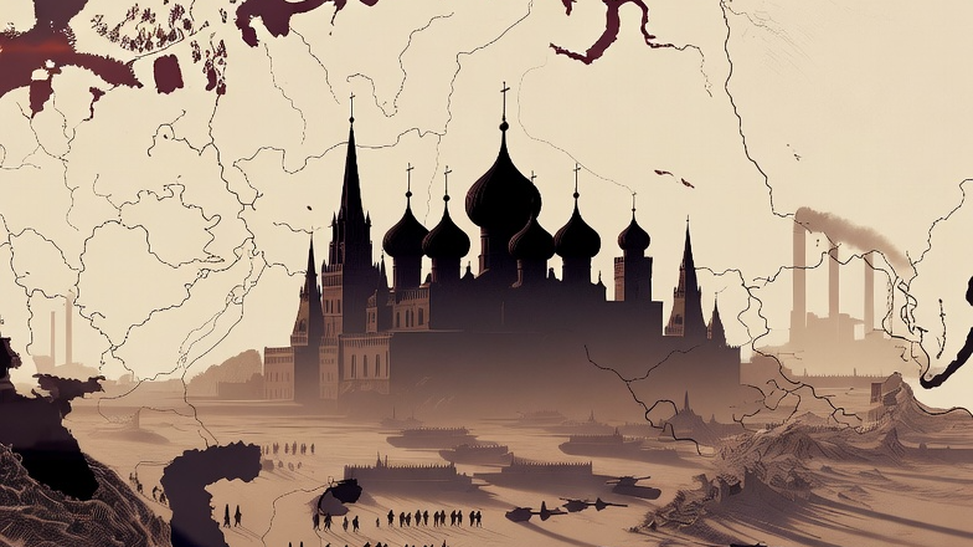

The skyline of the Kremlin set against a map of Russia.
Writing back in 1918, the American radical Randolph Bourne wryly observed that war reflects the health of the state. Whatever its other demerits, Bourne’s dictum was an accurate description of Russia’s extensive and intimate relationship with conflict.
Throughout Russian history, the regime in power there has measured the health of its state by its capacity for warmaking. Over time, the intrinsic and enduring militarization of the Russian state has shaped how Russia’s rulers have perceived and governed their empire and their relations with the rest of the world. That, in turn, tells us a great deal about the state of Russia today, and what it is liable to look like tomorrow.
A History Of Violence
Since at least the time of Ivan the Terrible (1530–84), Russian reforms have been aimed primarily at enhancing the state’s capability for waging war. This system reached its apogee under Soviet power, with ruinous results. As historians have diligently chronicled, excessive militarization on the part of the USSR was instrumental to the ultimate breakdown of the Soviet system. Nevertheless, in the post-Soviet period, the ambition to mobilize the entire economy and eligible manpower for military purposes returned with a vengeance. And today, this impulse is driving both the foreign and domestic policies of Vladimir Putin’s Russia.
The Kremlin is understandably loath to order a general call-up for its current “special military operation” against Ukraine, given the political and reputational costs that doing so would entail. But a creeping mobilization is nonetheless underway, along with active recruitment from places like North Korea, Asia, Africa, and Latin America.[1] Moreover, there is growing talk of an involuntary draft as the war’s costs continue to increase.[2]
At the same time, we are seeing a large-scale mobilization of economy and society for martial purposes, or, as the Wall Street Journal put it in a headline last year, “Putin Has Retooled His Economy to Focus Only On War.”[3] One can make a strong case that this focus has distinctly personal reasons, with Putin militarizing the Russian state in order to preserve the criminalized system of governance he has built up over the past quarter-century. But the problem runs deeper than Putin’s misrule, and extends to the country’s larger strategic outlook.
Russia’s president and his inner circle have convinced themselves that the country faces permanent, ongoing, and existential threats from the West, and framed state policy accordingly. They voluntarily adopted the Bolshevik threat assessment that the West represents a permanent threat to Russia either directly via invasion, or by fomenting “color revolutions” to undermine the country at home and on its periphery.[4] Suffice it to say, such thinking is utterly groundless. That, however, has not stopped it from being influential in the Kremlin’s corridors of power.
Likewise, Russia’s elites have accepted the Soviet notion that states like Poland are hostile to Moscow, not because of their own agency and history but because they are the puppets of great powers. As such, Russia’s neighbors, without any evidence, are deemed to be intrinsic enemies as well.
Guided by such perspectives, Russia’s current government has been at war with the U.S. and the broader West for more than a generation.[5] As long ago as 2005, then-Defense Minister Sergei Ivanov told the Russian Academy of Military Sciences: “Let us face it, there is a war against Russia under way, and it has been going on for quite a few years. No one declared war on us. There is not one country that would be in a state of war with Russia. But there are people and organizations in various countries, who take part in hostilities against the Russian Federation.”[6]
A decade later, Dmitri Trenin, Director of the Moscow office of the Carnegie Endowment, confirmed that, for some time now, “the Kremlin has been de facto operating in a war mode.” One sign of this war footing was that, by 2007-08, European security services were reporting across the board an enormous expansion in Russian espionage, both traditional and economic, across Europe.[7]
Regression to the (Soviet) Mean
Unfortunately, too many Western writers portray Russia’s “hybrid war” as something distinct from actual conflict. In doing so, they fail to realize that, as seen from Moscow, this sort of asymmetric action nonetheless reflects warfare, and Russia has effectively been at war with the West for at least twenty years.
Russian leaders do not attempt to hide this fact. Former President Dmitri Medvedev, now Putin’s bulldog as Secretary of the Security Council, has stated that “What is happening today is not a proxy war, but in fact, a fully-fledged war—launches of Western missiles, information from satellites [supplied to Ukraine], sanctions packages, loud statements about the militarization of Europe.”[8] In typical fashion, he also threatened missile strikes against Ukraine and the West. Putin and many others likewise depict the aggression against Ukraine as an existential war forced upon Russia by NATO.[9]
These remarks underscore the linkage in Russian strategic thinking between Moscow’s hybrid tactics against the West on the one hand, and Russia’s missile and nuclear arsenal on the other. This rhetoric, and much contemporary military writing, also conflates external and internal threats in a way strikingly similar to Soviet times. That shouldn’t be all that surprising, since the originators and purveyors of this assessment began their careers in the Soviet military and intelligence services (neither of which experienced meaningful post-Soviet reform). The resulting regression to the Soviet mean regarding threats and responses is therefore not surprising.
Empowering “Hybrid” Conflict
The results that follow are pronounced. Since Moscow conflates foreign and domestic threats, and is currently in no position to confront NATO, it must resort to a range of non-kinetic means.[10] These include subversion, information confrontation, the sabotage of infrastructure, assassinations, the operation of shadow fleets, and influence operations. Those tactics make up part of a larger hybrid campaign that is part of Russia’s generation-long global war for the recovery of its empire and global great power status.
Moreover, the linkage with nuclear power is intrinsic. Like its war of aggression against Ukraine, Russia’s “hybrid war” against Europe is unsustainable unless protected by frequent recourse to nuclear threats as a means of intimidation, blackmail, and deterrence. Russia has used such threats in abundance; as of this writing, Moscow has made 126 nuclear threats relating to Ukraine alone.[11]
As the Major Amos C. Fox observes, “The nuclear component is an inseparable part of Russian operational art that cannot be analyzed as a stand-alone issue” because it abets Russian conventional threats and aggression deterring meaningful adversary responses.[12] Fox characterizes the result as “cross-domain coercion,” a form of integrated influence “waged across several domains: nuclear, conventional, sub-conventional, and nonmilitary.”
But regardless of the methods employed at any given moment, this cross-domain coercion aims to manipulate an adversary’s perceptions, to alter its decision-making process, and to influence its strategic behavior, all while minimizing the scale of kinetic force that is used. As the scholar Dimitry Adamsky explains, “Current Russian operational art thus has a nuclear dimension that can only be understood in the context of a holistic coercion campaign; an integrated whole, in which conventional, informational, nuclear, and nonmilitary capabilities can be used in the pursuit of deterrence and compellence.”[13]
Beyond Boundaries
Russia’s war is truly global in scope. Recently, Argentina’s State Intelligence Secretariat (SIDE) identified a Russian entity called “The Company” active in that country, allegedly with the aim of a group of individuals loyal to Russian interests to develop disinformation and influence campaigns against the Argentine state.[14] Russian fingerprints are all over a recent attempted coup in Armenia.[15] Moreover, Moscow has incited similar efforts in Moldova, Romania, and possibly Serbia in recent years, on top of other coups attempted years ago in Macedonia and Montenegro.[16] These efforts are all part of the huge expansion of Russian-backed arson, assassination, information operations, and other so-called “gray-zone” activities since 2022.
In other words, the resort to the use of force abroad, either in the form of outright war in Ukraine or as subversion elsewhere, pervades Russian policy. Some Russian military thinkers believe that proxy wars, where Russia incites natives to fight for its interests in their home countries, may be increasing in the future.[17] This is so for good reason; many Russian writers see such proxy wars as an apt description of what the West is waging against Russia.[18] That perception, in turn, reflects the abiding Russian view that its aggression against Ukraine was supposedly forced upon it by the West, consonant with the myth that Russia is a victim, never an aggressor.
War has arguably been inherent in Putin’s project from the beginning. Indeed, some analysts trace covert actions against Russia’s neighbors back to 1992 and the Russian interventions in Abkhazia and Moldova then. Autocracy, Putin’s legacy from the Tsars and Soviets, presupposes empire in Russia, and empire under any definition all but forces Russia into a constant state of threat, if not war, against its neighbors. This is so because the Kremlin remains consumed with projects that diminish their sovereignty if not their territorial integrity.
But the threat isn’t just external. As Russian civilian and military leaders became convinced that the West sought either to destabilize Russia or to deprive it of its influence as a great power (that is, as an empire) they began to argue that not only did Russia have to wage a counter or asymmetric war against the West, but that it also must become more autocratic and militaristic to save itself. Analysts like Lilia Shevtsova have argued that the state today inherently needs militarization in order to preserve itself. “In the Russian case the primacy of the state has been legitimized with reference to real (or more often) imagined threats, both internal and external,” she notes. “Those threats had to be severe enough to justify the militarization of everyday life in Russia and the subjugation of the very foundations of society to the militarist goals. In short, Russia developed a unique model for the survival and reproduction of power in a permanent state of war.”[19] Her conclusion is stark: “Russia has survived by annihilating the boundary between war and peace; its state simply could not exist in a peaceful environment.”
It’s hardly surprising, therefore, that we find pervasive militarization across many areas of Russian domestic policy, especially in wartime. As a recent study of Russian military policy in Belarus notes, “The internal and external security environments are closely coupled concepts in the writings of Russian military experts who share a common view about the cause of their degradation, namely the Collective West.”[20]
All Politics Are Local
For its part, the Russian government has embraced this outlook and enshrined it in a bevy of official documents. For instance, Russia’s 2021 National Security Strategy states up front that it “is based on the inextricable relationship and interdependence of the national security of the Russian Federation and the country’s socio-economic development.” It goes on to cite both internal and external threats to Russian security, emulating the military’s tendency to conflate them. It also underlines the West as a truly civilizational threat—one deliberately attempting to dilute traditional values, incite interethnic and interfaith conflict, distort world history, and redefine Russia’s role and place in it.[22]
Relevant, too, is a pervasive sense of imperial destiny among Russia’s current rulers. Here, militarization serves a distinct purpose. It is necessary not simply to preserve the state system, but to make possible the increasingly popular idea of Russia as a Eurasian empire. Since empire inherently connotes the diminished sovereignty of subordinate members, any effort to restore it intrinsically requires an emphasis on forceful means of coercion. This drive for imperial restoration takes many forms but the threat of force always lurks in the background.
Such a vision requires resources, and Putin’s government is allocating tremendous blood and treasure toward a truly national mobilization. The ballooning costs of Russia’s Ukraine war (measured at upward of $100 billion in 2025[23]) are significant enough. But Russian military spending might be even more egregious; Germany’s Federal Intelligence Service (BND) estimates that the Russian government is spending 2/3 more on its military than is being officially reported. If that estimate holds, it means that Russia’s military spending now equals 40% of the state’s $287.6 billion budget: approximately 10% of Russia’s overall GDP.[24]
Even that, however, isn’t sufficient. Putin is now reportedly requesting that oligarchs help fund the war in a modern version of Tsarist expropriation of nobles’ properties. And although the present war in Iran may offer Russia some relief in the form of higher global energy prices, the long-term trend is decidedly negative in terms of Russia’s ability to support this budget (made all the more so by successful Ukrainian strikes which have knocked out s significant portion of the country’s oil export capabilities.)
Manpower issues also increasingly reflect a regression to older forms of rule. Despite statements denying a general mobilization, all signs point to the fact that Moscow is now preparing involuntary reserve call-ups. This demonstrates that, despite active recruitment campaigns in Asia, Africa, Latin America and the dispatch of nearly 11,000 North Korean troops to Russia, the staggering losses that Russia’s military has suffered on the Ukraine front simply cannot be made up without some form of mobilization.
Likewise, militarization pervades education. Russian drone companies in which Putin’s daughter holds shares and the state are diverting all manner of education into training drone experts among the nation’s children. The government is also reportedly integrating students from local polytechnic institutes into factories making defense products.
All this serves a distinct purpose, and it isn’t just imperial ambition. There is ample cause to argue that Putin’s regime, when public support falters, incites a war, preferably a short, victorious one, in order to regenerate public support and strengthen its hold on power. This is the “diversionary war” thesis, and it posits that rulers start wars to divert public opinion away from a critical stance toward the regime.
To be sure, there are an ample number of other reasons for Putin and his coterie to seek a securitized state. But building the capabilities to prevent the departure of wayward territories, or to punish those that attempt to leave Moscow’s embrace, is intrinsic to the ethos of leadership that Russia’s president has embraced. And if it helps to intimidate any domestic opposition into passivity, so much the better.
No Substitute for Seriousness
For today’s Russia, then, war really is about the health of the state. That in turn makes it a permanent threat to international security. Paradoxically, however, this same militarization inevitably becomes a crushing burden on both the society and the state. Ultimately, the only way to remove the threat to international security, and to Russians themselves, is deterrence and ultimately defeat. Only this, history instructs us, has the ability to lead to the meaningful reform of the type that Russia so desperately needs.
The logic is compelling. If Russia is decisively defeated in Ukraine, it could lead to the diminution of the mystique of empire, and reduce the mechanisms of autocracy and militarization that now pervade the state. If, however, the West falls short of providing Ukraine with the support and assistance it needs to battle back, it risks entrenching the pervasive militarization now visible in Russian society, as well as setting the stage for Moscow’s imperial urges to propel it into conflict elsewhere.
All this may not be welcome policy advice for those seeking an easy solution to the challenge posed by Putin’s Russia. But it represents the only surefire way to, as Ukrainian President Volodymyr Zelenskyy’s now-infamous t-shirt wryly counseled, “make Russia small again.”
-
[1] Signe Marie Cold-Ravnkilde and Karen Phillipe Larsen, “Russia Targeting African Migrants In Digital Recruitment Campaigns,“ Danish Institute for International Studies DIIS Policy Brief, January 20, 2026, https://www.diis.dk/en/research/russia-targeting-african-migrants-in-digital-recruitment-campaigns; Jean Mackenzie, “North Koreans Tell BBC They Are Being Sent To Work ‘Like Slaves’ In Russia,” BBC, August 12, 2025, https://www.bbc.com/news/articles/c2077gwjlvxo; Genya Savilov, “Russia Is Filling Its Ranks With Foreign Fighters and Treating Them As ‘Disposable Soldiers,’” Meduza, January 22, 2026, https://meduza.io/en/feature/2026/01/22/russia-is-filling-its-ranks-with-foreign-fighters-and-treating-them-as-disposable-soldiers.
[2] Roman Kohanets, “Kremlin Prepare Involuntary Reserve. Call-Ups As Russia Struggles To. Replace Losses,” United24 Media, March 30, 2026, https://united24media.com/latest-news/kremlin-prepares-involuntary-reserve-call-ups-as-russia-struggles-to-replace-losses-17395.
[3] Thomas Grove, “Putin Has Retooled Russia’s Economy to Focus Only on War,” Wall Street Journal, May 27, 2025, https://www.wsj.com/world/russia/russia-putin-ukraine-war-economy-7e410058.
[4] John A. Pennell, Assessing Russia’s Actions in Ukraine and Syria, 2014–2022: Implications For the Changing Character Of War (Lanham, Md.: Lexington Books, 2024); Peter Whitewood, Soviet-Polish War and its Legacy, The: Lenin’s Defeat and the Rise Of Stalinism (London: Bloomsbury Academic Press, 2025) 5, 7, 17.
[5] “Putin’s Revenge,” PBS Frontline, October 25, 2017, http://www.pbs.org/wgbh/frontline/film/putins-revenge/.
[6] M.A. Gareyev, Srazheniya na Voenno-Istoricheskom Fronte, Moscow: ISAN Press, 2010, p. 729 cited in MG I.N. Vorob’ev (RET) and Col. V.A. Kisel’ev (Ret), “Strategies of Destruction and Attrition,” Military Thought No. 1, January 1-2014-March 31, 2014.
[7] Open Source Center Report, Europe –Economic Espionage a Growing Concern For Intelligence Services, Business, May 12, 2008.
[8] Rebecca Robinson and Will Stewart, “Kremlin Declares Russia Is Already Fighting ’Open War With NATO and the West,” Express, July 17, 2025, https://www.express.co.uk/news/world/2083100/kremlin-declares-russia-already-fighting.
[9] Steven Pifer, “Russia Ukraine and Existential War,” Stanford University Center for International Security and Cooperation, March 6, 2023, https://cisac.fsi.stanford.edu/news/russia-ukraine-and-existential-war.
[10] Stephen Blank, “Clausewitz’s Russian Chameleon: Russia’s “Nameless” War,” in Olga Bertelsen Ed, Russian Influence Operations: Disinformation and Beyond (forthcoming 2026).
[11] Polina Sinovets, “At the Brink: How Moscow’s ‘Dirty Bomb’ Disinformation Campaign Risked a NATO-Russia War in October 2022,” Bulletin of the Atomic Scientists, March 12, 2026, https://thebulletin.org/premium/2026-03/at-the-brink-how-moscows-dirty-bomb-disinformation-campaign-risked-a-nato-russia-war-in-october-2022/.
[12] Major Amos C. Fox (USA) “Hybrid Warfare: The 21st Century Russian Way of Warfare,” School of Advanced Military Studies United States Army Command and General Staff College, Fort Leavenworth, KS 2017, 37.
[13] Dmitry Adamsky, “The Two Marshals: Nikolai Ogarkov, Andrew Marshall and the Revolution In Military Affairs,” in Hal W. Brands, ed., The New Makers of Modern Strategy: From the Ancient World To the Digital Age, (Princeton, NJ: Princeton University Press, 2025), 915.
[14] Mathew Cohen, “Argentina Dismantles Russian Network Linked To Wagner Founder,” IntelliNews, June 19, 2025, https://www.intellinews.com/argentina-dismantles-russian-network-linked-to-wagner-founder-386926/.
[15] Gabriel Gavin, ” Russia Tried To Stage Coup In Armenia, Prosecutors Allege,” Politico, September 18, 2024, https://www.politico.eu/article/russia-stage-violent-coup-armenia-investigation-allegiation/; “Coup Attempt In Armenia — Kremlin Shadows, Domestic Fractures, and Future Risks For Pashinyan,” Lansing Institute, June 25, 2025, https://lansinginstitute.org/2025/06/25/coup-attempt-in-armenia-kremlin-shadows-domestic-fractures-and-future-risks-for-pashinyan/.
[16] Cyril Barabaltchouk, “How Russian Propaganda Is. Trying To Hijack Bulgaria’s Elections,” United24 Media, March 30, 2026, https://united24media.com/latest-news/how-russian-propaganda-is-trying-to-hijack-bulgarias-parliamentary-elections-17392.
[17] Michael Petersen, Paul Schwartz, and Gabriela Iveliz Rosa-Hernandez, “Russian Concepts of Future Warfare: Based On Lessons From the Ukraine War,” Center For Naval Analyses, July 2025, https://www.cna.org/analyses/2025/08/russian-concepts-of-future-warfare-based-on-lessons-from-the-ukraine-war.
[18] Ibid.; Gabriela Iveliz Rosa-Hernandez, “The Shooting Party: Russia’s Evolving Threat Perceptions Since 2022,” Center for Naval Analyses, September 2025, https://www.cna.org/reports/2025/09/The-Shooting-Party-Russia-Evolving-Threat-Perceptions-Since-2022.pdf.
[19] Lilia Shevtsova, “What’s the Matter With Russia?” Journal of Democracy, XXI, no. 1, January 2010, as cited in Susan Stewart, “Fundamental Attitudes of the Russian Political Elite: Law, Truth, Public Welfare, and Violence,” Stiftung Wissenschaft Und Politik SWP Research Paper, 2017, 31, https://www.swp-berlin.org/en/publication/fundamental-attitudes-of-the-russian-political-elite.
[20] Gabriela Iveliz Rosa-Hernandez, Decker Eveleth and Paul Schwartz, “When Nuclear Weapons. Return to Belarus: Evolving Concepts In Russian Escalation Strategy,” Center for Naval Analyses, 2025, 36.
[21] Office of the President, Russian Federation, “STRATEGY of the National Security of the Russian Federation,” 2021, https://rusmilsec.blog/wp-content/uploads/2021/08/nss_rf_2021_eng_.pdf.
[22]Ibid.
[23] Eric Kliszcz, “Russia budget report reveals eyewatering cost of Ukraine war,” TVP World, December 19, 2025, https://tvpworld.com/90638664/russia-spent-more-than-5-of-gdp-on-war-in-ukraine-this-year.
[24] John C.K. Daly, “Military Spending Now Half of Russia’s Budget,” Jamestown Foundation, March 16, 2026, https://jamestown.substack.com/p/military-spending-now-half-of-russias.