

THE CHALLENGE OF PUTIN'S RUSSIA
Thinking Beyond Putin
Herman Pirchner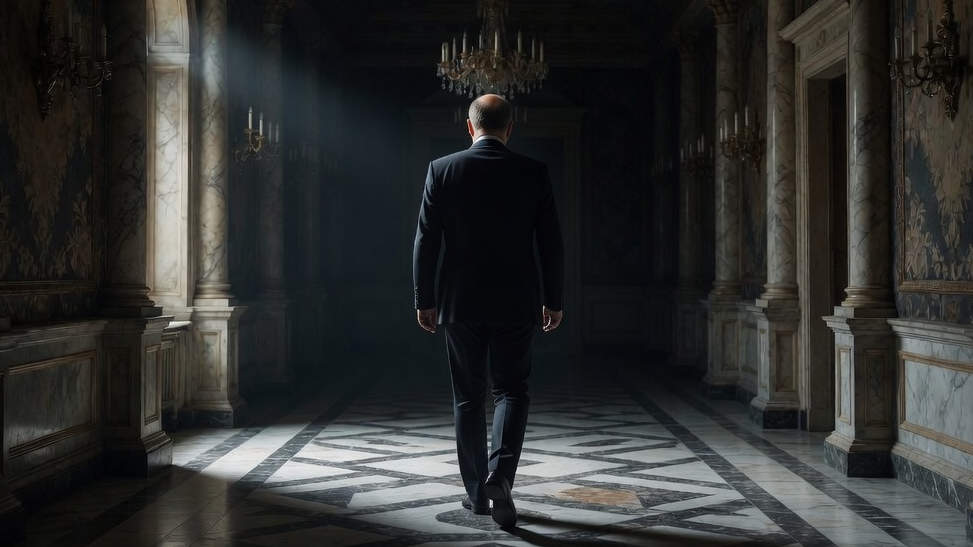

Putin walks alone down a dark hallway.
More than a quarter-century into his rule, Vladimir Putin’s grip on Russia has, for all intents and purposes, become absolute. But this unquestioned political dominance also means that Russia’s president bears full responsibility for the massive strategic losses caused by his disastrous 2022 invasion of Ukraine.
The list of setbacks is long. In human terms, the number of Russian soldiers killed or wounded as a result of the Kremlin’s “special military operation” now exceeds one million, making the Ukraine war more costly than all of the country’s post-World War II conflicts combined.[1] This loss, together with the exodus of between 500,000 and 1,000,000 Russians as a result of the war (including its most technically savvy and entrepreneurial inhabitants) has only served to deepen the country’s already-acute demographic crisis.[2]
The country’s military is deeply dysfunctional, riddled with low morale, inadequately trained and poorly resourced troops. Russia’s early stumbles, and its ongoing difficulties on the battlefield, have succeeded in shattering the post-Cold War mystique of its military prowess, the appeal of its weapons in the eyes of foreign consumers, and Moscow’s ability to help foreign allies such as Syria, Venezuela and Cuba. At the same time, its aggression against Ukraine has had a galvanizing effect on European governments, which at long last (thanks to prodding from the Trump administration) are spending significantly more on defense. European collective defense is expanding as well, and NATO’s most recent entrants include Finland, with its combined military force of 1.2 million people (larger than the combined forces of France, Germany and Great Britain). The cumulative effect has been a stronger and better resourced NATO, and one with an additional 830 miles of common border with the Russian Federation.
Moscow, meanwhile, has been unable to defend itself even against Ukrainian retaliatory strikes, which have wreaked havoc on vital infrastructure like refineries, pipelines and ports. As a result of those attacks, by April 2026 Russia was estimated to have lost one-fifth or more of its total oil export capacity. The attacks also disrupted supply lines to such an extent that Moscow service stations are expected to be forced to ration gas, as is now already being done in Crimea.[4] These problems, moreover, are sure to increase as Ukraine attacks continue.
Other economic costs have mounted as well. Western sanctions levied on Russia over the past half-decade have erased many of the gains made by the country since the end of the Cold War, while the war’s mounting costs have pushed Russia into economic stagnation.[5] Russia’s Sovereign Wealth Fund, traditionally used to cover the national budget deficit, stood at $210 billion in June of 2022.[6] By early 2026, the readily usable portion of it had shrunk to $53 billion, a serious problem, given that Russia’s estimated 2026 budget deficit is $72 billion.[7] Even worse, the remainder of Russia’s Sovereign Wealth Fund is largely composed of gold or Chinese yuan, thereby limiting how it can be used. At the same time, the closure of European markets to Russia has left the Kremlin with little choice but to sell its wares (and its energy) to a dwindling number of trading partners at bargain-basement prices.
Moreover, the worst economic news may be yet to come. Whenever the war ultimately ends, there will be no money on hand to retool factories that have been converted to the unneeded production of war materiel. And there will be no money to repair an increasingly frail system of bridges, sewers, and other critical infrastructure. That, in turn, will mean no jobs for soldiers coming home with guns and tales of the real situation on the front, something that will invariably raise the likelihood of anti-government ferment.
A Reign of Terror
Under any other system, the person responsible for such a comprehensive list of failures would have been removed long ago, or at a minimum prevented from doubling down on his errors. Democracies vote their leaders out. Communist systems remove theirs by committee. But dictators like Putin, who rule overwhelmingly through force and terror, are more likely to be removed involuntarily, via assassinations or coups.
Indeed, Putin’s longevity can be attributed largely to effective repression. For years, political opponents and dissidents, whether inside Russia or abroad, have met untimely ends. Some have fallen from open windows or died in some other “accident.” Still others have been killed in more exotic fashion or gunned down in public places (as in the case of former Deputy Prime Minister Boris Nemtsov, who was shot to death steps from the Kremlin).
Regardless of the method, everyone has absorbed the message: opposing Putin’s regime is extremely dangerous to your health. As a result, even those who think the current Russian president should be removed are loath to share such thoughts, because they simply don’t know who can be trusted. And without such communication, it becomes very difficult to organize such an ouster.
Nevertheless, history teaches us that most dictators do eventually leave the scene ignominiously. Of the 127 dictatorships that have existed since 1950 in countries with populations of 10 million or more, nearly half (42%) were removed by coups while in more than a fifth (21%), power changed hands as a result of assassination.[8] One or the other tends to happen when the proper people decide that a coup, or an assassination, is less dangerous than continued inaction.
Of course, it is simply not possible to tell when such a calculation could be made in Russia. Putin may stay in power until he dies a natural death. Alternatively, unforeseen events could trigger his removal. But if Putin’s ultimate fate is an open question, it’s still possible to identify the conditions that would make his ouster more probable.
Here, public opinion matters, but not in the way most people think. In authoritarian societies, consensus is manufactured and diligently curated to the point that polling becomes unreliable. That is why even the findings of the most credible Russian pollsters (such as the historically well-regarded Levada Center) need to be viewed with some caution.
Even so, there are always senior officials and public personalities who are so prominent that they have a degree of latitude not enjoyed by the rest of the population. When consensus among this cohort begins to shift, it is indicative of a deeper (and potentially transformative) trend.
That is happening in Russia now, as more and more of these elites make their displeasure with the war and domestic conditions known. One such individual is Col. Gen. Leonid Ivashov, the current head of the All Russia Officers Assembly, and the closest thing that Russia has to a national military hero. In a December 2025 interview, Ivashov offered up a litany of domestic failures, from corruption to military underperformance, that he put at the feet of the Kremlin.[9] Increasingly vocal critiques likewise can now be heard from propagandists, media personalities and assorted other corners of the Russian political scene, as my colleague S. Frederick Starr has documented.[10]
The fact that these individuals are now speaking out publicly in opposition to the Kremlin speaks volumes. In Russia’s rigid, tightly controlled political system, doing so without reprisal from entrenched organs of the state is simply impossible without a degree of political protection. Quite simply, absent the backing of key power brokers, critics are liable to end up in jail at best. At worst, they can meet fates like the one that befell anti-corruption crusader Alexei Navalny, who died in an Arctic penal colony from what was determined to be poisoning.[11]
The current level of criticism is thus notable. It suggests that those opposition views are sanctioned by another part of the Russian system.
Whatever the reason, the volume of criticism in Russia is getting louder and it is being taken seriously enough by Putin and his cohort that the government is intensifying domestic repression. In recent months, this has included all manner of restrictions and curbs, most prominent among them severe limitations on the Russian population’s use of the internet (an extremely unpopular move, especially among the country’s youth).
Through these steps, Putin has managed to establish an uneasy modus vivendi that has permitted him to continue to rule. But he will not do so forever. A deterioration of his health, forced retirement, or even an assassination could abruptly bring new leadership to Moscow.
What might such change look like? While the name of Putin’s successor is not yet known, the forces that will shape his rise to power are.
The Principles of Russian Power
History teaches us that attaining political power in Russia requires the mobilization of key institutions and the elites who control them. As in the past, the military, intelligence services, oligarchs, regional elites, and political office holders will all play roles in determining both the process and the outcome of a change in the country’s leadership. Understanding their interests, and the ways in which they interact, offers us the best available guide to how Russia’s post-Putin future may unfold.
The military, if it chooses to involve itself, will be decisive, because it is the state organ that has the most guns. The Russian army commands immense force, but its intervention in politics is not necessarily a given. It has historically been a cautious institution, often waiting to see which side of a political contest will prevail. In this context, the abortive coup launched in 2023 by the late Wagner head (and Putin confidante) Yevgeny Prigozhin was deeply troubling for Russia’s president, because it seemed, at least for a time, that Prighozhin was capable of harnessing Russia’s military for his own ends. Yet if the military commits decisively, it can determine the outcome of any struggle.
This is likely why Putin has, in recent years, invested so heavily in the Rosgvardiya, a pretorian guard of sorts headed by his personal friend, General Viktor Zolotov, the loyalty of which he can more readily command. (Indeed, Putin has become increasingly reliant on this force in the face of mounting domestic unrest; in early 2026, he expanded the Rosgvardiya in terms of both its organization and power.[12]) However, the Rosgvardiya also presents an inherent danger; its members are privy to Putin’s movements and are frequently in the same physical location. They are, therefore, prime recruits for any coup or assassination attempt.
Russia’s contemporary intelligence services (including the GRU, SVR, and FSB) operate alongside the armed forces, possessing capabilities that range from intelligence collection to covert action and political influence. Among them, the FSB stands out as a central pillar of the current system, deeply embedded in both political and economic life (just like its predecessor, the KGB, during Soviet times).
Other institutions add further complexity. The Ministry of Interior possesses extensive files (kompromat) on individuals across the political and economic spectrum, creating opportunities for leverage and blackmail. The Federal Protection Service controls elite security and communications, giving it unique insight into the intentions of competing factions. Each, of course, has its own interests, and each can be depended on to protect those interests during any transition.
Beyond formal institutions, significant power resides in the country’s entrenched networks of elites. Regional leaders possess influence that is rooted in economic and political ties, and their support (or opposition) can shape outcomes in moments of uncertainty. Russia’s infamous oligarchs wield significant financial resources, but they are not a coherent group per se. Their actions will be guided by pragmatic considerations: the protection of assets, the preservation of influence, and the avoidance of risk. Political office holders, meanwhile, are the pool from which a successor is most likely to emerge.
These actors are far from unified. Their interests diverge, and their alliances are fluid, all of which will shape dynamics of succession. In the absence of clear rules, competition among elites is inevitable.
Once that happens, recent history suggests that whoever follows Putin will need time to fully consolidate authority. After Vladimir Lenin’s death in 1924, Josef Stalin required 14 years to establish uncontested rule. It took his successor, Nikita Khrushchev, four years to do the same, while Leonid Brezhnev subsequently took nine years to fully vanquish his political enemies. Putin himself required more than a decade to bring oligarchs, regional officials, the media, and other institutions to heel after he assumed power in the last days of 1999. These precedents suggest that any future transition in Moscow will be prolonged, contested, and deeply shaped by institutional competition.
Planning for Uncertainty
Naturally, U.S. policy options for a post-Putin Russia will be, in part, determined by how Putin himself leaves power.
If he does so voluntarily, the transition may be more orderly, but it will still naturally involve at least some degree of competition. A successor selected from the existing system may seek to preserve stability while adjusting his policies so as to reduce external pressure. Yet even a managed transition would not eliminate the underlying tensions among Russia’s assorted institutions and elites.
If Putin leaves involuntarily, though, the risks will be significantly greater. A sudden departure could lead to a prolonged struggle for power, potentially one involving violence and repression, as political factions compete for control.
In turn, whoever emerges from this process will face immediate challenges. Consolidating power will require managing rival factions and ensuring loyalty among key institutions. Maintaining national cohesion will be critical, particularly in regions with strong identities and grievances. Economic stabilization will be essential, especially under the weight of Western sanctions and the structural weaknesses of the existing system. Decisions about accountability will pose difficult dilemmas as well, as new leaders balance the need for stability with pressures for justice. (Europe, meanwhile, has complicated matters considerably through its proposal for a tribunal to hold Putin and other top Russian officials to account for the war.[13])
These challenges may prove overwhelming. If the new leadership fails to consolidate authority and address them, Russia could face prolonged instability. In the most extreme case, the modern Russian state could begin to fragment, as regions like Chechnya and Dagestan seek greater autonomy or even independence. While such outcomes are difficult to predict, they cannot be dismissed out of hand.
Russia’s foreign policy will also be shaped by the outcome of its internal transition. Continuity is one possibility, with a successor maintaining the Kremlin’s current policies and continuing its confrontation with the West. Adjustment is another, accompanied by efforts to reduce tensions. However, it’s hard to imagine that, after a half-decade of grinding conflict, sanctions would be removed without significant concessions from Moscow. One is the return of the nearly 20,000 Ukrainian children that have been kidnapped by the Russian military.[14] Another is the surrender of Russians charged and convicted by Ukrainian courts (most likely in absentia) of the most heinous of war crimes. A third is agreement to use frozen Russian assets to rebuild Ukraine, something that Ukraine has demanded and Russia has so far refused.
What This Means for America
For the United States, Russia’s impending political transition holds out both risks and opportunities.
A weaker Russia may reduce the political pressure it exerts on nations on its periphery (most directly in the Caucasus and Central Asia), where the Kremlin currently seeks to retain a measure of dominion. But such a retraction would not be without risk, because a rollback of Russian power could create an opening for other powers (such as China) to seek to expand their influence.
A reform-oriented leadership in Moscow, meanwhile, could enable improved relations with the West. This would not necessarily mean that Russia would take a pro-Western turn, as it did in the immediate post-Soviet period.[15] However, lessening sanctions on those oligarchs central to the new regime’s consolidation of power may prompt a more pragmatic and conciliatory foreign policy course.
On the other hand, a nationalist successor could choose a more confrontational path, either for ideological reasons or for strategic ones. In time-tested Russian fashion, such a posture could include expanded cyber-attacks or acts of sabotage in Europe—disruptions that the Kremlin could then offer to stop, for a price. Moreover, probing incursions into territory on NATO’s “eastern flank” could help Moscow to confirm the hollowness of European resolve, if there turns out to be no will on the continent to repel them.
However, the sheer scope of the internal problems that will inevitably be faced by a new Russian government, whether a reformist or a nationalist one, suggests that its grip on power will be less than absolute. That, in turn, may set the stage for a protracted struggle for power in Moscow, and perhaps further political changes thereafter.
This ongoing turmoil could have significant consequences. A lack of attention from Russia’s “federal center,” coupled with bleak local political and economic conditions, could foster separatist tendencies among the Russian Federation’s constituent parts, especially in restive republics in places such as the North Caucasus. At the same time, a Russia locked in protracted political upheaval could become an inviting target for foreign powers seeking territorial or economic advantage, chief among them China.
Policymakers in Washington need to prepare for multiple scenarios, recognizing that the trajectory of post-Putin Russia will not be preordained. Such preparation, however, requires a clear understanding of the internal dynamics of Russian power. It also requires strategic patience and flexibility. The period following Putin’s exit may offer a window of opportunity to improve relations between Moscow and Washington, but that window is likely to be both brief and uncertain. Taking advantage of it will depend on the ability of the United States and its partners to respond quickly and effectively to changing conditions in Moscow.
-
[1] Seth G. Jones and Riley McCabe, “Russia’s Grinding War in Ukraine,” Center for Strategic & International Studies, January 27, 2026, https://www.csis.org/analysis/russias-grinding-war-ukraine#:~:text=Despite%20claims%20of%20battlefield%20momentum%20in%20Ukraine%2C,2%20million%20by%20the%20spring%20of%202026.
[2] Francesca Ebel and Mary Ilyushina, “Russians abandon wartime Russia in historic exodus,” Washington Post, February 13, 2023, https://www.washingtonpost.com/world/2023/02/13/russia-diaspora-war-ukraine/.
[3] See, for instance, Philip Wasielewski, “The Roots of Russian Military Disfunction,” Foreign Policy Research Institute, March 31, 2023, https://www.fpri.org/article/2023/03/the-roots-of-russian-military-dysfunction/.
[4] “Exclusive: Russian oil output cuts are unavoidable as drone attacks shrink exports, sources say,” Reuters, April 2, 2026, https://www.reuters.com/business/energy/russian-oil-output-cuts-are-unavoidable-drone-attacks-shrink-exports-sources-say-2026-04-02/.
[5] Thomas Grove, “Putin Has Retooled Russia’s Economy to Focus Only on War,” Wall Street Journal, May 27, 2025, https://www.wsj.com/world/russia/russia-putin-ukraine-war-economy-7e410058?gaa_at=eafs&gaa_n=AWEtsqc6fsb4MbZZbKoDsOMaaQ2_aPPvDZcM8gweIxHagwRTg2OOggxNJVyakHO2ta8%3D&gaa_ts=69a1bd34&gaa_sig=5IOJz1LGSk5o3sWJXT1d-SVKI9bdXMpAF3s52RVOVGOvOn2VbxMN3V92c7dP0i0OiuA3RDjIW0bvYyB2B3S_ZQ%3D%3D.
[6] “Russia’s wealth fund grow to $210.6 bln as of July 1,” Reuters, July 5, 2022, https://www.reuters.com/article/russia-economy-wealth-fund-july/russias-wealth-fund-grows-to-210-6-bln-as-of-july-1-idUKR4N2YA022/.
[7] “Russia to Tap National Wealth Fund at Record Pace as Oil and Gas Revenues Slump,” The Moscow Times, January 16, 2026, https://www.themoscowtimes.com/2026/01/16/russia-to-tap-national-wealth-fund-at-record-pace-as-oil-and-gas-revenues-slump-a91696; Peeter Helme, “Russia’s oil revenues collapse 24% as global prices slide further (INFOGRAPHICS),” EuroMaidan Press, February 2, 2026, https://euromaidanpress.com/2026/02/02/russia-oil-revenue-2025-collapse-deficit/#google_vignette.
[8] “Dictator Demise Study,” American Foreign Policy Council, June 28, 2019, https://www.afpc.org/publications/special-reports/dictator-demise-study.
[9] Paul Goble, “’We are in Trouble’: General Ivashov Sounds the Alarm on Russia’s Decline Under Putin,” The Saratoga Foundation, January 1, 2026, https://www.saratoga-foundation.org/p/we-are-in-trouble-general-ivashov.
[10] S. Frederick Starr, “Transition in the Kremlin: What Does History Have to Say?” AFPC Central Asia-Caucasus Institute, April 28, 2025, https://www.afpc.org/publications/articles/transition-in-the-kremlin-what-does-history-have-to-say.
[11] See, for instance, Matthew Ward Agius, “The frog poison that killed Alexei Navalny likely lab-made,” Deutsche Welle, February 16, 2026, https://www.dw.com/en/navalny-dart-frog-poison-likely-made-in-russian-lab/a-75993255.
[12] “Putin Expands Rosgvardia’s Role,” The Moscow Times, February 12, 2026, https://www.themoscowtimes.com/2026/02/12/putin-expands-rosgvardias-role-a91934.
[13] See Council of Europe, “Agreement between the Council of Europe and Ukraine on the Establishment of the Special Tribunal for the Crime of Aggression against Ukraine,” June 2025, https://rm.coe.int/agreement-and-statut-english/1680b66127.
[14] “Fact Sheet: Russia’s Kidnapping and Re-education of Ukraine’s Children,” Yale School of Medicine, March 17, 2025, https://medicine.yale.edu/news-article/fact-sheet-russias-kidnapping-and-re-education-of-ukraines-children/#.
[15] For a detailed review of this period, see Andrei Kozyrev, Firebird: The Elusive Fate of Russian Democracy (University of Pittsburgh Press, 2019).